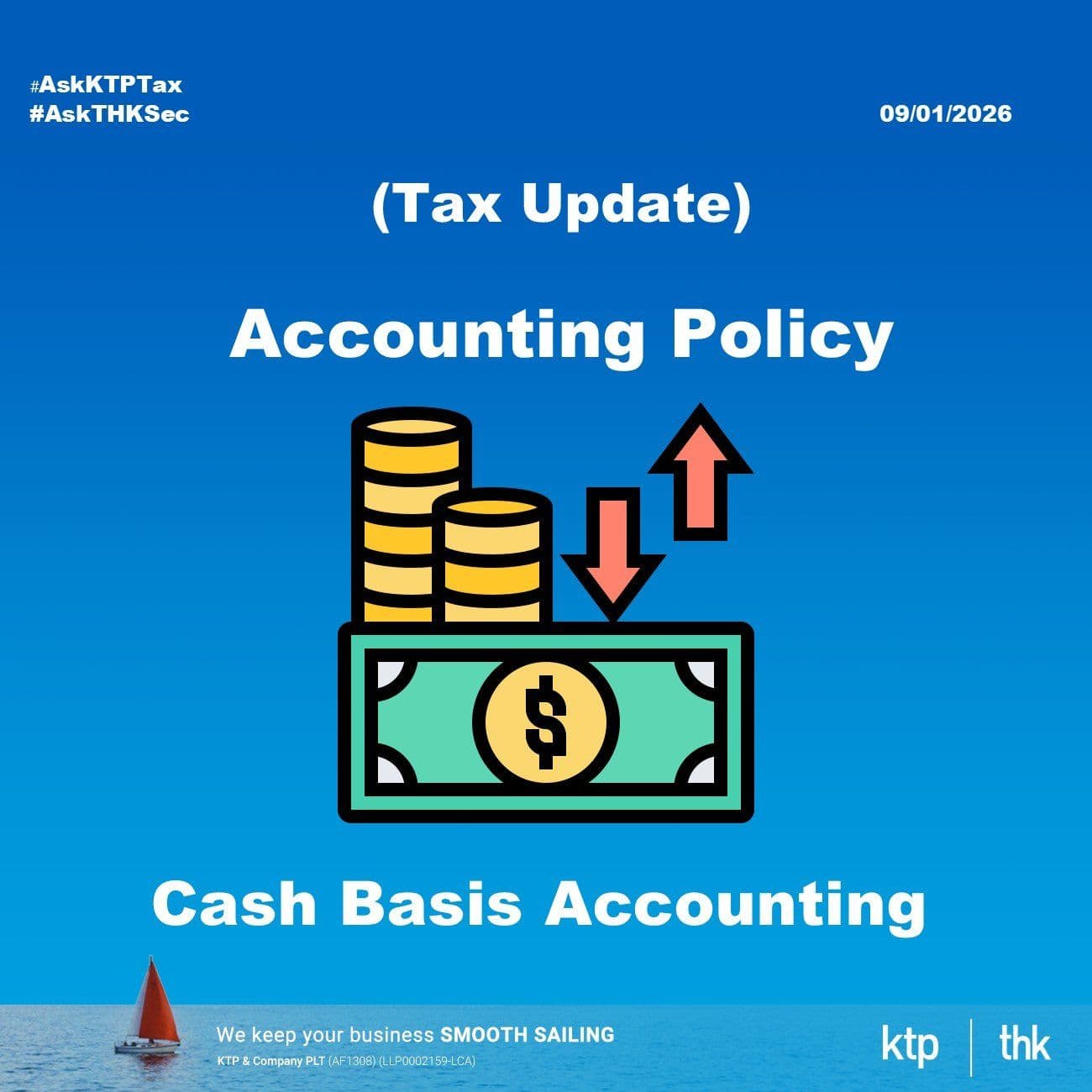
(TAX UPDATE) Can a Sdn Bhd Use Cash Basis Accounting in Malaysia
01Introduction
Last month, I received a call from a newly incorporated Sdn Bhd.
The director asked calmly:
“Can I prepare my accounts based on cash basis? Very unfair to pay tax when customers not pay us yet!”
I was stunned. Almost fainted.
Not because it was a silly question but because many SME directors do not realise that this simple choice can create serious audit, tax, and legal problems later.
Cash basis feels simple.
But for a Sdn Bhd, it is not allowed, not compliant, and not safe.
This article explains, in simple English, whether a Sdn Bhd can use cash basis accounting in Malaysia, what the law really says, and what SME directors should do instead.
02Key Summary for SME Owners
- A Sdn Bhd cannot prepare accounts on cash basis
- Malaysian law requires accrual basis accounting for companies
- Cash basis is only allowed for very small sole proprietors and partnerships
- Tax law does provide concession on small sole proprietor and partnership
03Why a Sdn Bhd Cannot Use Cash Basis Accounting
1. Companies Act 2016 Requires Approved Accounting Standards
Section 244 of the Companies Act 2016 requires all companies to prepare financial statements in accordance with approved accounting standards.
In Malaysia, these standards are:
- MPERS for private entities
- MFRS for larger entities
Both require accrual accounting.
There is no option for cash basis.
2. MPERS Clearly Requires Accrual Basis
MPERS Section 2.36 states that financial statements must be prepared using the accrual basis of accounting (except for cash flow statements).
This means:
- Revenue is recorded when earned
- Expenses are recorded when incurred
- Assets, liabilities, debtors, and creditors must be recognised
Cash basis ignores all of this and therefore does not comply.
3. Cash Basis Cannot Show a True and Fair View
The Companies Act requires financial statements to show a true and fair view.
Cash basis hides:
- Outstanding invoices
- Unpaid expenses
- Real profitability
- Real obligations
This makes the financial statements misleading.
04What About Income Tax Rules?
Some SME owners point to the Income Tax Act 1967 and LHDN Public Ruling 5/2000 - Keeping Sufficient Records (Individuals & Partnerships).
Yes! LHDN allows very small businesses (sole proprietors and partnerships) to keep a simple cash book for tax record-keeping purposes.
LHDN “Small Business” Threshold (Public Ruling 5/2000)
This concession applies only if both conditions are met:
- The business is a sole proprietor or partnership (not a company), and
- The business is below the following thresholds:
- Sale of goods …not exceeding RM150,000
- Provision of services …not exceeding RM100,000
If the business exceeds these limits, a simple cash book is no longer considered sufficient by LHDN.
Once you incorporate as a Sdn Bhd:
- The Companies Act applies
- Accounting standards apply
- Cash basis is no longer acceptable
What Are The Full Records
1. Accounting records : a cash book, a sales ledger, a purchases ledger and a general ledger
2. Supporting documents : invoices, bank statements, pay-in slips, cheque butts, receipts for payments, payroll records and copies of receipts issued should be retained.
3. Receipts issued should be serially numbered when sales of goods exceed RM150,000 or services performed exceeds RM100,000.
4. A valuation of the stock in trade or work in progress should be made at the end of each accounting period and the appropriate records maintained
5. Other documents necessary to verify entries in any books of accounts
What are the requirement under Income Tax Act 1967 and Companies Act 2016?
1. Accounting entries for each transaction should be recorded not later than 60 days after the transaction.
2. Records and books of accounts should be written in the national language or the English language.
3. The company is required to keep sufficient records for a period of 7 years.
4. All documents that relate to any income in Malaysia shall be kept and retained in Malaysia.
5. If the records and books of accounts are kept outside Malaysia, the records and books of accounts should be produced at the registered office or the business premises of the company.
What are the consequences if sufficient records are not kept?
1. Additional tax payables arise from:
i. The chargeable income of the taxpayer may be determined according to the best judgement of IRB and an assessment made accordingly.
ii. Deduction is not allowed If the taxpayer fails to provide supporting records.
2. The financial statement of the company is not reliable
i. It will affect the auditors’ opinion on financial statement and modified audit opinion will be issued according the effect of misstatement.
ii. A modified audit opinion will limit the company’s ability to borrow money from banker.
iii. The supplier might evaluate company’s creditworthiness through audited financial statement. If the company’s financial statement is not reliable, the supplier may reluctant to give longer credit terms.
05SME Implications
If you use cash basis in a Sdn Bhd:
- Your accounts may not comply with the Companies Act
- Your audit opinion may be qualified
- LHDN may challenge your records
- Directors may face penalties
- Rectification later is costly
06KTP View
Cash basis is just wrong for companies.
A Sdn Bhd is not a personal business account.
It is a legal entity with legal responsibilities
Visit Us
- Wisma KTP, 53 Jalan Molek 1/8, Taman Molek, 81100 Johor Bahru
- Wisma THK, 41, Jalan Molek 1/8, Taman Molek, 81100 Johor Bahru
KTP (Audit, Tax, Advisory)
An approved audit firm and licensed tax firm operating under the KTP group based in Johor Bahru providing audit, tax planning, advisory and compliance services to clients
- Website www.ktp.com.my
- Instagram https://bit.ly/3jZuZuI
- Linkedin https://bit.ly/3sapf4l
- Telegram http://bit.ly/3ptmlpn
THK (Secretarial, Bookkeeping, Payroll, Advisory)
A licensed secretarial firm in Johor Bahru providing fast reliable incorporation, secretarial services, corporate compliance services, outsourcing bookkeeping, and payroll services to clients
- Website www.thks.com.my
- Facebook https://bit.ly/3nQ98rs
KTP Lifestyle
An internal community for our colleagues on work and leisure.
- Tiktok http://bit.ly/3u9LR6Q
- Youtube http://bit.ly/3ppmjyE
- Facebook http://bit.ly/3ateoMz
- Instagram https://bit.ly/3jZpKLo
KTP Career
An external job community on vacancies in Johor Bahru for interns, graduates & experienced candidates.
- Instagram https://bit.ly/3u2PxHg
- Facebook http://bit.ly/3rPxz9o
Come say hello.
Two firms in the heart of Taman Molek, Johor Bahru.
KTP & Company PLT
Wisma KTP, 53, 53-01 & 53-02, Jalan Molek 1/8, Taman Molek, 81100 Johor Bahru, Johor, Malaysia