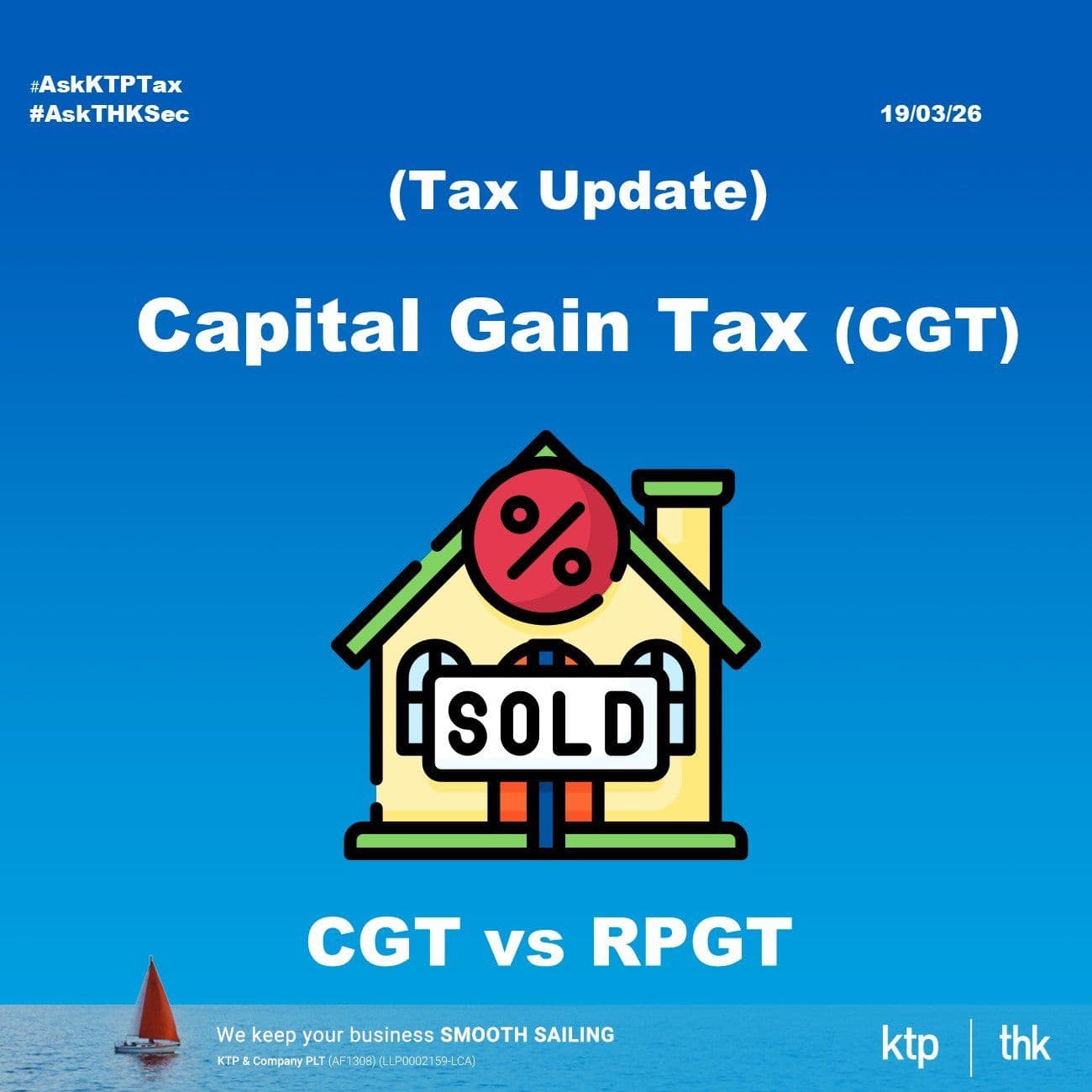
(TAX UPDATE) CGT or RPGT? A Practical Guide for SMEs
01(TAX UPDATE) CGT or RPGT? A Practical Guide for SMEs
02Introduction
As Malaysia’s Capital Gains Tax (CGT) framework continues to develop since 2024, one area that can easily confuse SME owners is the difference between assets that fall under CGT and assets that remain under RPGT.
At first glance, many business owners may assume that once CGT is introduced, all capital assets will automatically come under one tax regime.
That is not the case.
Malaysia still keeps a very important distinction between real property and shares in a real property company.
This distinction matters because the wrong classification can lead to the wrong tax rate, wrong filing treatment, and unnecessary penalty exposure.
For SME groups involved in property holding, corporate restructuring, investment activities, or disposal of shares, this is not a small technical issue. It is a practical tax risk.
03Key Summary
The key point is simple.
1. Real property remains under RPGT
The disposal of real property in Malaysia does not move into CGT.
It remains governed by the Real Property Gains Tax framework.
In simple terms, if a company or individual disposes of land, buildings, or other qualifying real property in Malaysia, the transaction continues to fall under RPGT, not CGT.
This means the existing RPGT rules still remain relevant and must not be ignored.
2. Shares in a Real Property Company may fall under CGT scope
A very important area for business owners to understand is the treatment of shares in a Real Property Company.
This is where the tax analysis becomes more sensitive.
A disposal involving RPC shares may now need to be analysed under the Income Tax Act through the CGT framework instead of the older assumption that everything linked to property must automatically go under RPGT.
This creates a major distinction.
A taxpayer may now be dealing with two different tax regimes depending on the exact asset being disposed of:
- disposal of real property itself means RPGT may apply
- disposal of RPC shares means CGT treatment may need to be considered
That difference is very important during tax planning, compliance review, and transaction documentation.
3. Misclassification can create real tax consequences
If the asset is wrongly classified, the consequences can be serious.
Wrong tax rate application
If the asset is wrongly treated under CGT instead of RPGT, or the other way around, the taxpayer may apply the wrong tax rate. This may result in underpayment or overpayment of tax.
Incorrect filing regime
CGT and RPGT are governed by different laws and different filing requirements. Using the wrong filing regime can cause the taxpayer to miss the correct compliance steps.
Penalty exposure
If the taxpayer fails to classify the asset correctly and does not follow the correct tax treatment, this may lead to penalties and interest exposure.
04SME Implications
For many SME owners, this may sound like an issue only for large property groups.
Actually, it can affect SMEs quite easily.
Companies holding factory land or office property
If your company disposes of industrial land, a factory building, office lot, warehouse, or shoplot, the tax treatment must be reviewed carefully under the correct framework.
You should not assume that the transaction falls under CGT just because capital gains tax is now a more common discussion point.
Groups holding property through companies
Some business groups do not hold property directly.
Instead, they hold shares in a company that owns property.
In that case, a disposal of the shares may require analysis under the CGT regime if the company falls within the Real Property Company rules.
This is where confusion often starts.
The transaction may look like a normal share sale, but the nature of the company behind those shares can completely change the tax treatment.
Internal restructuring exercises
During family restructuring, group reorganisation, shareholder exits, or succession planning, many SME groups transfer shares between related parties or reorganise asset-holding companies.
Where RPC shares are involved, this becomes a tax issue that should not be treated casually.
A transaction that looks internal or administrative may still trigger tax filing and tax consequences.
Commercial team, legal team and tax team must align early
In practice, many business transactions are discussed from a commercial angle first.
The price is negotiated.
The lawyer prepares the agreement.
The accounts team records the entries later.
But tax classification must be reviewed right at the beginning.
If not, the company may move too far into execution before realising that the asset has already been placed under the wrong tax regime.
05KTP View
At KTP, our view is straightforward.
The biggest danger for many SME clients is not deliberate tax avoidance.
Very often, it is tax misunderstanding.
A business owner may act honestly, disclose the transaction, and still face tax problems because the disposal was analysed under the wrong regime.
That is why the distinction between real property and RPC shares is so important.
From a practical advisory perspective, clients should not ask only:
“Is there tax?”
They should first ask:
“What exactly is the asset being disposed of?”
That question comes first.
If the asset is real property, RPGT remains highly relevant.
If the asset is shares in an RPC, CGT analysis may become necessary.
This is not just a technical compliance point.
It affects the tax amount, filing timeline, supporting documents, deal structure, and penalty risk.
For SMEs, especially those with family-owned groups, investment structures, or long-held property companies, this issue should be reviewed carefully before any disposal takes place.
In our experience, many costly mistakes do not happen because the deal is complex.
They happen because the classification was assumed too early and checked too late.
06Call to Action
If your company is planning to dispose of property, transfer shares, carry out a restructuring exercise, or review whether an entity may fall within the Real Property Company rules, this is the time to get the tax treatment checked properly.
At KTP, we help SME owners, directors, and accountants review transactions from a practical Malaysian tax perspective so the correct regime is applied from the start.
Past Blog on Capital Gain Tax
23 Nov 2023 Malaysia's Budget 2024: A Glimpse into Capital Gain Tax Updates (Part I)
https://www.ktp.com.my/blog/malaysias-budget-2024-capital-gain-tax-part1/23nov23
4 Jan 2024 Preparing for the Implementation of Capital Gain Tax
https://www.ktp.com.my/blog/capital-gain-tax-malaysia-2024/04jan24
10 Jan 2024 Real Property Company (RPC) under Capital Gain Tax (CGT)
https://www.ktp.com.my/blog/real-property-company-under-capital-gain-tax/10jan24
30 Jan 2024 Capital Gain Tax: Filing Deadline
https://www.ktp.com.my/blog/capital-gain-tax-filing-deadline/30jan24
23 Feb 2024 Capital Gain Tax: Unresolved Questions
https://www.ktp.com.my/blog/capital-gain-tax-unresolved-questions/23feb24
5 Mar 2024 Capital Gain Tax: Gains From Disposal Of Capital Asset Arising From Outside Malaysia Received in Malaysia
https://www.ktp.com.my/blog/capital-gain-tax-exemption-foreign-source-income/05march24
6 Mar 2024 Guidelines on Capital Gains Tax for Unlisted Shares
https://www.ktp.com.my/blog/guidelines-on-capital-gains-tax-for-unlisted-shares/05march24
3 Apr 2024 Foreign Capital Assets CGT Guidelines
https://www.ktp.com.my/blog/foreign-capital-assets-cgt-guidelines/03apr2024
17 Apr 2024 Capital Gain Tax Malaysia
https://www.ktp.com.my/blog/video-capital-gain-tax-malaysia/17apr2024
This article is provided for general information only and reflects the author’s personal professional view based on the facts described. It does not constitute tax, legal, or other professional advice and should not be relied upon as a substitute for advice tailored to your specific circumstances. Tax and stamp duty outcomes may vary depending on documentation, ownership, beneficial interest, and actual usage. Readers should consult their own tax adviser and/or legal counsel before taking any action or implementing any arrangement described in this article.
Visit Us
- Wisma KTP, 53 Jalan Molek 1/8, Taman Molek, 81100 Johor Bahru
- Wisma THK, 41, Jalan Molek 1/8, Taman Molek, 81100 Johor Bahru
KTP (Audit, Tax, Advisory)
An approved audit firm and licensed tax firm operating under the KTP group based in Johor Bahru providing audit, tax planning, advisory and compliance services to clients
- Website www.ktp.com.my
- Instagram https://bit.ly/3jZuZuI
- Linkedin https://bit.ly/3sapf4l
- Telegram http://bit.ly/3ptmlpn
THK (Secretarial, Bookkeeping, Payroll, Advisory)
A licensed secretarial firm in Johor Bahru providing fast reliable incorporation, secretarial services, corporate compliance services, outsourcing bookkeeping, and payroll services to clients
- Website www.thks.com.my
- Facebook https://bit.ly/3nQ98rs
KTP Lifestyle
An internal community for our colleagues on work and leisure.
- Tiktok http://bit.ly/3u9LR6Q
- Youtube http://bit.ly/3ppmjyE
- Facebook http://bit.ly/3ateoMz
- Instagram https://bit.ly/3jZpKLo
KTP Career
An external job community on vacancies in Johor Bahru for interns, graduates & experienced candidates.
- Instagram https://bit.ly/3u2PxHg
- Facebook http://bit.ly/3rPxz9o
Come say hello.
Two firms in the heart of Taman Molek, Johor Bahru.
KTP & Company PLT
Wisma KTP, 53, 53-01 & 53-02, Jalan Molek 1/8, Taman Molek, 81100 Johor Bahru, Johor, Malaysia