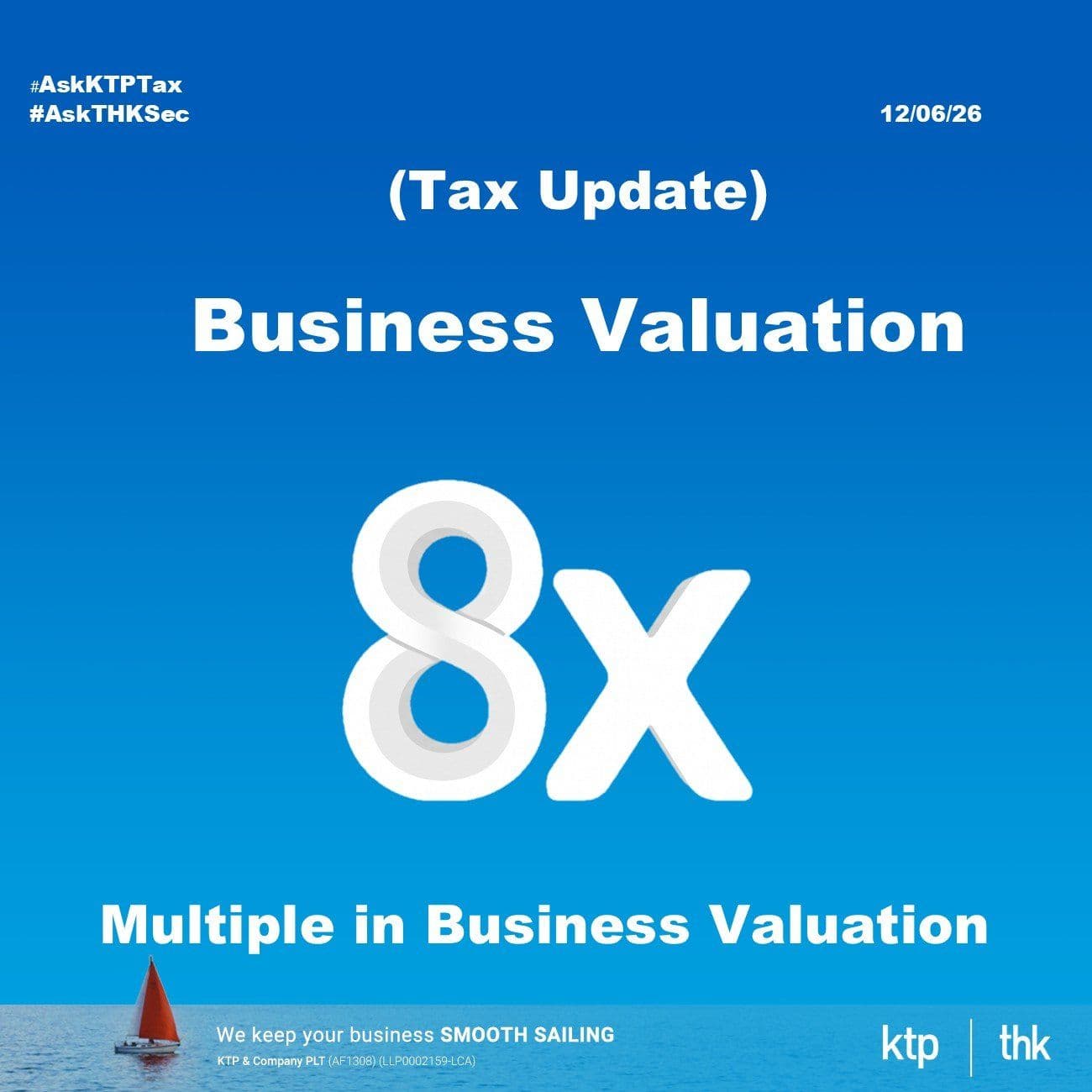
(VALUE UPDATE) My Industry Trades at 8x: The Most Expensive Sentence in SME Valuation
A perspective from Mr Koh Teck Peng, An Approved Auditor and Licensed Tax Agent in Malaysia and Member of IACV (International Association of Certified Valuators).
01Introduction
A business owner sat across from us last year with a genuine offer on the table. A strategic buyer, clean terms, real money.
He rejected it.
His reason: "My industry trades at 8 times PAT. This offer is only 5 times. The buyer is lowballing me."
Eighteen months later, the buyer acquired his competitor instead. The next enquiry that reached him came in lower than the offer he had turned down. He is still running the business, still waiting for his 8 times.
If you are thinking about selling, raising capital, or planning succession, this article may save you from the same mistake.
02Where Does the "8x" Figure Come From?
When an owner quotes a multiple, we always ask one question : 8 times of what, and based on whom?
The answer is almost always the same. A listed company in the same industry, a headline from a deal announcement, or a figure passed around at a business dinner.
Here is the problem.
That multiple was priced for a listed company on Bursa Malaysia or another exchange. It reflects liquidity, because listed shares can be sold tomorrow at a quoted price while your Sdn Bhd shares cannot. It reflects scale, diversified customers, and bargaining power. It reflects governance, audited group accounts and independent boards that reduce the buyer's risk. And it reflects minority-interest pricing, small parcels of shares changing hands, not control of an entire company.
When you borrow a listed multiple, you are borrowing the price of all these features without actually having them. That is not a shortcut. It is a category error.
03The Discounts You Cannot Ignore
A proper valuer does not stop at the headline multiple. Three adjustments are standard practice, and each one cuts into the number.
Size discount. Smaller businesses carry higher earnings volatility, customer concentration, and financing constraints. For a typical Malaysian SME, this adjustment often lands between 10% and 20%.
Illiquidity discount, known formally as the Discount for Lack of Marketability (DLOM). Private company shares take months or years to sell, with no guarantee of finding a buyer at all. This alone commonly reduces value by 20% to 30%.
Key-person risk. If the business depends on you for client relationships, technical knowledge, or banking lines, the buyer is not buying a business. The buyer is buying you, and you are leaving. Expect a discount, an earn-out, or both.
These are not inventions of a cautious valuer. International Valuation Standards (IVS) expressly recognise DLOM and the Discount for Lack of Control (DLOC) as standard adjustments under the market approach. What IVS does not do is hand you a fixed percentage. The standard requires the valuer to quantify each discount using reasonable methods supported by market evidence, which is why the same headline multiple can produce very different values in two different businesses.
What This Looks Like in Ringgit
Theory is painless. Let us make it hurt a little.
Say your company earns RM2 million PAT a year, and the listed players in your industry trade at 8 times. In your head, the business is worth RM16 million.
Now run the adjustments a buyer's adviser will run. The 8 times comes down for size and illiquidity, often to somewhere between 4 and 5 times for a business of this profile. If the top three customers sit on your personal relationships, part of the price moves into an earn-out you must stay and work for.
The defensible range is now roughly RM6 million to RM9 million, with some of it conditional. Not RM16 million.
That gap, 30% to 60% in most engagements we have reviewed, is the distance between the offer on your table and the number in your head. The buyer who offered 5 times was not lowballing. He was the market.
Multiples Are a Sanity Check, Not a Method
This is the part most owners have never been told.
In professional practice, a market multiple is a cross-check, not a valuation. IVS requires a valuer to consider three approaches and triangulate. The income approach, typically a discounted cash flow, values the business on its future earning power and the risk attached to it. The market approach uses comparable transactions and listed multiples, properly adjusted. The asset approach values the underlying net assets, which matters for asset-heavy or underperforming businesses.
So the next time someone tells you your business is worth "8 times," ask three questions. Eight times of what, PAT or EBITDA, normalised or reported? Compared to whom, listed giants or genuine private transactions? Adjusted for what, size, illiquidity, key-person dependence?
If there are no answers, there is no valuation. There is only a wish.
The Good News: Discounts Can Shrink
Here is what the "8x" crowd never tells you. Every discount in this article is a problem you can fix before you sell.
Key-person risk shrinks when you build a second layer of management, document your processes, and move client relationships from your handphone to the firm. Two years of deliberate succession work can convert an earn-out into cash at completion.
The illiquidity and governance gap shrinks when your accounts are clean, audited without qualification, and free of personal expenses running through the company. A buyer who trusts your numbers pays closer to the multiple.
Customer concentration shrinks when no single customer exceeds 20% of revenue. Diversification is boring. It is also worth real money on exit day.
The owners who get the best prices are not the ones who hold out for a borrowed multiple. They are the ones who spent two or three years making the discounts smaller before the buyer ever walked in.
04KTP View
The most dangerous number in a sale process is the one in the owner's head, because nobody priced it and nobody will pay it.
We have seen good offers die over borrowed multiples. We have also seen owners enter negotiations with a properly triangulated valuation under IVS and walk away with better terms, because they knew exactly where their number came from and could defend every assumption behind it.
A multiple is a sanity check. A valuation is a discipline. And the best exits are engineered years in advance, not negotiated in the final month. If a sale, a capital raise, or succession is anywhere on your horizon, talk to us early, while the discounts can still be fixed.
Disclaimer : The contents of this article are for general information only and do not constitute professional advice. Legislation, regulatory guidelines, and market practice may change after the date of publication. KTP Group of Companies accepts no liability for reliance placed on this material. Please consult a qualified professional before acting on any matter discussed.
Visit Us
- Wisma KTP, 53 Jalan Molek 1/8, Taman Molek, 81100 Johor Bahru
- Wisma THK, 41, Jalan Molek 1/8, Taman Molek, 81100 Johor Bahru
KTP (Audit, Tax, Advisory)
An approved audit firm and licensed tax firm operating under the KTP group based in Johor Bahru providing audit, tax planning, advisory and compliance services to clients
- Website www.ktp.com.my
- Instagram https://bit.ly/3jZuZuI
- Linkedin https://bit.ly/3sapf4l
- Telegram http://bit.ly/3ptmlpn
THK (Secretarial, Bookkeeping, Payroll, Advisory)
A licensed secretarial firm in Johor Bahru providing fast reliable incorporation, secretarial services, corporate compliance services, outsourcing bookkeeping, and payroll services to clients
- Website www.thks.com.my
- Facebook https://bit.ly/3nQ98rs
KTP Lifestyle
An internal community for our colleagues on work and leisure.
- Tiktok http://bit.ly/3u9LR6Q
- Youtube http://bit.ly/3ppmjyE
- Facebook http://bit.ly/3ateoMz
- Instagram https://bit.ly/3jZpKLo
KTP Career
An external job community on vacancies in Johor Bahru for interns, graduates & experienced candidates.
- Instagram https://bit.ly/3u2PxHg
- Facebook http://bit.ly/3rPxz9o
Come say hello.
Two firms in the heart of Taman Molek, Johor Bahru.
KTP & Company PLT
Wisma KTP, 53, 53-01 & 53-02, Jalan Molek 1/8, Taman Molek, 81100 Johor Bahru, Johor, Malaysia