(TAX UPDATE) Current MIDA Incentives vs NIF 2026: What SME Investors Must Know
01Introduction
For many years, Malaysian companies applied for tax incentives through MIDA using the “classic” routes under the Promotion of Investments Act 1986 mainly Pioneer Status (PS) or Investment Tax Allowance (ITA).
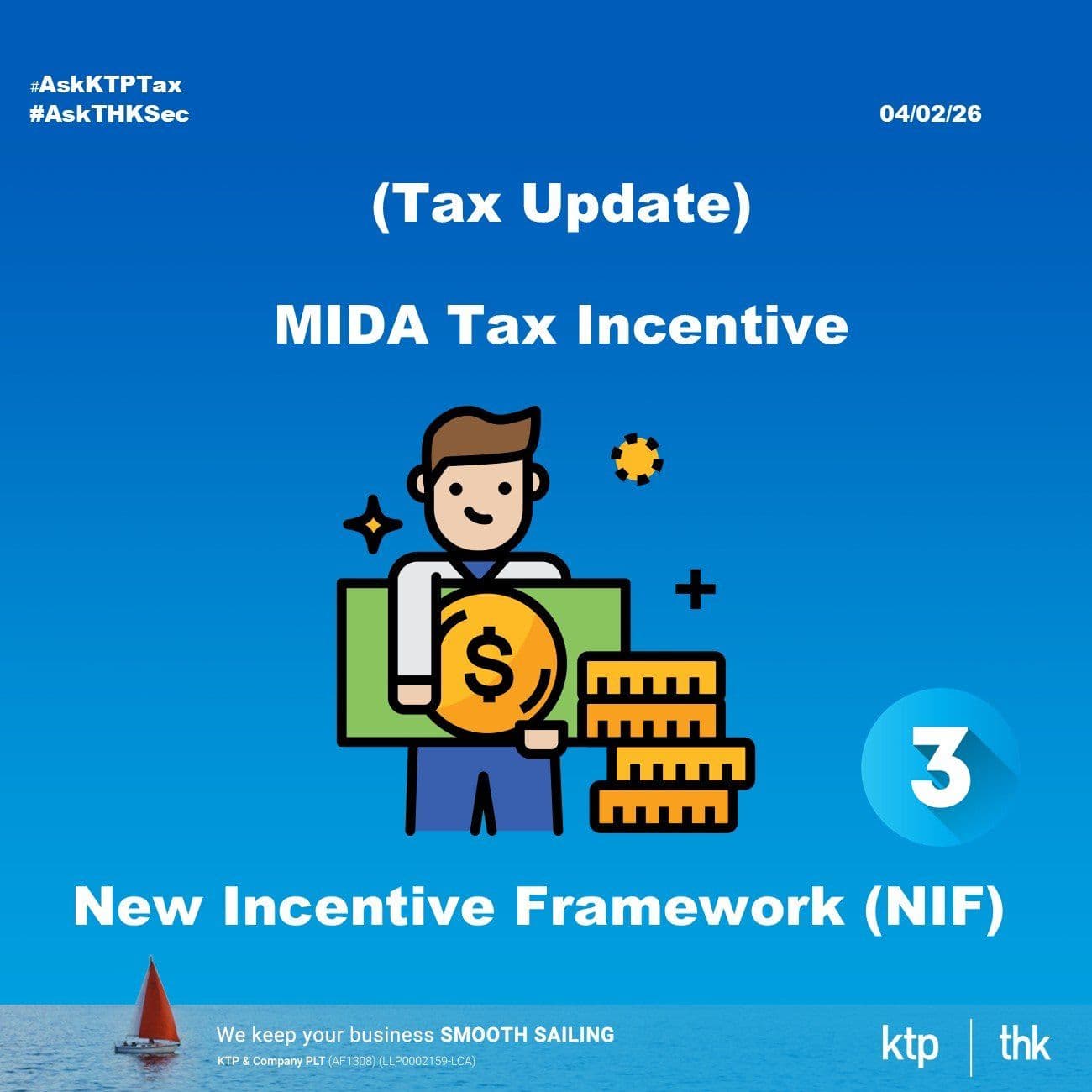
Now, the Government is rolling out the New Incentive Framework (NIF) starting with manufacturing. This is not just a new form. It is a new mindset : incentives are tied to measurable outcomes, not just “you invested money, so you qualify”.
There is a very real deadline for manufacturing players: 28 February 2026 (3.00pm) is the final submission time for new manufacturing incentive applications under the old system.
02Key Summary (60-second read for SME owners)
Current system (PS / ITA under PIA 1986):
- PS = partial income tax exemption (commonly tax on 30% of statutory income for 5 years; incentive period starts from “Production Day”).
- ITA = 60% allowance based on qualifying capital expenditure (capex-based relief) with partial tax exemption up to 70% of statutory income.
- Eligibility is strongly linked to whether your project falls under gazetted promoted activities/products.
New system (NIF):
- Assessment is outcome-based, using the NIA Scorecard (commitments + contribution to national priorities).
- Only two incentive options, and they are mutually exclusive:Special Tax Rate (STR), orInvestment Tax Allowance (ITA)
Only two incentive options, and they are mutually exclusive:
- Special Tax Rate (STR), or
- Investment Tax Allowance (ITA)
- STR provides a reduced corporate income tax rate (range depends on category and assessment outcome), with the guideline indicating 5%–10% (new investment) and up to 5 years.
- ITA provides an allowance of up to 60%-100% on QCE, claimable within an incentive period of up to 5 years, and the allowance may be utilised to offset 70%–100% of statutory income.
- Once your application is accepted, your selection is treated as final (per the guideline).
- For manufacturing, NIF is positioned to start from 1 March 2026, with services to follow after that.
03What is the real difference between NIF and the current PS/ITA approach?
1) “Promoted activity” vs “Proven impact”
Old (PS/ITA):
Most companies start with one question:
“Is my project a gazetted promoted activity/product?”
That list matters because it is the gateway for PS/ITA consideration.
New (NIF):
The starting question becomes:
“What outcomes can my project deliver for Malaysia and can I prove/commit to it?”
NIF uses the NIA Scorecard as the main tool to measure and quantify impacts based on commitments to national priorities.
In simple words:
Before this, you “fit into a category”.
Now, you must “score on impact”.
2) “Pioneer Status tax holiday style” vs “Special Tax Rate (STR)”
Old (PS):
PS is widely understood as a form of income tax exemption for a period (commonly 5 years), such as paying tax only on 30% of statutory income (depending on the incentive category).
New (NIF):
Instead of PS, NIF offers STR … a reduced corporate tax rate on taxable income for a specified 5 years period.
Why this matters to SMEs:
PS is easy to explain (“exempt this portion”).
STR is more like a rate deal, and the benefits depend on your profitability pattern and the approved STR terms.
3) ITA still exists but the “entry ticket” is different
Old ITA:
ITA is capex-based and relief is linked to qualifying capital expenditure, and the mechanics have been long established under the current incentive framework.
NIF ITA:
NIF still offers ITA, but it sits inside an outcome-based, tiering + scorecard approach … meaning the “why you deserve it” is tied to measurable outcomes, not only capex.
4) More documentation, more accountability
NIF is designed to focus on economic substance and measurable national benefits, not tax advantage alone.
So in practice, you should expect:
- more structured commitments (talent, technology, supply chain, sustainability, etc.)
- clearer monitoring of what was promised vs what was delivered
This is the “new normal” direction globally, especially with global tax developments pushing countries to be more careful about how incentives are granted.
04SME Implications (What will hit clients on the ground)
A) If you are planning a new manufacturing investment … timing is now a tax strategy
If your project was targeting PS/ITA under the old approach, the manufacturing timeline is tight because new applications under the old system have a hard stop on 28 February 2026 (3.00pm).
Meaning : delays in board approval, feasibility papers, or capex budgets can become a tax cost.
B) Your “incentive file” is no longer just a tax file
Under NIF, the incentive story is not only about financial projections.
It becomes a combined pack:
- operations plan
- hiring & skills plan
- technology roadmap
- supply chain plan
- sustainability initiatives
Because the Scorecard is about outcomes, not only spending.
C) Choosing between STR vs ITA needs a different calculation
Under NIF, you must choose one (mutually exclusive).
So the old “PS vs ITA” decision framework will shift into “STR vs ITA”, and the best answer depends on:
- profit ramp-up speed (how fast you become profitable)
- capex size and timing
- group tax position, losses, and utilisation pattern
- future expansion plans
Also note: NIF guideline states certain treatments such as loss carry-forward rules during STR (details matter in modelling).
05KTP View
NIF is not “more complicated for fun”.
For SME bosses, the risk is simple:
- If you treat NIF like “just a new MIDA form”, you may under-prepare.
- If you treat NIF as a business strategy submission (with tax inside), your chances improve.
Our practical advice:
- Start early and don’t wait until the project is already halfway done.
- Prepare a clear “impact story” that is real and defensible.
- Do a proper STR vs ITA tax model … not guessing, not hope-based.
- Keep your documentation clean, because incentives today are moving toward tighter governance.
06Call to Action (Talk to KTP before you commit)
If you are:
- planning new manufacturing investment in 2026, or
- currently preparing a PS / ITA application, or
- unsure whether you should go STR vs ITA under NIF,
We can help you:
- map your project to the right incentive route (old vs NIF timing),
- structure the “impact narrative” properly (Scorecard mindset),
- build a STR vs ITA model that fits your profit + capex pattern,
- and prepare a clean submission pack your management team can stand behind.
Reference materials
Further details, eligibility, and application processes are to be read together with the NIF Implementation Guidelines on the official MITI and MIDA portals.
Visit Us
- Wisma KTP, 53 Jalan Molek 1/8, Taman Molek, 81100 Johor Bahru
- Wisma THK, 41, Jalan Molek 1/8, Taman Molek, 81100 Johor Bahru
KTP (Audit, Tax, Advisory)
An approved audit firm and licensed tax firm operating under the KTP group based in Johor Bahru providing audit, tax planning, advisory and compliance services to clients
- Website www.ktp.com.my
- Instagram https://bit.ly/3jZuZuI
- Linkedin https://bit.ly/3sapf4l
- Telegram http://bit.ly/3ptmlpn
THK (Secretarial, Bookkeeping, Payroll, Advisory)
A licensed secretarial firm in Johor Bahru providing fast reliable incorporation, secretarial services, corporate compliance services, outsourcing bookkeeping, and payroll services to clients
- Website www.thks.com.my
- Facebook https://bit.ly/3nQ98rs
KTP Lifestyle
An internal community for our colleagues on work and leisure.
- Tiktok http://bit.ly/3u9LR6Q
- Youtube http://bit.ly/3ppmjyE
- Facebook http://bit.ly/3ateoMz
- Instagram https://bit.ly/3jZpKLo
KTP Career
An external job community on vacancies in Johor Bahru for interns, graduates & experienced candidates.
- Instagram https://bit.ly/3u2PxHg
- Facebook http://bit.ly/3rPxz9o
Come say hello.
Two firms in the heart of Taman Molek, Johor Bahru.
KTP & Company PLT
Wisma KTP, 53, 53-01 & 53-02, Jalan Molek 1/8, Taman Molek, 81100 Johor Bahru, Johor, Malaysia