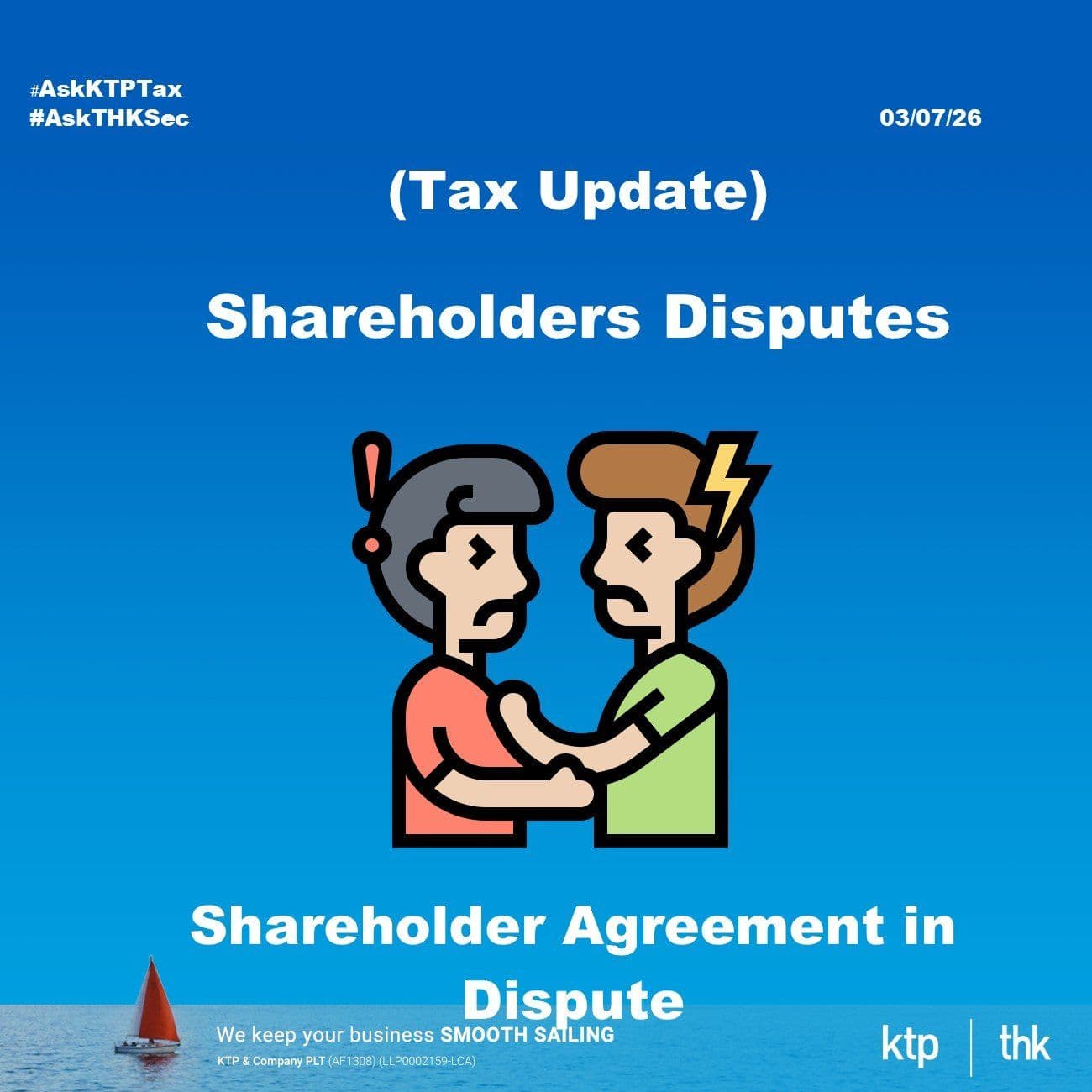
(TAX UPDATE) Why Every New Venture Needs a Shareholder Agreement & Director’s Service Agreement Before the First Ringgit Moves
01Introduction
You have found your partner. The chemistry is right, the timing feels perfect, and you are both talking about market share in Thailand and Indonesia before the company has even opened a bank account.
This week, Malaysians watched a version of that story play out in public. A well known businessman and social media personality had built a livestream e-commerce venture with a food content creator, reportedly handing over 51 percent of the company along with the resources and network to run it.
Two years later, the partnership ended in a public social media announcement, accusations on both sides, and lawyers now in the picture.
Whatever the eventual outcome for those involved, the pattern is one KTP sees constantly among SME founders and joint venture partners in Johor Bahru and beyond. Two people build something together on trust, verbal understanding, and shared excitement. Nobody wants to be the one who asks for a contract when the relationship is still warm. Then the relationship changes, and there is no document to fall back on. What follows is public, expensive, and avoidable.
Here is what should be in place before you let anyone else onto your share register.
02The Shareholders' Agreement Is Not Optional Paperwork
A company constitution tells the world the basic rules of the company. A shareholders' agreement, or SHA, is the private contract between the actual people involved, and it is where the real protection sits.
At minimum, your SHA should cover:
How decisions get made. Which matters need unanimous consent, which need a majority, and what happens when two shareholders disagree and neither will back down. Without this, a 51:49 split can leave the minority shareholder with no real say at all, or leave both sides deadlocked with no way to break the tie.
What happens on exit. Death, disagreement, loss of interest, or simply wanting out. A good SHA has a pre-agreed mechanism, such as a right of first refusal, a valuation formula, or a buy sell clause, so that an exit does not turn into a public standoff over what the shares are actually worth.
Good leaver and bad leaver provisions. If a shareholder who also runs the business leaves under a cloud, should they walk away with the same value as someone who leaves on good terms after years of contribution? Most SHAs answer this differently for each scenario, and it needs to be decided in advance, not argued about after the fact.
Confidentiality and non-compete. If the relationship ends, can either party immediately set up a competing business using what they learned inside yours? This needs to be addressed while everyone is still on good terms, because it becomes almost impossible to negotiate once trust has broken down.
Dispute resolution. Mediation or arbitration clauses, agreed in advance, keep a falling out inside a private room instead of on a livestream.
03The Director's Service Agreement Protects the Company From the Person Running It
Handing someone significant equity and putting them in charge of daily operations is common in founder led ventures. But equity is not the same as an employment or director relationship, and the two need separate documents.
A Director's Service Agreement should define:
- The scope of authority. What can this person decide alone, and what needs board or shareholder approval.
- Remuneration and benefits, separate from any dividend entitlement that comes from shareholding.
- Grounds and process for removal as a director, distinct from removal as a shareholder. Under the Companies Act 2016, a director can be removed by ordinary resolution, but the practical and reputational fallout is very different if this has never been discussed in writing beforehand.
- Assignment of intellectual property created during the engagement. If your director builds the brand, the content library, or the operating playbook, does that belong to the company or to them personally.
- Post-termination restraints, so the working relationship ending does not immediately create a competitor next door.
Without this document, a founder who gave someone operational control and a large equity stake has very little to point to if that person's conduct as a director becomes the actual problem, separate from their status as a shareholder.
04Watch for Family and Romantic Partners Inside the Operation
One detail from this case deserves its own section, because it shows up in Malaysian SME disputes far more often than founders like to admit. Reports that the company was handed over to his girlfriend to run together. This is one of the most common and most under discussed sources of conflict of interest in a young company.
The moment a shareholder's family member or romantic partner is inside the business, whether managing accounts, handling operations, or simply present in day to day decisions, the commercial relationship changes character.
It is no longer purely business between the parties who signed the shareholders' agreement. Decisions about spending, hiring, or strategy can become entangled with a personal relationship that the other shareholders have no visibility into and no ability to manage.
This is not a comment on any individual's competence or intentions. It is a structural problem. A conflict of interest exists whenever a person with influence over the company's decisions also has a personal or financial interest that could affect their judgement, and a spouse or partner working inside the business almost always creates exactly that condition, especially where they hold no formal shareholding or accountability of their own.
05The Constitution Sets the Rules Everyone Defaults To
Many Malaysian companies incorporate using the standard template and never revisit it. Under the Companies Act 2016, a company without a customised constitution runs on the Act's default provisions, which are generic and were never built with your specific shareholding structure in mind.
A properly drafted constitution should address:
- Share transfer restrictions. Can a shareholder sell or transfer shares to an outsider without the other shareholders' consent? Without this, a 49 percent stake could end up in the hands of someone the other shareholders never chose to work with.
- Pre-emption rights, so existing shareholders get first opportunity on any new shares issued or any shares being sold.
- Drag along and tag along rights, which matter enormously if the company is ever sold. Drag along protects a majority shareholder's ability to sell the whole company. Tag along protects a minority shareholder's right to be included on the same terms.
- Quorum and voting thresholds for key decisions, tailored to your actual shareholder structure rather than left at statutory default.
06KTP View
The uncomfortable truth about founder disputes is that they almost never start as legal problems. They start as relationship problems, personal disappointment, or a difference in expectations that nobody wrote down. By the time lawyers get involved, positions have already hardened, and what could have been a clean, pre-agreed exit becomes a public and costly fight.
If you are entering a new venture with a partner, whether that is a livestream commerce platform, a construction joint venture, or a professional services tie up, treat the SHA, the Director's Service Agreement, and the constitution as part of the cost of starting the business, not an optional extra once things are running smoothly. Draft them while the relationship is at its best. That is precisely when both sides are most willing to agree to fair terms for the day things are not.
If you are already in a venture without these documents in place, it is not too late. A properly negotiated SHA can still be put in place between existing shareholders, and a constitution can be amended by special resolution. The best time to do this was before the company was incorporated. The second best time is now.
This article is general educational content on Malaysian company law principles and does not constitute legal or tax advice on any specific matter. It refers to publicly reported events for illustrative purposes only and does not comment on the legal merits of any ongoing dispute.
Visit Us
- Wisma KTP, 53 Jalan Molek 1/8, Taman Molek, 81100 Johor Bahru
- Wisma THK, 41, Jalan Molek 1/8, Taman Molek, 81100 Johor Bahru
KTP (Audit, Tax, Advisory)
An approved audit firm and licensed tax firm operating under the KTP group based in Johor Bahru providing audit, tax planning, advisory and compliance services to clients
- Website www.ktp.com.my
- Instagram https://bit.ly/3jZuZuI
- Linkedin https://bit.ly/3sapf4l
- Telegram http://bit.ly/3ptmlpn
THK (Secretarial, Bookkeeping, Payroll, Advisory)
A licensed secretarial firm in Johor Bahru providing fast reliable incorporation, secretarial services, corporate compliance services, outsourcing bookkeeping, and payroll services to clients
- Website www.thks.com.my
- Facebook https://bit.ly/3nQ98rs
KTP Lifestyle
An internal community for our colleagues on work and leisure.
- Tiktok http://bit.ly/3u9LR6Q
- Youtube http://bit.ly/3ppmjyE
- Facebook http://bit.ly/3ateoMz
- Instagram https://bit.ly/3jZpKLo
KTP Career
An external job community on vacancies in Johor Bahru for interns, graduates & experienced candidates.
- Instagram https://bit.ly/3u2PxHg
- Facebook http://bit.ly/3rPxz9o
Come say hello.
Two firms in the heart of Taman Molek, Johor Bahru.
KTP & Company PLT
Wisma KTP, 53, 53-01 & 53-02, Jalan Molek 1/8, Taman Molek, 81100 Johor Bahru, Johor, Malaysia