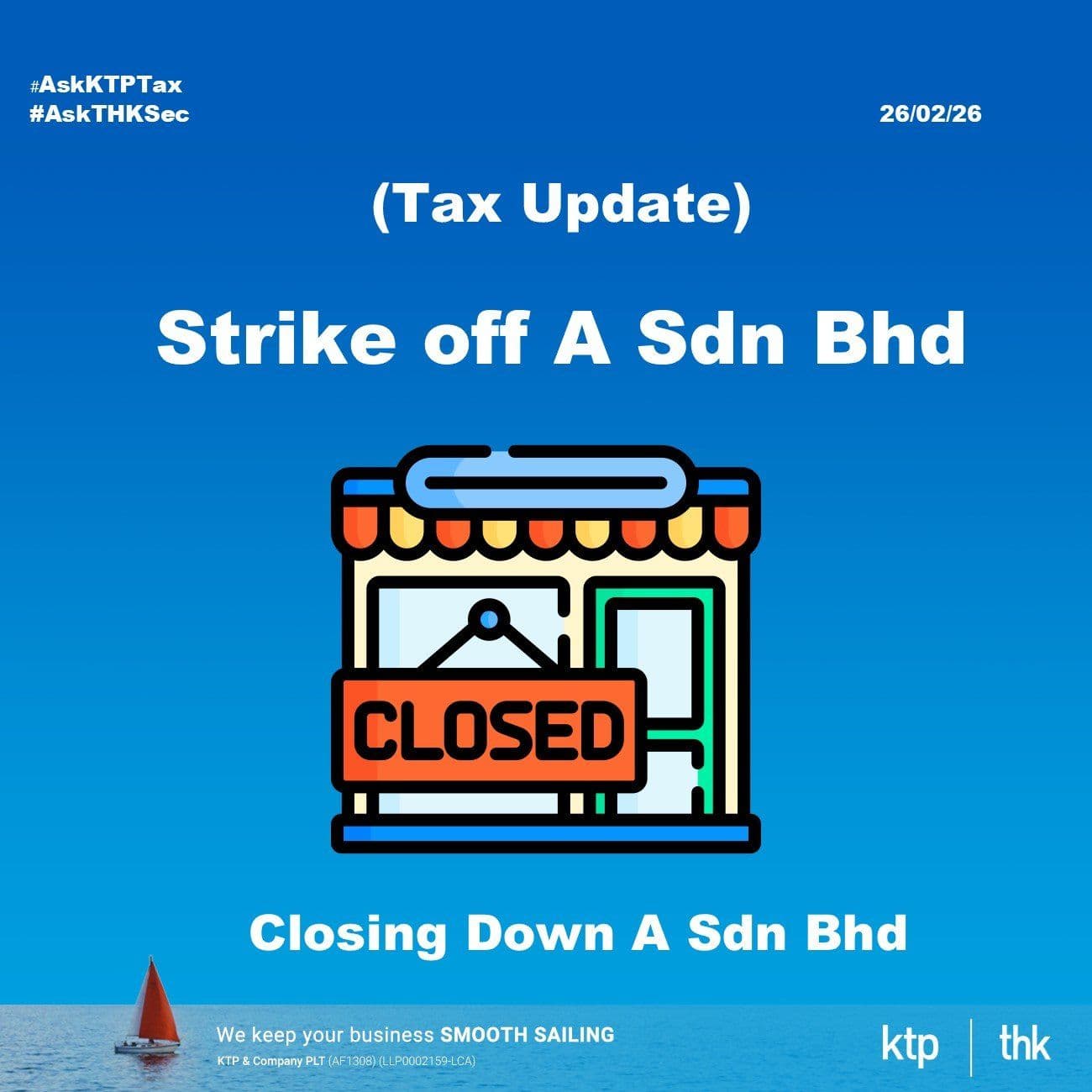
(TAX UPDATE) Closing Down Your Sdn Bhd? What Every SME Must Check First
01(TAX UPDATE) Closing Down Your Sdn Bhd? What Every SME Must Check First
SSM & LHDN Strike Off Guideline
02Introduction
A few weeks before Chinese New Year, one of our clients came to see us.
His face said everything before he even started talking.
Business had slowed down. Costs were rising. The market was no longer as forgiving as before. He looked at us and asked a simple question many SME owners are now asking:
“Can I just strike off my Sdn Bhd and move on?”
Over the past few months, we have seen more enquiries and applications relating to the striking off of private limited companies. The reason is not hard to understand. Current market conditions have caused many business owners to review old dormant companies, inactive entities, and even companies that no longer serve a commercial purpose.
But this is where many directors get a surprise.
Striking off a company is not just about stopping business. It is about proving that nothing is left behind, not in the accounts, not in the tax file, not in payroll, and not with the authorities.
That is why a strike-off application may look simple on the surface, but from a tax and compliance perspective, it must be handled carefully.
03Why this matters
In Malaysia, the striking off of a company is governed by Section 550 of the Companies Act 2016, which allows the Registrar to remove a company from the register if the company is no longer carrying on business or is not in operation.
For many SMEs, striking off is often viewed as a lower-cost and more practical alternative to formal winding-up.
That may be true.
However, the process is not merely a corporate secretarial exercise. It involves important tax, payroll, and regulatory clearance issues. A company that appears dormant from a business perspective may still face delay, objection, or rejection if its tax affairs, employee obligations, or statutory matters have not been properly resolved.
SME owners, directors, and finance teams should therefore treat strike-off as a full closure exercise rather than a simple filing exercise.
Overview of the strike-off framework
A strike-off under Section 550 is generally intended for companies that are dormant, non-operational, and have no remaining assets or liabilities.
It is commonly used where the company has ceased operations and there is no intention to continue business. However, the process is only suitable where the company is able to meet the conditions imposed by the Companies Commission of Malaysia (“SSM”).
In practical terms, the company must be able to show that it is fully cleared from both a legal and financial perspective.
Key eligibility conditions
Before proceeding with a strike-off application, the company should ensure that all of the following conditions are satisfied:
- the company is not carrying on business or has ceased operations;
- the company has no assets and no liabilities;
- there are no outstanding charges registered with SSM;
- there are no ongoing legal proceedings, whether in Malaysia or overseas;
- all SSM penalties or compounds have been settled;
- there are no outstanding liabilities with government agencies, including LHDN, EPF, SOCSO and Customs; and
- the company is not a holding company, guarantor corporation, or another category restricted under the strike-off framework.
This “zero position” is one of the most important practical requirements.
A company may have stopped trading, but if its accounts still show receivables, payables, tax recoverable balances, director current accounts, or cash at bank, it may not yet qualify for strike-off.
Tax clearance remains a critical part of the process
Although SSM administers the legal strike-off process, LHDN plays an important role in ensuring that no outstanding tax matters remain unresolved.
This means tax clearance should not be treated as a later step. It should be addressed early in the closure process.
For companies seeking to be struck off, the company’s tax affairs generally need to be regularised through the relevant LHDN procedures, including the use of the e-SPC facility in the MyTax Portal, where applicable. In this context, Form CP7 is generally relevant for tax clearance purposes relating to strike-off.
The practical message is simple.
A company may be dormant in business terms, but until the tax file is properly settled, the closure process may still be incomplete.
Key tax matters to review before strike-off
1. Final tax returns and outstanding filings
The company should ensure that all outstanding income tax returns have been submitted up to the date of cessation or the relevant year of assessment.
Where the company has ceased operations, the final return position should be reviewed carefully to ensure consistency with the cessation date, final accounts, and supporting documents.
Any outstanding filing can delay tax clearance and affect the strike-off application.
2. Settlement of tax arrears, penalties and compounds
All outstanding taxes, penalties, late payment charges, and compounds should be settled before the application is made.
A dormant company is not automatically a cleared company. If there are unresolved tax balances, LHDN may object or raise issues once the strike-off process is underway.
3. Review of final accounts and supporting records
Even where the company is inactive, the final tax position should still be supportable.
This includes reviewing matters such as:
- disposal of company assets;
- treatment of directors’ current accounts;
- directors’ fees, bonuses, or other remuneration;
- final dividends or shareholder distributions; and
- any write-off of balances.
The accounting treatment and the tax treatment should be aligned. Proper records should be kept in case questions arise later.
4. Dormant or never-commenced companies
Where a company never commenced business, this should not be taken to mean that tax clearance is automatic.
The company may still need to support its position with declarations, incorporation records, bank statements, and evidence showing that no business transactions were carried out.
Employee-related obligations should not be overlooked
Where the company has employees, employers should also review whether all employee tax obligations have been properly addressed.
This includes the submission of the relevant employee cessation forms, such as Form CP22A or CP22B, where applicable.
This is an area sometimes overlooked when management is focused on retrenchment, final payroll, or business closure. However, from a tax compliance perspective, employee-related matters remain part of the overall closure process.
A tax refund may delay the strike-off
One practical issue often overlooked is the treatment of a tax recoverable balance.
Under the strike-off framework, the company must have no assets. If the company is still due to receive a tax refund, that refund may still be regarded as an asset of the company.
As a result, the company may not yet satisfy the zero-asset requirement.
This is why a company should not rush into a strike-off while a tax refund is still pending. The refund should first be received, recorded properly, and the final bank balance brought down to nil before the application is finalised.
Many directors think a small refund is not material.
But for strike-off purposes, even a small unresolved amount can become a problem.
Common issues encountered by SMEs
In practice, strike-off applications are commonly delayed by the following matters:
- outstanding tax returns not filed;
- unpaid taxes, penalties or compounds;
- unresolved EPF, SOCSO or Customs balances;
- employee tax clearance obligations not completed;
- bank accounts still open;
- remaining balances in directors’ current accounts;
- tax recoverable or other receivable balances still appearing in the accounts; and
- insufficient records to show proper cessation and settlement.
For SME groups, these issues often arise where dormant companies have been left inactive for years without a proper clean-up exercise.
Practical implications for directors and finance teams
From a governance and risk management perspective, a strike-off should be treated as a multi-disciplinary closure process.
This usually requires coordination between:
- the company secretary for the Section 550 application;
- the accounting team for the final management accounts and zeroisation of balances;
- the tax agent for tax clearance and final tax filing matters; and
- the HR or payroll function for employee-related obligations.
The earlier this review is carried out, the lower the risk of delay or objection.
Directors should avoid signing strike-off documents based on assumption alone. The company’s records should clearly support the position that there are no remaining assets, liabilities, tax exposures, or unresolved statutory obligations.
Our observations
In our view, the strike-off process is often underestimated by SME owners.
Because the company is no longer active, there is a tendency to assume that closure should be straightforward. In reality, dormant does not necessarily mean compliant, and non-operational does not necessarily mean ready for dissolution.
The biggest risk is not in filing the application.
The biggest risk is filing it too early.
Where accounts, tax matters, payroll issues, or government balances have not been fully regularised, the application may face unnecessary complication.
For this reason, a proper pre-submission review is highly advisable.
Directors should ensure that the legal position, accounting records, tax file, and employee obligations all lead to the same conclusion: the company has genuinely ceased operations and has nothing left to settle.
How SMEs should prepare
Before proceeding with a strike-off, companies should consider the following steps:
- confirm the actual cessation status of the company;
- prepare updated management accounts;
- clear all remaining assets and liabilities;
- review all outstanding tax returns and payments;
- resolve employee cessation and payroll tax matters;
- close the bank account only after all final transactions are completed; and
- coordinate with the company secretary on the required corporate documents and declarations.
This approach can help reduce the risk of rejection and avoid unnecessary delay.
How KTP can help
At KTP, we regularly assist SME clients in reviewing whether a dormant or inactive company is genuinely ready for strike-off.
This includes reviewing the company’s tax position, final balances, management accounts, employee-related tax issues, and practical closure risks before the Section 550 application is submitted.
For directors, this review is often more valuable than dealing with objections after submission.
A strike-off may be intended as a simple exit route.
But from a tax and compliance perspective, the details matter.
If your company is dormant, inactive, or no longer required, this may be the right time to assess whether it is truly ready for closure.
Contact KTP to review your company’s strike-off readiness before the application is made.
Visit Us
- Wisma KTP, 53 Jalan Molek 1/8, Taman Molek, 81100 Johor Bahru
- Wisma THK, 41, Jalan Molek 1/8, Taman Molek, 81100 Johor Bahru
KTP (Audit, Tax, Advisory)
An approved audit firm and licensed tax firm operating under the KTP group based in Johor Bahru providing audit, tax planning, advisory and compliance services to clients
- Website www.ktp.com.my
- Instagram https://bit.ly/3jZuZuI
- Linkedin https://bit.ly/3sapf4l
- Telegram http://bit.ly/3ptmlpn
THK (Secretarial, Bookkeeping, Payroll, Advisory)
A licensed secretarial firm in Johor Bahru providing fast reliable incorporation, secretarial services, corporate compliance services, outsourcing bookkeeping, and payroll services to clients
- Website www.thks.com.my
- Facebook https://bit.ly/3nQ98rs
KTP Lifestyle
An internal community for our colleagues on work and leisure.
- Tiktok http://bit.ly/3u9LR6Q
- Youtube http://bit.ly/3ppmjyE
- Facebook http://bit.ly/3ateoMz
- Instagram https://bit.ly/3jZpKLo
KTP Career
An external job community on vacancies in Johor Bahru for interns, graduates & experienced candidates.
- Instagram https://bit.ly/3u2PxHg
- Facebook http://bit.ly/3rPxz9o
Come say hello.
Two firms in the heart of Taman Molek, Johor Bahru.
KTP & Company PLT
Wisma KTP, 53, 53-01 & 53-02, Jalan Molek 1/8, Taman Molek, 81100 Johor Bahru, Johor, Malaysia