(TAX UPDATE) How LHDN Knows Your Related Party Transactions
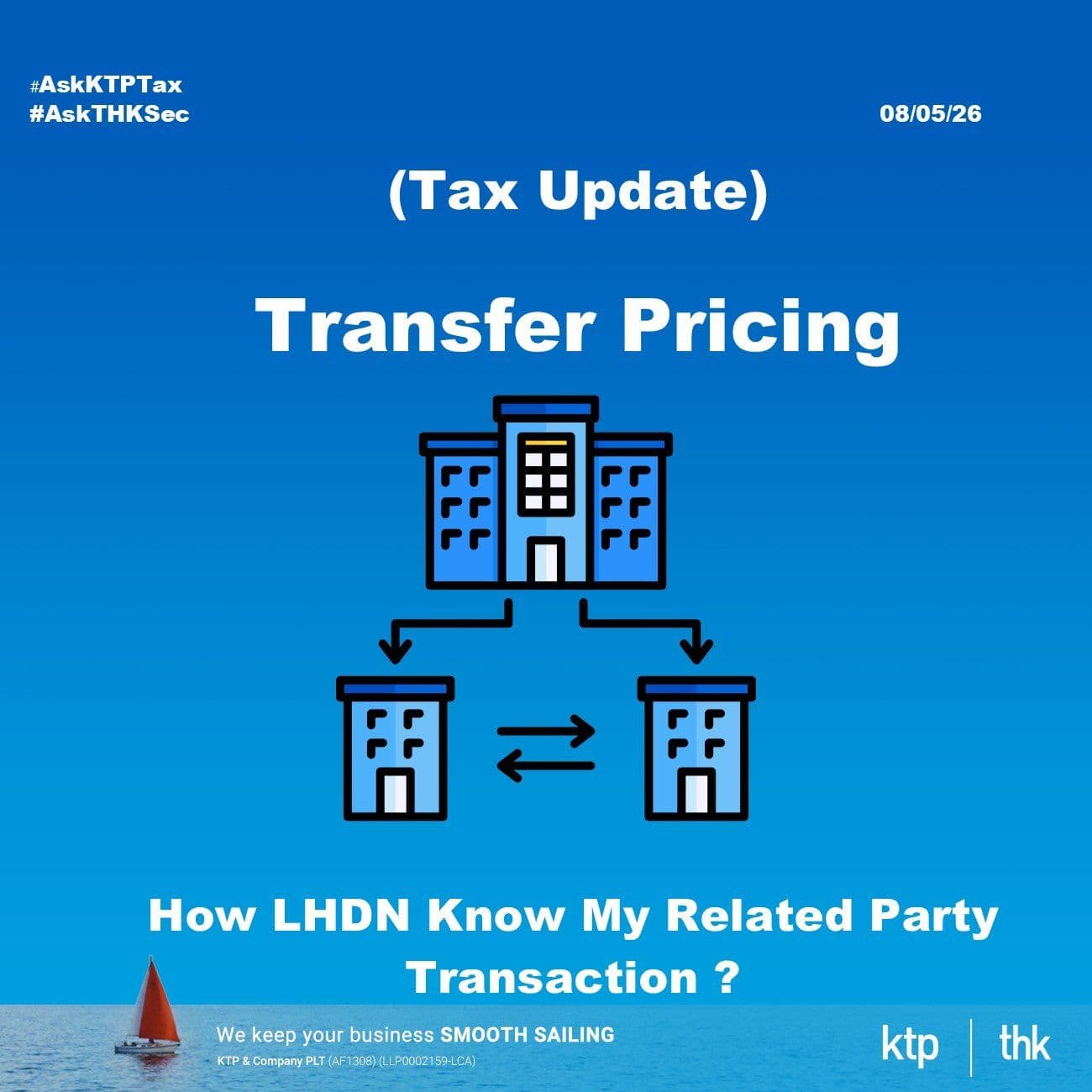
Why growing Malaysian SMEs with multiple entities need to act on transfer pricing before the Inland Revenue Board does.
01Introduction
Many SME bosses still believe related party transactions (RPT) are "private family business". Your Sdn Bhd A sells to your Sdn Bhd B, you pay management fee to your holding company, you take a director loan, all kept quietly inside the group.
Sounds safe. Sounds nobody-will-know.
But the truth is, LHDN sees more than you think. Today let me walk you through the actual channels LHDN uses to detect and cross-check RPT, so you understand why "aiya, internal one only" is the most expensive sentence in Malaysian tax.
02First, what counts as a related party?
Under Section 140A of the Income Tax Act 1967 and the Income Tax (Transfer Pricing) Rules 2023, a related party (or "associated person") includes:
- Companies under common shareholders or common directors
- Holding, subsidiary, and fellow subsidiary companies
- Directors and their immediate family members
- Sister companies, joint ventures, and partnerships with common control
Common RPT examples in SME world:
- Sales between Company A and Company B (same boss)
- Management fee from operating co to holding co
- Director loan / director account movements
- Rental of shoplot owned by director's wife
- Royalty paid to overseas related company
- Inter-company expense recharges
03The 10 ways LHDN already knows
1. Your own Form C
Form C contains a specific section requiring disclosure of controlled transactions: counterparty name, country, type of transaction, and amount. You sign and declare this is true and complete.
If you tick "no" but your audited account says "yes", you have already created a contradiction inside LHDN's own system. Audit risk score goes up immediately.
2. Your audited financial statements
MFRS 124 (and MPERS Section 33 for private entities) requires the auditor to disclose related party transactions in the notes to the accounts. The notes must list:
- Names of related parties and the relationship
- Nature and amount of transactions
- Outstanding balances at year end
This audited account is lodged with SSM and submitted with your tax return. LHDN officers read the notes carefully. Sometimes more carefully than the P&L itself.
3. The OTHER party's tax return
This part many SME owners forget.
If Company A claims a management fee deduction of RM500,000 to Company B, LHDN's system can cross-match. A claims RM500k expense, B should declare RM500k income.
If the numbers don't tally, one side will receive a query letter. If A claims the deduction but B never reports the income, both sides got problem.
4. Withholding tax forms (CP37, CP37A, CP37D)
Cross-border related party payments such as royalty, interest, technical fee, contract payment, and service fee to overseas related company will trigger withholding tax. The CP37 form itself records the payee, the country, the nature, and the amount.
The moment you submit WHT, LHDN already know this is a related party cash flow.
5. SSM company search
LHDN officers run SSM searches as part of normal risk profiling. From one director's IC number, they can pull up every company he is a shareholder or director of, including dormant ones, including the spouse's company.
Once the group structure is mapped, every transaction between these companies becomes a candidate for further review.
6. Stamp duty on property and share transfers
Transfer of property or shares between related parties is captured at the adjudication and stamping stage. The stamp office assesses whether the consideration reflects market value (otherwise additional duty applies), and this data sits inside the same Hasil ecosystem.
7. CRS and Automatic Exchange of Information
Malaysia is a participating jurisdiction under the OECD Common Reporting Standard. Foreign bank balances, foreign company shareholdings, and offshore distributions held by Malaysian tax residents are reported back to LHDN automatically by partner jurisdictions every year.
The old strategy of "park the money in Singapore, nobody know" is no longer relevant.
8. MITRS (Malaysian Income Tax Reporting System)
Starting Year of Assessment 2025, under Section 82B of the Income Tax Act 1967, every company and LLP is required to submit their audited financial statements and full tax computation through MITRS via the MyTax portal, within 30 days after the Form C submission deadline.
What this means for RPT. LHDN now holds your full audited accounts (including the related party note), your detailed income statement, AND your line-by-line tax computation, all sitting digitally in one file under your tax reference number. Officers no longer need to write in to "please furnish your accounts". The data is already with them, ready to be cross-checked against your Form C disclosure and your counterparty's filings.
Failure to submit through MITRS is an offence under Section 120(1)(d). The fine is between RM200 and RM20,000, or imprisonment up to 6 months, or both.
9. Stamping of inter-company agreements
Under the Stamp Act 1949, instruments executed in Malaysia must be stamped within 30 days of execution. Inter-company agreements such as management service agreements, royalty agreements, inter-co loan agreements, tenancy with director's family, and IP licensing all need to be stamped to be admissible as evidence.
The moment the agreement enters the stamping system, LHDN already sees: parties involved, the relationship, the consideration, the duration, the recurring fees. With the move toward self-assessment stamping and digital lodgement, this information is captured electronically and flows into the same Hasil intelligence pool used for income tax risk profiling.
And here is the trap many SME bosses fall into. If you DON'T stamp the agreement, your management fee or royalty payment loses its evidential backbone. LHDN can argue the transaction lacks substance and disallow the deduction outright. If you DO stamp, LHDN sees everything. Either way, the related party transaction is on their radar.
10. Data analytics and informants
LHDN now applies data analytics to compare your gross profit margin, related party expense ratio, and director remuneration against industry benchmarks. Outliers get flagged for desk audit before any human officer even opens your file.
And don't forget. LHDN runs a formal informant reward scheme. Disgruntled ex-staff, ex-spouse, ex-partner, ex-supplier all qualify.
04Where SME usually kena
From audits we have handled in our JB practice, the most common RPT issues raised by LHDN are:
- Director loans without interest charged, caught under Section 140B (deemed interest at Bank Negara's Average Lending Rate), not Section 140A
- Management fees with no service substance and no agreement
- Sales to sister companies below market price
- Rental paid to director's family at above-market rate
- Inter-company expense recharges with no documentation and no markup
Each of these has been adjusted in real audits. The exposure is not just "back tax". It can include penalty under Section 113(2) up to 100% of tax undercharged (commonly imposed at 15% to 45%), OR a surcharge under Section 140A(3C) of up to 5% on the TP adjustment, applicable even when the company is in a tax loss position.
05A real-world scenario: what RM500k can really cost
Let me show you the math, using a scenario we've seen play out many times.
The setup. Boss owns Profit Sdn Bhd (trading, profitable) and Dormant Sdn Bhd (dormant, just holding shares). To shift profit, Profit Sdn Bhd pays a management fee of RM500,000 per year to Dormant S/B. No written agreement. No staff in Dormant S/B No services actually performed. The amount is a round figure, conveniently large.
On paper, looks clean. Profit Sdn Bhd claims RM500k deduction. Dormant S/B declares RM500k income but offsets against unutilised losses brought forward. Net tax saving: RM120,000 per year. Boss thinks "tax saving achieved liao".
Three years later, audit letter arrives. LHDN cross-checks:
Form C ✓,
Audited Financial Statement ✓,
Counterparty filing ✓.
But no agreement, no service substance, no benchmarking, no TPD. LHDN disallows the RM500,000 entirely under Section 39 / Section 140.
The bill, for ONE year:
- Tax on RM500,000 disallowed @ 24% = RM120,000
- Penalty under S113(2) at 45% (typical first offence) = RM54,000
- Subtotal: RM174,000
For 3 years of assessment, the total exposure climbs to roughly RM520,000. All for one transaction the boss thought was "internal only".
And this is before considering interest on late payment, professional fees to handle the audit, and the partner-in-charge of the audit also reading every other note in your account.
The "tax saving" of RM360,000 (RM120k × 3) becomes a real cash outflow of RM520,000+. Net result: paid more, not less.
06What you should do (practical steps)
- Map your group structure honestly. List down every related party, including spouse and children's companies.
- Reconcile your Form C disclosure against the audited account notes. No contradictions.
- Confirm the counterparty also reports the matching income on their side.
- Have proper written agreements for inter-co management fee, royalty, rental, and licensing. And STAMP them.
- Benchmark your pricing. At minimum, a simple comparable analysis to support arm's length.
- If you exceed the TPD threshold, prepare the documentation BEFORE filing Form C, not after the audit letter arrives.
07KTP View
Many SME bosses still operate with the mindset that "my company, my money, I move how I like". Legally, once you incorporate Sdn Bhd, the company is a separate legal person. Every transaction between you, your family, and your other companies is a related party transaction. Full stop.
LHDN does not need to "discover" your RPT through some spy work. The information is already sitting across Form C, MITRS, your audited accounts, your withholding tax filings, your stamped agreements, SSM records, and your counterparty's tax file. They just need to connect the dots, and these days, the dots are connected by a computer, not a clerk.
Our advice is straightforward. Assume LHDN already knows. File like LHDN already knows. Document like LHDN will ask tomorrow.
That way, when the query letter does come, you can sleep through the night.
If you would like to discuss how the transfer pricing regime applies to your group, please contact KTP's tax advisory team.
Visit Us
- Wisma KTP, 53 Jalan Molek 1/8, Taman Molek, 81100 Johor Bahru
- Wisma THK, 41, Jalan Molek 1/8, Taman Molek, 81100 Johor Bahru
KTP (Audit, Tax, Advisory)
An approved audit firm and licensed tax firm operating under the KTP group based in Johor Bahru providing audit, tax planning, advisory and compliance services to clients
- Website www.ktp.com.my
- Instagram https://bit.ly/3jZuZuI
- Linkedin https://bit.ly/3sapf4l
- Telegram http://bit.ly/3ptmlpn
THK (Secretarial, Bookkeeping, Payroll, Advisory)
A licensed secretarial firm in Johor Bahru providing fast reliable incorporation, secretarial services, corporate compliance services, outsourcing bookkeeping, and payroll services to clients
- Website www.thks.com.my
- Facebook https://bit.ly/3nQ98rs
KTP Lifestyle
An internal community for our colleagues on work and leisure.
- Tiktok http://bit.ly/3u9LR6Q
- Youtube http://bit.ly/3ppmjyE
- Facebook http://bit.ly/3ateoMz
- Instagram https://bit.ly/3jZpKLo
KTP Career
An external job community on vacancies in Johor Bahru for interns, graduates & experienced candidates.
- Instagram https://bit.ly/3u2PxHg
- Facebook http://bit.ly/3rPxz9o
Come say hello.
Two firms in the heart of Taman Molek, Johor Bahru.
KTP & Company PLT
Wisma KTP, 53, 53-01 & 53-02, Jalan Molek 1/8, Taman Molek, 81100 Johor Bahru, Johor, Malaysia