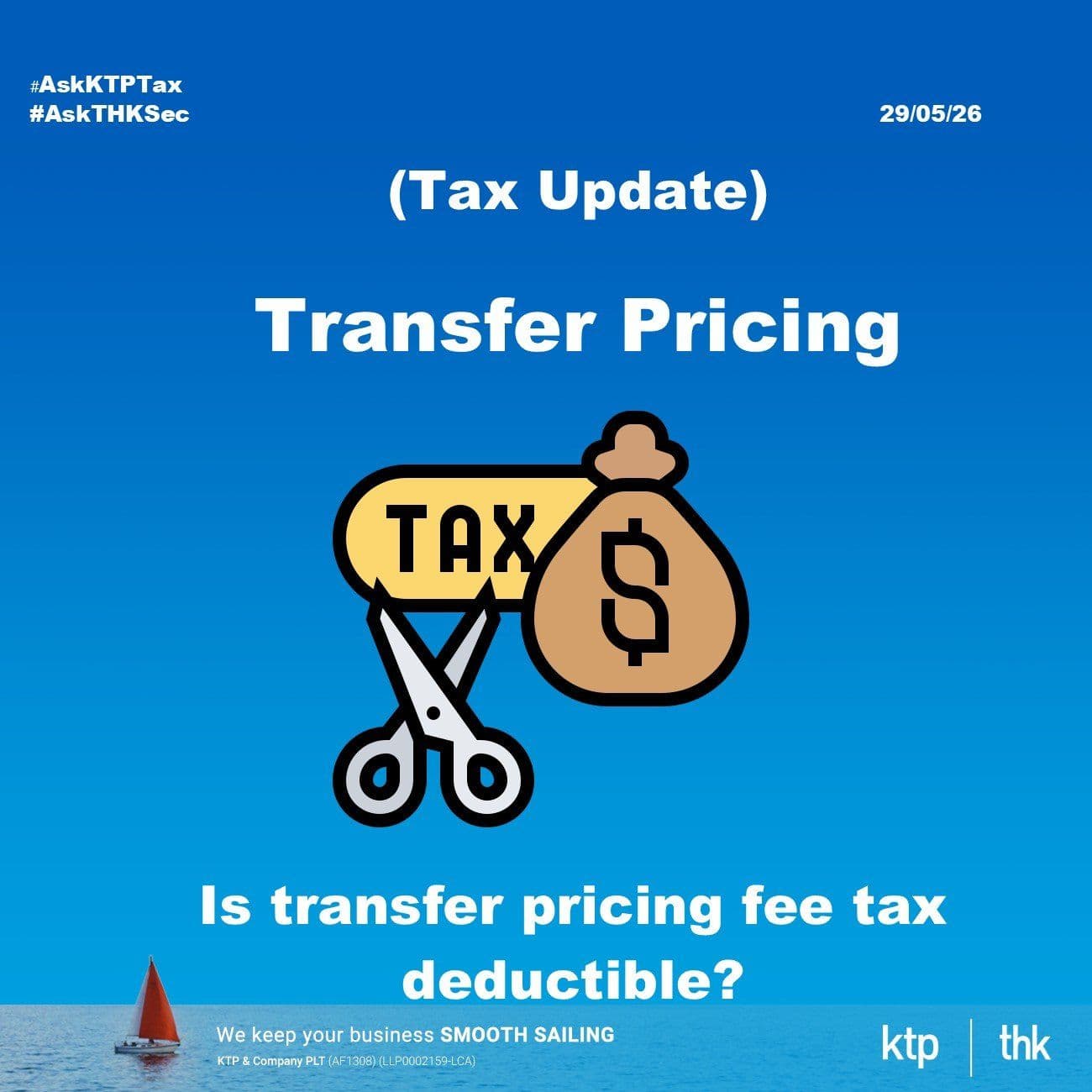
(TAX UPDATE) Tax Deduction on Transfer Pricing Documentation: A New Four-Year Window Under P.U.(A) 193/2025
Issued: KTP Tax Alert | 29 May 2026
01Introduction
First announced by YAB Dato' Seri Anwar Ibrahim, Prime Minister cum Finance Minister, when he tabled Budget 2024 in the Dewan Rakyat on 13 October 2023. Gazetted twenty months later on 23 June 2025 as P.U.(A) 193/2025, the Income Tax (Deduction for Expenditure in relation to Environmental Preservation, Social and Governance) Rules 2025.
Despite the ESG branding in the title, the rules deliver something Malaysian companies have been waiting for : an express, gazetted tax deduction for the cost of preparing contemporaneous transfer pricing documentation (CTPD).
The deduction is capped at RM50,000 per year of assessment, available to companies and Labuan companies resident in Malaysia, and applies from YA 2024 to YA 2027 only.
This is a closed window. After YA 2027, the position reverts to the uncertainty that existed before.
02Background: Why This Gazette Matters
Section 140A of the Income Tax Act 1967, read with the Income Tax (Transfer Pricing) Rules 2023 [P.U.(A) 165/2023] and the Malaysia Transfer Pricing Guidelines 2024, requires companies with controlled transactions above prescribed thresholds to maintain CTPD.
The documentation must be ready by the due date of the corporate tax return and furnished to LHDN within 14 days of a written request.
Failure to comply carries serious consequences. Under Section 113B ITA, monetary penalties range from RM20,000 to RM100,000 per year of assessment, with possible imprisonment of up to six months. Section 140A(3C) imposes a transfer pricing surcharge of up to 5% on any TP adjustment, irrespective of tax payable.
Preparing proper CTPD is no longer optional for affected taxpayers. It is a statutory cost of doing related party business in Malaysia.
The question that has long divided practitioners and LHDN officers : is the professional fee paid to prepare this CTPD tax deductible?
03The Pre-Gazette Position
Before YA 2024, there was no specific subsidiary legislation, no Public Ruling, and no LHDN technical guideline addressing the deductibility of TPD preparation fees.
Taxpayers and advisers fell back on two arguments.
Argument 1 : Section 33(1) general deduction. TPD fees are wholly and exclusively incurred in the production of gross income from controlled transactions. The documentation substantiates the arm's length pricing of revenue-generating transactions. The fee is therefore deductible under the parent provision.
Argument 2 : By analogy to P.U.(A) 162/2020. The Income Tax (Deduction for Expenses in relation to Secretarial Fee and Tax Filing Fee) Rules 2020 grants a deduction of up to RM15,000 per YA for tax filing fees. However, the gazette defines "tax filing fee" exhaustively as fees charged by an approved tax agent for the preparation and submission of returns under sections 77, 77A, 77B, 83, 86 and 107C of the ITA, plus equivalent provisions for SST, Departure Levy and Tourism Tax.
CTPD is not a "return in the prescribed form." It is contemporaneous documentation maintained under a separate statutory regime. P.U.(A) 162/2020 does not cover it.
The result before YA 2024 : taxpayers claimed TPD fees under Section 33(1), but the position was technically exposed during LHDN field audits. Officers occasionally challenged the deduction on the basis that TPD is a compliance cost rather than a production cost. There was no clean answer.
From Budget Speech to Gazette: The 20-Month Journey
The deduction did not appear out of thin air on 23 June 2025. The policy was announced almost two years earlier.
On Friday, 13 October 2023, YAB Dato' Seri Anwar Ibrahim, Prime Minister cum Finance Minister, tabled Budget 2024 in the Dewan Rakyat. The theme was "Economic Reforms, Empowering the People." Tucked inside the Budget 2024 ESG initiatives was a single line that mattered for the transfer pricing community: a deduction of up to RM50,000 per year of assessment for ESG related expenditure, expressly including the preparation of transfer pricing documentation, effective from YA 2024 to YA 2027.
That was the announcement. The implementing law followed twenty months later.
The gap matters for two reasons.
First, many December 2024 year-end companies filed their YA 2024 Form C in July 2025, just weeks after the gazette appeared. Tax agents who took a conservative position and waited for the gazette before claiming the deduction may have under-claimed in YA 2024. For those clients, a revised return under Section 131 ITA 1967 should be considered, subject to the time bar.
Second, Budget 2026, tabled by Anwar Ibrahim on 10 October 2025 as the Fourth MADANI Budget, did not extend the deduction window. The YA 2027 sunset stands firm. There is no current indication the window will be extended further. Plan accordingly.
04What P.U.(A) 193/2025 Provides
The new rules are made under paragraph 154(1)(b) read together with paragraph 33(1)(d) of the ITA 1967.
The relevant provision is Rule 3(1)(b)(ii), which allows a deduction for:
Expenditure incurred by a company or Labuan company for preparing the contemporaneous transfer pricing documentation.
The term "contemporaneous transfer pricing documentation" takes the meaning assigned in the Income Tax (Transfer Pricing) Rules 2023 [P.U.(A) 165/2023]. This anchors the deduction directly to the CTPD regime in force.
Key features :
- Eligible persons. A company or Labuan company resident in Malaysia. Sdn Bhd companies clearly qualify.
- Deduction cap. Total expenditure for deduction under Rule 3(1) shall not exceed fifty thousand ringgit (RM50,000) for a year of assessment. This is a combined cap across all categories under the rules, not a TPD-specific cap.
- Effective period. YA 2024 to YA 2027 inclusive. Four years only.
- No double claim. Rule 4 expressly disapplies the rules where the company has already made a claim for deduction under Section 33 of the Act, has been granted exemption under paragraph 127(3)(b) or subsection 127(3A), or has claimed under any other rules made under Section 154. The taxpayer must elect.
- No certification required for TPD. Unlike the Tax Corporate Governance Framework expenditure under Rule 3(1)(b)(i), the CTPD deduction does not require a certificate of compliance.
05The Time Frame: A Closed Window
This is the single most important practical point. The rules expressly state they have effect from the year of assessment 2024 to the year of assessment 2027.
Three implications follow.
First, the YA 2024 claim is retrospective. The rules were gazetted on 23 June 2025, but they bite from YA 2024. Companies with December 2024 year-ends that have already filed Form C without claiming this deduction should review whether a revised return is warranted. Companies with non-December year-ends covering YA 2024 should ensure the claim is captured in the current filing cycle.
Second, plan TPD engagement timing. Companies preparing CTPD for the first time, or refreshing benchmarking studies, should ensure the professional fee is incurred within the basis period for YA 2024 to YA 2027. A fee incurred in the basis period for YA 2028 currently has no specific gazette support.
Third, the position after YA 2027 reverts to uncertainty. Unless the rules are extended by further gazette order, taxpayers will be back to relying on Section 33(1) arguments from YA 2028 onwards. We have seen sunset rules extended in Malaysia before, but we have also seen them lapse. Do not assume continuity.
The RM50,000 Cap : Practical Considerations
The RM50,000 cap is a combined limit across all qualifying expenditure under Rule 3(1), which includes ESG reporting, Tax Corporate Governance Framework reporting, CTPD preparation, and e-invoice consultation fees for micro and SME businesses.
For a company with multiple qualifying expenditures in the same year of assessment, careful planning is required. Where TPD fees alone exceed RM50,000, the excess is not deductible under these rules.
The non-application clause in Rule 4 adds a further consideration. If the excess is claimed under Section 33(1) general deduction, the company may be barred from also claiming the first RM50,000 under P.U.(A) 193/2025. The conservative reading is that the company must elect: either the full Section 33(1) claim (with technical risk on full deductibility) or the gazetted RM50,000 cap with statutory certainty.
In practice, for the majority of SME clients with TPD fees within the RM50,000 range, the gazetted route offers cleaner ground.
Action Points for Malaysian Companies
- Review the YA 2024 corporate tax position. If TPD fees were incurred and the deduction was not claimed (or was claimed under Section 33(1)), assess whether a revised return is appropriate.
- Ensure invoices from TPD service providers clearly describe the scope as "Preparation of Contemporaneous Transfer Pricing Documentation pursuant to Section 140A ITA 1967 and the Income Tax (Transfer Pricing) Rules 2023." Loose wording invites challenge.
- Track the RM50,000 cap against all qualifying expenditure under Rule 3(1). A combined claim schedule should be maintained.
- Decide between Section 33(1) and P.U.(A) 193/2025 explicitly. The two are mutually exclusive under Rule 4. The decision should be documented in the tax computation working papers.
- Diarise the YA 2027 expiry. Engage in TPD planning conversations with clients before the window closes.
06KTP View
For four years, Malaysian companies have a clean, gazetted answer to a question that has lingered for over a decade. That is welcome.
But the gazette also tells us something else. The fact that a specific deduction order was needed at all confirms that LHDN's official position has been that CTPD preparation fees do not automatically qualify as a Section 33(1) deduction. This is the silent message in P.U.(A) 193/2025. It is the same logic that produced P.U.(A) 162/2020 for secretarial and tax filing fees: a special rule was created because the general rule was not enough.
When the four-year window closes at the end of YA 2027, that silent message will remain. Companies and their advisers should not assume the deduction will automatically continue under Section 33(1) thereafter.
For now, use the window. Use it cleanly. Document the claim. And start a conversation with your tax adviser well before YA 2027 ends.
This alert is prepared for general information only and does not constitute tax advice. Companies should consult their tax adviser on the application of P.U.(A) 193/2025 to their specific circumstances. KTP & Company PLT is an Approved Auditor, Licensed Tax Agent under Section 153(3) of the Income Tax Act 1967, and an MIA Registered Firm.
Visit Us
- Wisma KTP, 53 Jalan Molek 1/8, Taman Molek, 81100 Johor Bahru
- Wisma THK, 41, Jalan Molek 1/8, Taman Molek, 81100 Johor Bahru
KTP (Audit, Tax, Advisory)
An approved audit firm and licensed tax firm operating under the KTP group based in Johor Bahru providing audit, tax planning, advisory and compliance services to clients
- Website www.ktp.com.my
- Instagram https://bit.ly/3jZuZuI
- Linkedin https://bit.ly/3sapf4l
- Telegram http://bit.ly/3ptmlpn
THK (Secretarial, Bookkeeping, Payroll, Advisory)
A licensed secretarial firm in Johor Bahru providing fast reliable incorporation, secretarial services, corporate compliance services, outsourcing bookkeeping, and payroll services to clients
- Website www.thks.com.my
- Facebook https://bit.ly/3nQ98rs
KTP Lifestyle
An internal community for our colleagues on work and leisure.
- Tiktok http://bit.ly/3u9LR6Q
- Youtube http://bit.ly/3ppmjyE
- Facebook http://bit.ly/3ateoMz
- Instagram https://bit.ly/3jZpKLo
KTP Career
An external job community on vacancies in Johor Bahru for interns, graduates & experienced candidates.
- Instagram https://bit.ly/3u2PxHg
- Facebook http://bit.ly/3rPxz9o
Come say hello.
Two firms in the heart of Taman Molek, Johor Bahru.
KTP & Company PLT
Wisma KTP, 53, 53-01 & 53-02, Jalan Molek 1/8, Taman Molek, 81100 Johor Bahru, Johor, Malaysia