(TAX UPDATE) Director’s Personal Car Placed “Under Trust” in a Sdn Bhd
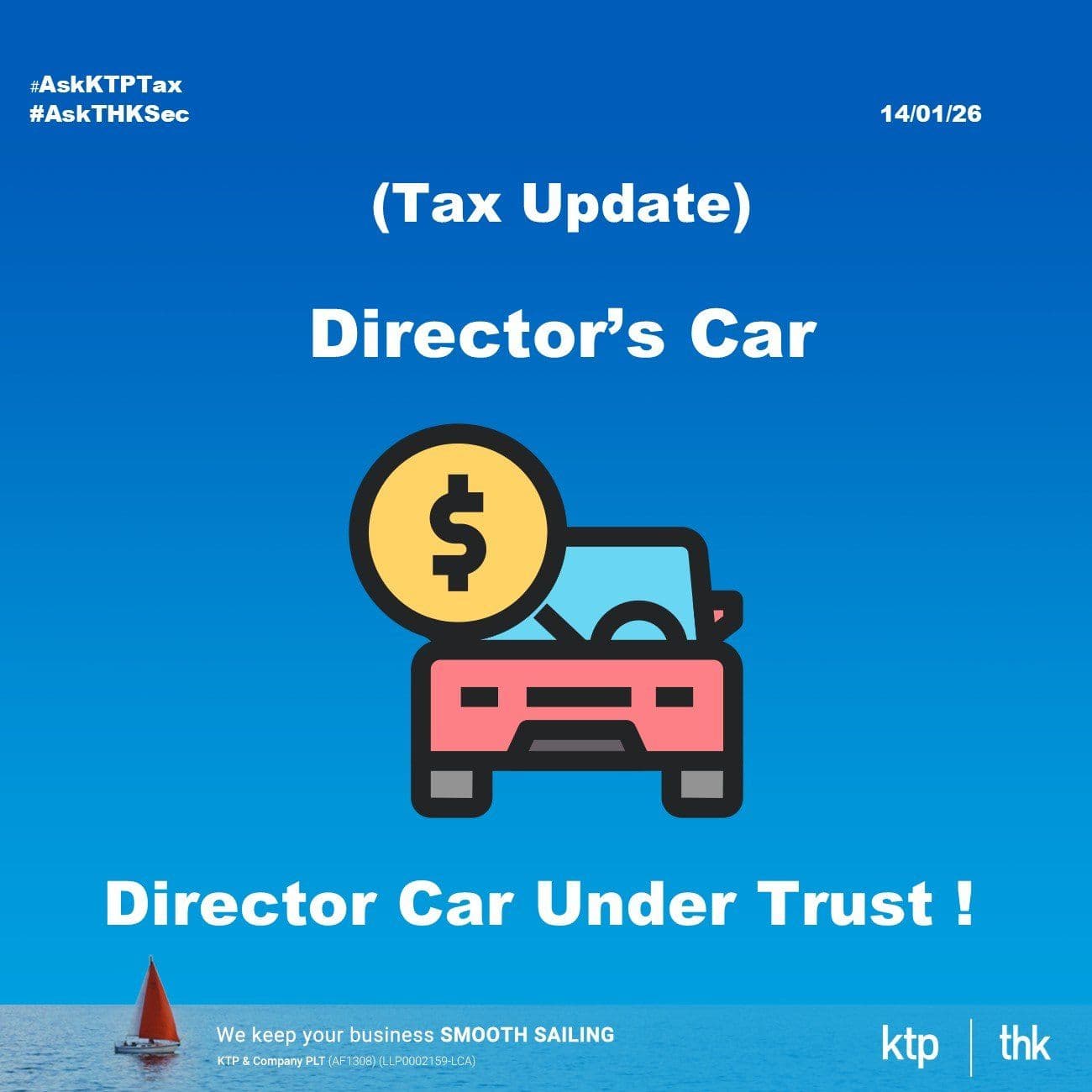
Why SMEs Often Lose Capital Allowance, Face Expense Addbacks, and Still Incur Stamp Duty Exposure
01Introduction
It is common for SMEs to consider placing a director’s personally-owned motorcar “under trust” in the company’s name, with the expectation that the company can then claim:
- capital allowances, and
- running costs such as insurance, road tax, repairs, servicing and petrol.
In practice, this arrangement frequently results in capital allowance disputes, deduction disallowances, benefit-in-kind (BIK) exposure, and unexpected stamp duty implications. LHDN typically evaluates these arrangements based on substance over form
Namely who incurred the cost, who benefits from the asset, and whether the expenditure is genuinely business-related.
021. Background: The Typical Question
A common question raised by SME owners is:
“The director’s car is in personal name. If we appoint the company as trustee using a trust deed, and the company pays insurance, road tax, servicing and petrol, can the company claim tax deduction? Can we also claim capital allowance?”
A key misconception is that once the company appears in documentation (e.g., as trustee), the expenditure automatically becomes a deductible “company expense”.
From a tax perspective, this is not necessarily the case.
032. Key Tax Considerations
2.1 Capital Allowances: Ownership, Qualifying Expenditure and Use
Capital allowance entitlement is governed by Schedule 3 of the Income Tax Act 1967 and clarified in Public Ruling 5/2014 (Ownership and Use of Asset for the Purpose of Claiming Capital Allowances).
In broad terms, entitlement to claim capital allowances is generally assessed by reference to whether the claimant:
- carries on a business,
- incurs qualifying expenditure (QE) on the asset,
- is regarded as the owner at the relevant time, and
- uses the asset for the purposes of the business (for annual allowance).
Practical implication for “trust” arrangements:
Where the director (rather than the company) effectively finances the vehicle (e.g., the director paid the purchase price or services the hire purchase instalments), LHDN may challenge whether the company has in fact incurred QE, even if the company is reflected as trustee or legal holder in documentation.
Accordingly, “putting the car under trust” does not, by itself, strengthen the company’s capital allowance position.
2.2 Deductibility of Running Costs: Section 33(1) vs Section 39
The general deductibility rule under Section 33(1) requires that expenses are incurred wholly and exclusively in the production of gross income.
Conversely, Section 39 disallows deductions for domestic or private expenses.
In LHDN audits, the central question is often framed very plainly:
“Is this expenditure incurred for the company’s income-producing activities, or for the director’s personal benefit and lifestyle?”
For a motorcar that continues to be used for personal purposes (e.g., home travel, weekends, family use), it is typically difficult for SMEs to demonstrate that running costs are wholly and exclusively business-related.
As a result, addbacks are common unless there is strong evidence of business use (e.g., logbooks, clear travel policies, supporting documents).
2.3 Benefit-in-Kind (BIK): Tax May Shift to the Director
Where a company bears the cost of a motorcar that is effectively used as a director’s personal benefit, the tax exposure often shifts to employment income treatment.
The provision of a motorcar benefit and related running costs can fall within BIK treatment (commonly linked to Section 13(1)(b) principles). In such cases:
- the company may seek deduction (subject to the rules above), but
- the director may be required to declare taxable benefits, and
- the employer must ensure proper reporting, valuation, and consistency of treatment.
This is not “tax free”. In many cases it is simply tax re-allocation from company to director.
2.4 Motor Vehicle Limits Still Apply Even for “Proper” Company Cars
Even where the company genuinely acquires and owns the vehicle outright, SMEs should note that motor vehicle claims are frequently subject to:
- capital allowance restrictions (including QE limits), and/or
- deduction limitations for lease or rental arrangements.
These are common audit focus areas, particularly where claims appear to be made without regard to statutory caps or established practice.
043. Stamp Duty Implications: Not Always RM10
A trust deed is not “administrative only”. Under Malaysia’s stamp duty framework (including the self-assessment regime), the stamp duty outcome depends heavily on how the instrument is drafted and characterised.
While certain declarations of trust may be stamped at a fixed duty (commonly RM10), instruments that resemble a settlement or transfer of beneficial interest may be treated closer to conveyance-type instruments, attracting ad valorem duty.
Simple illustration (for understanding)
If an instrument is treated as conveyance-like and the vehicle value is RM150,000, the duty (based on commonly referenced conveyance rates) may be approximately:
- 1% on first RM100,000 = RM1,000
- 2% on next RM50,000 = RM1,000
Total: RM2,000 (not RM10)
Additionally, stamping timelines and late stamping penalties may apply (commonly referenced as 30 days for instruments executed in Malaysia).
054. Our Practical View
As a tax agent, our view is direct:
Using a trust deed to place a director’s personal car “under the company” as a tax-saving strategy is generally not recommended.
In many cases, it creates four layers of exposure:
- Capital allowances may be challenged (particularly where QE is not incurred by the company).
- Running costs may be disallowed due to private use and Section 39 risk.
- BIK reporting obligations arise, shifting tax to the director and increasing compliance burden.
- Stamp duty exposure may arise, depending on the drafting and classification of the instrument.
065. More Audit-Resilient Alternatives
SMEs should consider one of the following approaches, depending on business needs:
Option A (Cleanest governance):
The company purchases and owns the vehicle properly, and any private use is treated as BIK with appropriate reporting.
Option B (Simplest operationally):
The director retains personal ownership, and the company reimburses business mileage supported by a logbook and a clear internal policy.
Option C (Where company pays personal running costs):
Treat it as a director benefit, document it properly (including board approval), and apply BIK treatment consistently in line with relevant public rulings and guidance.
07Next Steps for SMEs
If your company already has a “trustee car” arrangement, it is advisable to review it proactively before an audit.
A practical review typically covers:
- who incurred the qualifying expenditure,
- ownership and use position in substance,
- whether expenses are defensible or should be treated as BIK, and
- whether the trust deed triggers stamp duty exposure.
This article is provided for general information only and reflects the author’s personal professional view based on the facts described. It does not constitute tax, legal, or other professional advice and should not be relied upon as a substitute for advice tailored to your specific circumstances. Tax and stamp duty outcomes may vary depending on documentation, ownership, beneficial interest, and actual usage. Readers should consult their own tax adviser and/or legal counsel before taking any action or implementing any arrangement described in this article.
Visit Us
- Wisma KTP, 53 Jalan Molek 1/8, Taman Molek, 81100 Johor Bahru
- Wisma THK, 41, Jalan Molek 1/8, Taman Molek, 81100 Johor Bahru
KTP (Audit, Tax, Advisory)
An approved audit firm and licensed tax firm operating under the KTP group based in Johor Bahru providing audit, tax planning, advisory and compliance services to clients
- Website www.ktp.com.my
- Instagram https://bit.ly/3jZuZuI
- Linkedin https://bit.ly/3sapf4l
- Telegram http://bit.ly/3ptmlpn
THK (Secretarial, Bookkeeping, Payroll, Advisory)
A licensed secretarial firm in Johor Bahru providing fast reliable incorporation, secretarial services, corporate compliance services, outsourcing bookkeeping, and payroll services to clients
- Website www.thks.com.my
- Facebook https://bit.ly/3nQ98rs
KTP Lifestyle
An internal community for our colleagues on work and leisure.
- Tiktok http://bit.ly/3u9LR6Q
- Youtube http://bit.ly/3ppmjyE
- Facebook http://bit.ly/3ateoMz
- Instagram https://bit.ly/3jZpKLo
KTP Career
An external job community on vacancies in Johor Bahru for interns, graduates & experienced candidates.
- Instagram https://bit.ly/3u2PxHg
- Facebook http://bit.ly/3rPxz9o
Come say hello.
Two firms in the heart of Taman Molek, Johor Bahru.
KTP & Company PLT
Wisma KTP, 53, 53-01 & 53-02, Jalan Molek 1/8, Taman Molek, 81100 Johor Bahru, Johor, Malaysia