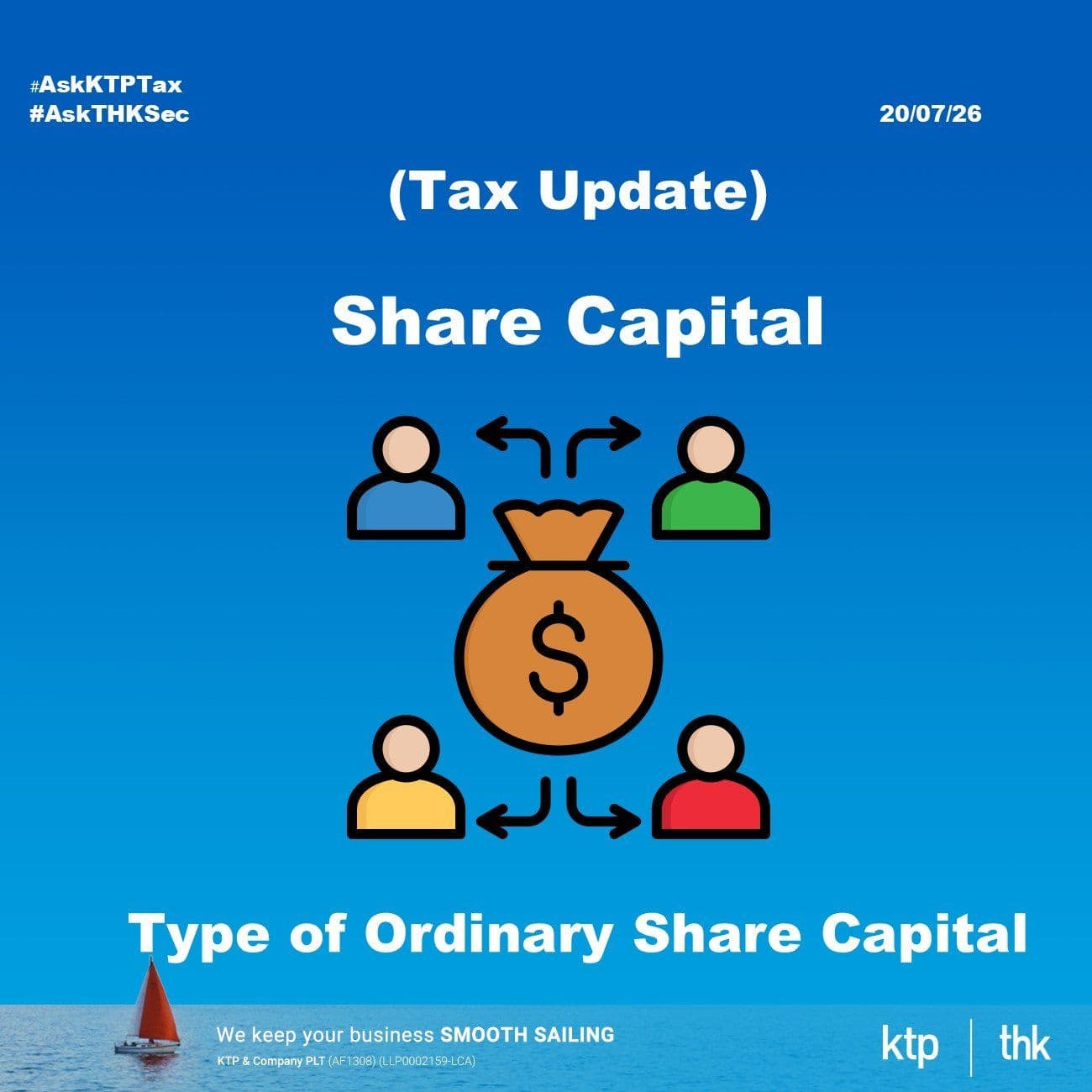
(TAX UPDATE) SSM Practice Directive 11/2026: What You Must Lodge About Your Shares
01Introduction
Most business owners treat their share capital as settled. The shares were issued years ago, the register sits with the company secretary, and nobody looks at it again until something goes wrong.
Practice Directive 11/2026 is a reason to look at it now.
On 14 July 2026, SSM issued PD 11/2026, Lodgement of Shareholders' and Share Capital Information, under section 20C of the Companies Commission of Malaysia Act 2001. It supports the rollout of SSM's new Corporate Registry System (CRS), and it introduces a lodgement that affected companies must complete before they can carry out a range of routine share related filings.
If you are caught by it, this is not optional, and it has a deadline.
02Who must comply
The directive applies to two groups:
- Local companies whose members hold more than one type of shares.
- All foreign companies registered in Malaysia.
Read that first line carefully. If your company has only ordinary shares held on the same terms, you fall outside the mandatory lodgement.
If your members hold a mix, for example ordinary and preference, or any special class, you are in scope. This is exactly where owners get caught out, because many assume they have "only ordinary shares" when the constitution and the register say otherwise.
03What you must lodge
In-scope companies must lodge two templates with the Registrar, set out in Annexure B of the directive:
- Table A, Capital Structure.
- Table B, Shareholders Breakdown.
Lodgement is done over the counter at SSM's Head Office or any SSM state office. No fee is charged.
04The detail SSM now wants
This is the part worth understanding, because it goes well beyond "how many shares".
Table A asks you to state, for each type of share, not just whether it is Ordinary or Preference, but the further category where relevant: Golden Shares, Priority Shares, Special Shares, or Others. It also captures whether the shares carry voting rights, whether they were paid in cash or otherwise, and whether they are listed or unlisted.
For preference shares, it asks whether they are cumulative or non-cumulative, redeemable or non-redeemable, convertible or non-convertible, and participating or non-participating.
Table B then breaks this down shareholder by shareholder, with each holder's particulars and the type and rights of the shares they hold. Where a shareholder is a body corporate that is a holding company, you must also declare whether it controls the board, controls more than half of the voting power, or holds more than half of the issued share capital excluding preference shares.
The message from the Registry is clear. SSM is no longer recording only the number of shares. It is recording what each share can do.
05The deadline and the consequence
Companies have six months, from 14 July 2026 to 14 January 2027, to lodge the information. The Registrar may extend that period, but you should not plan around an extension.
The consequence of not lodging is practical and immediate. Until the information is lodged, an affected company cannot access the CRS services that depend on it. Those services include the everyday filings that keep a company's share records in order, such as:
- Notifying changes to the register of members under section 51.
- Redemption of preference shares under section 72.
- Approval for allotment and return of allotment under sections 76 and 78.
- Alteration of share capital under section 84.
- Variation of class rights under sections 94 and 95.
- Reduction of share capital under sections 116 to 119.
- Increase in share capital of a foreign company under section 567.
In other words, if you do not lodge, your company can be locked out of issuing shares, transferring them, or restructuring its capital at the very moment you need to.
06Accuracy is not negotiable
The lodgement is signed by a director or the company secretary, with a declaration that the information is true. The directive carries the standard warning under section 591 of the Companies Act 2016. A false or misleading statement can lead to imprisonment of up to ten years, a fine of up to RM3 million, or both.
This is not a form to complete from memory. It should be reconciled against your constitution, your register of members, and your allotment and transfer records before it is signed.
07Why this matters beyond the filing
Underneath the compliance exercise is a point every SME owner should absorb.
Two shareholders can hold the same number of shares and sit in completely different positions. One class can carry a preferential dividend. Another can carry priority on winding up. Another can carry special or weighted voting rights. The count can be identical while the control and the economics are not.
This is why financing, equity planning, and governance can never be read off the shareholding percentage alone. The rights attached to each class decide who really controls the company and who really carries its value. PD 11/2026 simply puts that reality on the public record.
08What to do now
- Confirm whether your company has more than one type of share, or is a foreign company. If yes, you are in scope.
- Pull your constitution and register of members, and map the rights attached to each class.
- Reconcile the register against your allotment, transfer, and capital alteration history.
- Prepare Table A and Table B accurately.
- Lodge over the counter at SSM before 14 January 2027, and keep proof of lodgement.
09KTP View
Most owners quietly assume that a share is the same as ownership. The more accurate version is that a share plus its rights is what ownership really means.
PD 11/2026 is SSM asking you to state that clearly, in writing, and on the record. Treat it as a deadline, but also as a prompt. If you have never properly documented what each class of your shares can do, this is the moment to get it right, before a fundraise, a buyout, or a dispute forces the question for you.
If you are unsure whether you are in scope, or what rights your shares actually carry, speak to your company secretary or advisor well before the January window closes.
This article is general educational content on Malaysian company law and is not advice for any specific company or transaction. Please seek professional advice on your own facts. This piece was reviewed by KTP before publication.
Visit Us
- Wisma KTP, 53 Jalan Molek 1/8, Taman Molek, 81100 Johor Bahru
- Wisma THK, 41, Jalan Molek 1/8, Taman Molek, 81100 Johor Bahru
KTP (Audit, Tax, Advisory)
An approved audit firm and licensed tax firm operating under the KTP group based in Johor Bahru providing audit, tax planning, advisory and compliance services to clients
- Website www.ktp.com.my
- Instagram https://bit.ly/3jZuZuI
- Linkedin https://bit.ly/3sapf4l
- Telegram http://bit.ly/3ptmlpn
THK (Secretarial, Bookkeeping, Payroll, Advisory)
A licensed secretarial firm in Johor Bahru providing fast reliable incorporation, secretarial services, corporate compliance services, outsourcing bookkeeping, and payroll services to clients
- Website www.thks.com.my
- Facebook https://bit.ly/3nQ98rs
KTP Lifestyle
An internal community for our colleagues on work and leisure.
- Tiktok http://bit.ly/3u9LR6Q
- Youtube http://bit.ly/3ppmjyE
- Facebook http://bit.ly/3ateoMz
- Instagram https://bit.ly/3jZpKLo
KTP Career
An external job community on vacancies in Johor Bahru for interns, graduates & experienced candidates.
- Instagram https://bit.ly/3u2PxHg
- Facebook http://bit.ly/3rPxz9o
Come say hello.
Two firms in the heart of Taman Molek, Johor Bahru.
KTP & Company PLT
Wisma KTP, 53, 53-01 & 53-02, Jalan Molek 1/8, Taman Molek, 81100 Johor Bahru, Johor, Malaysia