KTP Interactive Budget 2027 Webpage
01Executive summary
Budget 2027 gives targeted tax relief to middle-income households and smaller businesses while keeping the Government on its fiscal consolidation path. Prime Minister and Finance Minister Datuk Seri Anwar Ibrahim tabled the fifth MADANI Budget in the Dewan Rakyat on 9 October 2026, under the theme Menggapai di Langit, Mengakar di Bumi.
The Budget allocates RM510 billion, up from RM470 billion in 2026. This comprises RM376.8 billion of operating expenditure and RM83 billion of development expenditure, with the balance coming from GLIC, statutory body and public-private investment. The fiscal deficit is projected to narrow from 3.6% to 3.3% of GDP, with a target of 3% by 2028.
For taxpayers, three themes stand out:
- Relief targeted at the middle. Individual relief rises to RM12,000 for the first time since 2010, and two middle-income rate bands fall by one percentage point. At the top end, the 30% rate now applies from RM1 million.
- Support for MSMEs, with a compliance edge. The MSME tax rates fall to 14% and 16%, but larger companies must pay salaries through financial institutions or cashless channels to keep their deductions.
- Sharper incentives. The Global Services Hub incentive is enhanced, while green technology incentives are extended but narrowed to fewer qualifying activities.
The tax measures remain proposals until the Finance Bill 2026 is passed. We expect further detail through the Bill and the guidelines that follow.
02Explore our interactive Budget 2027 guide
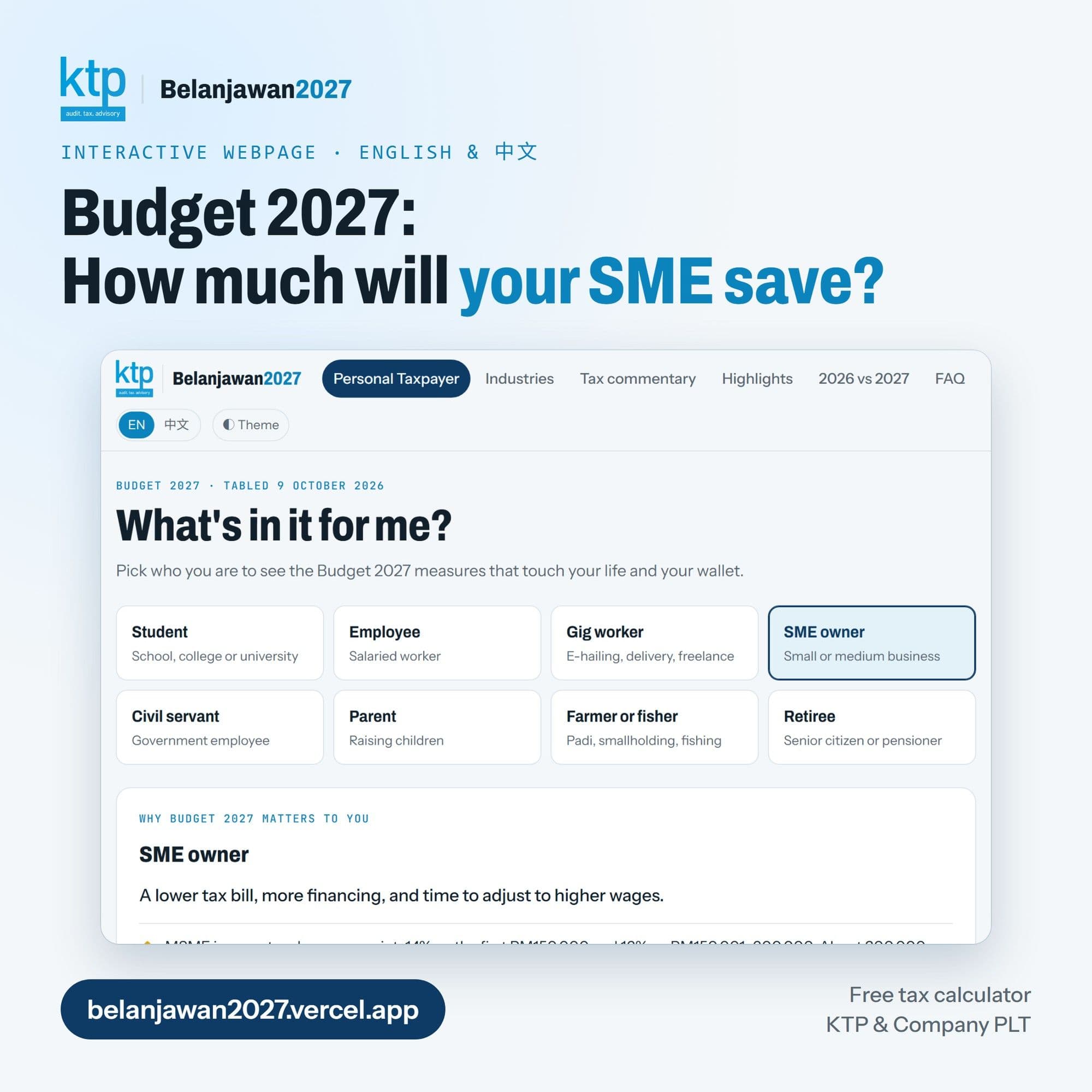
Every measure discussed in this article is set out in our interactive guide at belanjawan2027.vercel.app, in English and Chinese. Readers can use it to:
- see the measures that apply to them as a student, employee, gig worker, SME owner, civil servant, parent, farmer or retiree;
- read industry briefings covering what the speech says, what it means and what to do;
- browse our tax commentary which arranged in the order;
- estimate their personal and SME tax savings with the built-in calculators;
- compare Budget 2027 with 2026 side by side.
03Individuals: more relief for the middle, more tax at the top
The individual measures redistribute the tax burden towards the middle-income group, which the Government estimates will benefit about 5 million taxpayers by up to RM1,600 a year. That figure is the combined effect of the higher relief and the lower rates.
Rate changes from YA 2027
- RM70,001–100,000: reduced from 19% to 18%.
- RM100,001–150,000: a new band at 24%, carved out of the existing 25% band. RM150,001–400,000 stays at 25%.
- RM600,001–1,000,000: stays at 28%.
- Above RM1 million: taxed at 30%, previously applicable only above RM2 million.
Worked example. A resident with chargeable income of RM120,000 under the current rules pays about RM14,400. With the extra RM3,000 relief and the new bands, the same person pays about RM13,180, a saving of about RM1,220. By contrast, chargeable income of RM1.5 million attracts about RM8,300 more tax, because the 2% increase on the slice above RM1 million outweighs the relief. These estimates ignore rebates and zakat.
Wider reliefs from YA 2027
- Individual relief: RM9,000 to RM12,000, the first revision since 2010.
- Health and Well-being (formerly medical treatment, RM10,000): now covers postnatal care up to RM3,000 and breastfeeding equipment up to RM1,000.
- Parents and grandparents (RM8,000): now covers all types of care expenses, without certification by a registered medical practitioner.
- Education and Skills Training Fees (RM7,000): your own studies in any field at a recognised local institution or professional body; TVET upskilling for self or spouse up to RM3,000; and a new RM2,000 sub-limit for non-work courses for self or spouse, and STEM, arts, language and religious classes or tuition for children.
- Lifestyle (RM2,500): now includes AI software and app subscriptions, pet adoption from registered shelters, and pet vaccination, spaying or neutering at registered vets.
- Sports equipment (RM1,000): now includes sports shoes, limited to RM300.
- SOCSO (RM350): extended to mandatory LINDUNG KENDIRI contributions, with an extra RM150 for voluntary contributions.
In our view, the relief changes favour the “sandwich generation” supporting both children and ageing parents. High-income individuals should review the timing of income and the use of available reliefs ahead of YA 2027.
04MSMEs and companies: lower rates, tighter conditions
Qualifying MSMEs will pay 14% on the first RM150,000 of chargeable income and 16% on RM150,001 to RM600,000 from YA 2027, down from 15% and 17%. Income above RM600,000 remains at 24%. The saving is 1% of chargeable income up to RM600,000, capped at RM6,000 a year, and the Government expects about 300,000 MSMEs to benefit.
Eligibility is unchanged. A qualifying company is generally a Malaysian-resident company with paid-up capital of RM2.5 million or less and gross business income of RM50 million or less. The existing conditions on foreign ownership and related companies continue to apply, so group structures should be checked before relying on the lower rates.
Capital allowances
- The 100% allowance for small-value assets rises from RM2,000 to RM3,000 per asset. The annual cap for companies other than MSMEs rises from RM20,000 to RM30,000; MSMEs have no cap.
- Accelerated Capital Allowance on ICT equipment and software, and on locally produced plant and machinery, is extended to 31 December 2030.
- The reinvestment allowance is under review. No details have been announced.
Salary deductions: a new compliance condition
From YA 2028, companies other than MSMEs can deduct salaries only if they are paid through financial institutions or cashless payment instruments prescribed under the Employment Act 1955. Other expenses are not affected. The Budget appendix does not define MSME for this purpose, so the scope of the exclusion should be confirmed once the Finance Bill is published.
New and expanded deductions
- PTPTN loan repayments made by employers on behalf of full-time employees (1 January 2027 to 31 December 2028), provided the amount is not recovered and the employee is not the owner or a family member. The benefit may be taxable in the employee's hands.
- Companies implementing Bakat MADANI training programmes (29 June 2026 to 31 December 2030).
- Contributions of food and equipment to Program Dapur Siswa MADANI (2027 to 2030).
- Donations to public universities for infrastructure and equipment, within the 10% of aggregate income limit, and a wider scope for School Public Contribution Fund (TSUWAS) contributions.
The rate cut is modest in absolute terms but welcome. The salary deduction condition is the more significant change for larger groups: cash wages become a tax audit point, and payroll processes should be reviewed well before YA 2028.
05Investment incentives: enhanced for hubs, narrowed for green
The incentive measures show a clear shift from broad-based incentives to targeted ones, tied to strategic activities and longer-term commitments.
Global Services Hub (GSH), from 1 January 2027
- New companies: a 5% special tax rate on qualifying income.
- Existing Principal Hub or GSH companies: 15% on income up to the base income (the average of the previous three years) and 5% above it.
- Exempt income is extended to treasury fund management (TFM) activities prescribed by the Minister of Finance.
- Incentive tenure granted in five-year blocks, for up to 30 years.
- For GSH companies undertaking TFM for cash pooling via onshore intermediaries, including under the Johor–Singapore Special Economic Zone package: withholding tax exemption on interest paid to non-residents and full stamp duty exemption on foreign-currency intercompany loans, for applications to MIDA from 1 January 2027.
Green technology: extended to 2030, but narrower
- Project-based Green Investment Tax Allowance (GITA) is streamlined into two tiers, with 100% retained only for Tier 1 activities (green hydrogen and ocean thermal energy conversion).
- Integrated waste management and solar projects no longer qualify for the project incentive. Applications for the solar leasing income tax exemption close on 31 December 2026.
- For assets acquired for own use, green building and energy efficiency drop out. Battery energy storage remains in Tier 1, and renewable energy integrated systems with storage, plus a prescribed asset list, are added.
Other incentives
- Full income tax exemption for Malaysian shipping companies extended to YA 2036, subject to substance conditions in Malaysia.
- Shariah-compliant fund management exemption continues for YA 2028 to 2030, but reduced from 60% to 40%.
- Sukuk Prisma issuance costs deductible for YA 2027 to 2030; SRI Sukuk and Bond Grant Scheme grants tax-exempt from 1 January 2027.
- Relocation costs of up to RM5 million deductible for wholly Malaysian-owned automotive vendors moving to the Automotive Hi-Tech Valley in Tanjong Malim (2027 to 2030).
- A new Multi-Family Office model in Forest City, alongside the existing Single Family Office scheme.
Businesses planning solar projects should act before the end of 2026, while those planning green asset purchases should check the prescribed asset list before committing.
06Indirect tax and stamp duty: targeted reliefs
There are no changes to SST rates generally, and the e-Invoicing rollout continues as planned. Budget 2027 instead offers several targeted reliefs, most effective from 1 January 2027.
Sales and service tax
- Sales tax refund facility. Local traders and distributors that paid sales tax on machinery, spare parts and equipment supplied to manufacturers may claim a refund. The facility also covers raw materials for pharmaceuticals, animal feed, fertilisers and pesticides. Manufacturers do not claim the refund themselves, so they should agree with suppliers how the saving will be passed on.
- Elderly care. Service tax falls from 8% to 6%. Fees of up to RM96,000 per person a year are exempt where the provider is registered under the Care Centres Act 1993 or the Private Aged Healthcare Facilities and Services Act 2018.
Entertainment duty
- Events at Stadium Merdeka and Stadium Negara are exempt from 1 January 2027.
- Tickets for local films and theatre in Kuala Lumpur, Labuan and Putrajaya qualify for a 100% exemption for four years, on application to the Ministry of Finance between 2027 and 2030.
Duty-free islands. From 1 January 2027, the duty-free limit in Langkawi and Labuan rises from RM1,000 to RM10,000 for visitors staying at least 48 hours. Alcohol, tobacco, e-cigarettes, tyres and tubes are excluded.
Stamp duty
- First homes: full exemption on the loan agreement and transfer for Malaysian first-time buyers of homes up to RM500,000; homes up to RM750,000 get full relief on the first RM500,000 and 50% on the balance (SPAs signed 2027 to 2030).
- Abandoned housing projects: full exemption reintroduced for rescuing contractors, developers and original buyers.
- Financing: duty on foreign-currency loans from Malaysian banks and on ship financing capped at RM2,000 (up to RM100 million) or RM5,000 (above). Duty above RM10 remitted for MSME peer-to-peer financing, supplier financing arrangements, and CAKNA I and II financing.
- Bank accounts: full exemption on instruments for opening savings and current accounts.
There are no Budget 2027 proposals on real property gains tax, capital gains tax or the Labuan business activity tax regime.
07Employers and the workforce
Employers face higher wage floors from mid-2027, with relief for smaller businesses and new deductions for investing in staff.
- Minimum wage. The national minimum wage rises from RM1,700 to RM2,000 a month from June 2027, covering more than 4 million workers. MSMEs with annual sales below RM50 million are exempt.
- Graduate and semi-skilled wage floor. The Government will reform the wage framework, beginning with a minimum starting salary of RM2,500 a month for graduates and semi-skilled workers. No start date has been announced.
- Living wage benchmark. GLICs and GLCs raise their benchmark from RM3,100 to RM3,400 a month.
- MediAsas. The basic medical plan launches in January 2027. Employers with fewer than 75 workers receive a RM200 first-year premium subsidy per worker, for up to 50 workers.
- Training. HRD Corp offers 3 million training places from a RM3 billion fund, and companies running Bakat MADANI programmes may claim a deduction.
- Social security. EPF membership becomes automatic at age 18, and the Government co-funds PERKESO contributions for gig workers.
Even where the minimum wage exemption applies, competition for staff will push wages up. Employers should plan for gradual increases rather than rely on the exemption indefinitely.
Budget 2027 is a measured budget. It returns money to middle-income households and smaller businesses without new broad-based taxes, while continuing to narrow the deficit. The higher top rate, the narrower green incentives and the new salary payment condition show that relief is paired with tighter targeting and stronger compliance.
We recommend the following steps before the end of 2026.
For businesses
- Confirm your MSME status for YA 2027, including paid-up capital, gross income and any foreign ownership or related-company issues.
- Revise CP204 tax estimates for YA 2027 once the Finance Act is passed, to avoid overpaying instalments.
- Review the fixed asset register and plan purchases of small-value assets, ICT and local machinery to use the higher limits and the extended accelerated allowance.
- Move all payroll, including part-time and casual staff, to financial institutions or approved cashless channels well before YA 2028.
- Check your annual sales against the RM50 million minimum wage exemption and budget for wage increases from June 2027.
- If you buy machinery from local distributors, agree with them how the sales tax refund will be reflected in prices.
- Solar leasing businesses should submit incentive applications before 31 December 2026.
For individuals
- Keep receipts for the new relief items from 1 January 2027, including postnatal care, parent care, children's classes, AI subscriptions and pet care.
- High-income individuals with chargeable income above RM1 million should review the timing of income and available reliefs.
- First-time home buyers should note the stamp duty window for agreements signed from 2027 to 2030.
Come say hello.
Two firms in the heart of Taman Molek, Johor Bahru.
KTP & Company PLT
Wisma KTP, 53, 53-01 & 53-02, Jalan Molek 1/8, Taman Molek, 81100 Johor Bahru, Johor, Malaysia