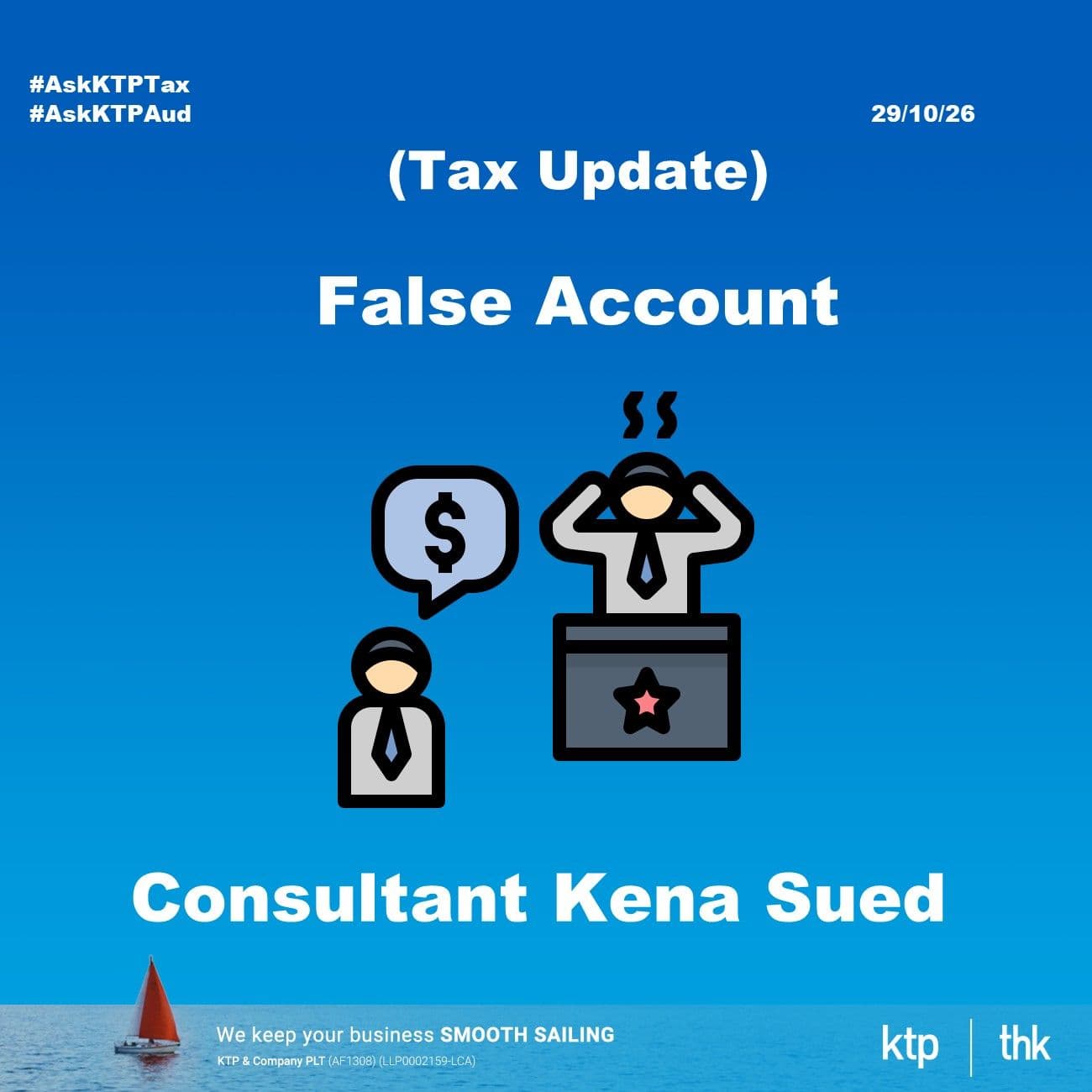
You Do Not Need a Director Title to Go to Jail for False Accounts
01The person who never signed
You are not on the board. Your name is not on the SSM register. You never sign the directors' report.
So when the numbers go wrong, it is not your problem. Right?
On 28 October 2026, the Securities Commission Malaysia (SC) announced that the Kuala Lumpur High Court had upheld the conviction of a former adviser to the board of a listed company for false financial statements. He was never a director of that company.
Responsibility for false accounts is usually pinned on directors. This case shows that the law looks at who gave the instruction, not who holds the title. For Malaysian SME owners, family business founders, and the "adviser" who still calls the shots from behind the scenes, it deserves a careful read.
02What happened
Lee Koon Huat was Adviser to the Board of Directors of Axis Incorporation Berhad. According to the SC, the evidence showed that he gave instructions to inflate Axis's revenue in its four unaudited quarterly results for the financial year ended 31 March 2007. Those results were furnished to Bursa Malaysia.
The case took 19 years from the quarters in question to the High Court's decision.
In March 2013, the SC charged three former executive directors of Axis over false revenue for FY2007 and FY2008. Days later, on 26 March 2013, it charged Lee with four counts of abetting Axis in furnishing false statements to Bursa Malaysia.
In July 2017, two of the former executive directors pleaded guilty under plea bargains and were jailed and fined.
On 11 April 2022, the Sessions Court convicted Lee on all four charges. He was sentenced to six months' imprisonment and a RM200,000 fine for each charge, with the jail terms to run concurrently.
In October 2026, the High Court dismissed his appeal and upheld the conviction and sentence. The jail term has been stayed, but the fine has not. He must pay a total of RM800,000 by 28 October 2026, or serve imprisonment in default.
All three former executive directors, Lee Han Boon, Saipuddin Lim Abdullah and Koh Tee Jin, eventually pleaded guilty. Their sentences ranged from one day to 12 months' imprisonment, with fines of RM200,000 each.
The SC said the decision reaffirms the importance of accuracy and integrity in financial reporting by listed companies.
03The offence: abetment, not authorship
Lee was not charged with preparing the false statements. He was charged with abetting the company in furnishing them.
The four charges were brought under section 122C(c) read together with section 122B(a)(bb) of the Securities Industry Act 1983 (SIA). Section 122B covers false or misleading statements furnished to the stock exchange. Section 122C(c) extends liability to a person who abets the offence.
When he was charged in 2013, the SC stated that each charge carried a maximum fine of RM3 million, imprisonment of up to 10 years, or both.
The point is simple. He did not need to key in a single number. Giving the instruction was enough.
The SIA has since been repealed and replaced by the Capital Markets and Services Act 2007, which governs listed issuers today. Most SMEs are not listed, so the more relevant question is what the Companies Act 2016 and the Income Tax Act 1967 say about the same behaviour.
04Companies Act 2016: there is no "title test"
The Axis offences predate the Companies Act 2016 (CA 2016) and were prosecuted under securities law. But if you run a Sdn Bhd today, three provisions apply the same logic to you.
Section 2: the shadow director. Under CA 2016, "director" includes any person occupying the position by whatever name called, and a person in accordance with whose directions or instructions the majority of directors are accustomed to act (SSM, Company Directors' Responsibilities). An "adviser", "chairman emeritus" or founding parent whose instructions the board routinely follows may be a director in law, with the duties that come with it.
Section 248: true and fair. Directors must ensure the company's financial statements give a true and fair view of its financial position and performance. Inflating revenue, or suppressing it, fails that test regardless of who asked for it.
Section 591: false or misleading statements. It is an offence to make, or authorise the making of, a statement that a person knows is false or misleading. On conviction, the penalty is imprisonment of up to 10 years, a fine of up to RM3 million, or both (SSM). Note the word "authorise". The person who instructs is within reach, not only the person who signs.
Section 245 adds the foundation: the company must keep accounting records that sufficiently explain its transactions and financial position, and retain them for seven years. False results usually start with records that were never right.
05Income Tax Act 1967: false accounts do not stay in the annual report
Axis inflated its revenue to look better to the market. In SMEs, the pressure usually runs the other way: revenue understated to pay less tax. Either way, the same accounts flow into Form C, and the Income Tax Act 1967 (ITA) has its own version of "abetment".
Section 82: records. Every person carrying on a business must keep sufficient records to ascertain income, and retain them for seven years.
Section 113(2): incorrect returns. Where a return understates income, a penalty equal to the amount of tax undercharged may be imposed in lieu of prosecution.
Section 114(1) and (1A): wilful evasion and assisting. Section 114(1) targets wilful evasion of tax. Section 114(1A) reaches any person who assists in, or advises on, the preparation of a return that results in an understatement of tax. LHDN's Public Ruling No. 8/2000 explains how these provisions apply. The adviser who says "just leave that out" is exposed, as we discussed in our recent piece on the Penang accountant charged under section 114(1A).
Section 75A: directors' personal liability. Directors can be held jointly and severally liable for the company's unpaid tax. For this purpose, section 75A(2) defines a director as a person who occupies the position by whatever name called, is involved in management, and owns directly or indirectly at least 20% of the ordinary share capital (Public Ruling No. 2/2019). Once again, the label on your business card is not the test.
06What this means for you
- If you give the instructions, you carry the risk. Adviser, consultant, chairman, or "the boss's father": the law asks what you did, not what you are called.
- If you follow the instructions, you are not shielded either. All three Axis executive directors pleaded guilty. "I was told to" did not keep them out of court.
- Unaudited numbers count. The Axis charges related to unaudited quarterly results. Management accounts handed to a bank, an investor or LHDN are not "just drafts".
- Inflating and suppressing are both wrong. Revenue recognition follows MFRS 15 or Section 23 of the MPERS, not the year's target or the year's tax bill.
- Put roles in writing. If someone advises your board, document the scope of the role and record board decisions properly, so it is clear who decided what.
- Time does not erase it. These were FY2007 numbers. The appeal was decided in 2026.
This article is general information and does not constitute legal, tax or audit advice for any specific situation. This article was prepared with the assistance of AI tools and reviewed by a licensed professional before publication.
07Sources
- SC: Former Adviser of Axis Incorporation Bhd Sentenced to Six Months Jail and Fine of RM800,000 (11 April 2022)
- SC: SC Charges Former Advisor of Axis Incorporation Bhd (26 March 2013)
- SC: Axis' Former Executive Directors Jailed for Furnishing False Statements (10 July 2017)
- SSM: Company Directors' Responsibilities booklet
- LHDN Public Ruling No. 8/2000: Wilful Evasion of Tax and Related Offences
- LHDN Public Ruling No. 2/2019: Director's Liability
In many Malaysian family businesses, the real decision maker is not on the board. It is the founder who "retired", the uncle who "advises", or the investor who "just helps out".
That arrangement feels informal. The law does not treat it that way.
The Axis case is a reminder that liability follows conduct. If you shape the numbers, you own the numbers. If you sign numbers someone else shaped, you own them too.
The fix is not complicated. Keep proper records. Recognise revenue by the standard, not by the mood. Let the people who decide also be the people who are accountable.
Clean accounts are not only a compliance exercise. They are the cheapest insurance you will ever buy.
Come say hello.
Two firms in the heart of Taman Molek, Johor Bahru.
KTP & Company PLT
Wisma KTP, 53, 53-01 & 53-02, Jalan Molek 1/8, Taman Molek, 81100 Johor Bahru, Johor, Malaysia