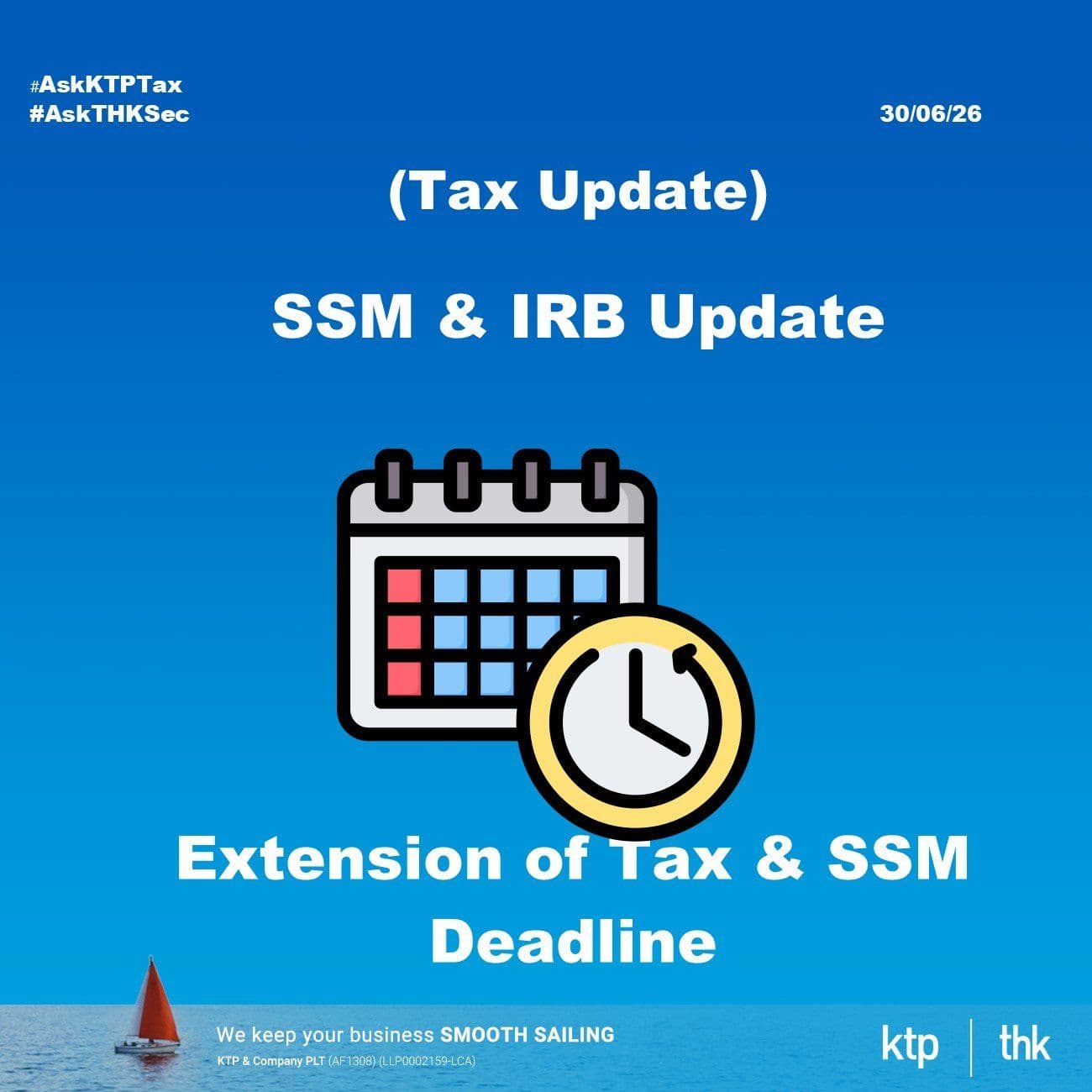
(TAX UPDATE) Two Extension Reliefs from SSM & LHDN 2026
01Introduction
A client called me last month, a little embarrassed. He had found a tenancy agreement from 2023, signed, filed, and never stamped. He wanted to know how bad it was going to be.
It is a familiar conversation. You sign the document, you move on to the next deal, and the stamping quietly slips. The same thing happens with annual lodgements. The business runs, the deadline passes, and the penalty starts counting in the background while you are busy doing the work that actually pays.
Here is the good news for that client, and possibly for you. Two announcements have just turned those forgotten documents from a liability into a short, deliberate piece of housekeeping.
The first is from the Inland Revenue Board, on stamp duty. The second is from SSM, on late annual lodgements. They cover different documents and different penalties, but they share a shape. Each one suspends a penalty you would otherwise owe, each one runs for a fixed period, and each one closes the door the moment that period ends.
One gives you until the end of the year. The other gives you two months. Both reward the people who move early, and both leave the people who wait paying in full. The difference between a clean file and a penalty notice, in many cases, will simply be whether you acted inside the window.
So it is worth knowing exactly what each relief covers, who qualifies, and by when. Here is what changed, and what you should do about it.
021. Stamp duty: the SVDP has been extended to 31 December 2026
The Inland Revenue Board (IRB) has issued a media release on the extension of the Special Voluntary Disclosure Programme (SVDP) for stamp duty. The programme was originally set to run from 1 January 2026 to 30 June 2026. It now runs to 31 December 2026.
The benefit is straightforward and it is worth real money. Under the SVDP, the late stamping penalty, being RM100 or 20% of the deficient duty whichever is higher, is fully remitted, provided the stamp duty itself is paid within the SVDP period. You pay the duty you owed. You do not pay the penalty for being late.
The qualifying conditions have not changed. The SVDP applies to:
- unstamped chargeable instruments executed between 1 January 2023 and 31 December 2025; and
- instruments executed during that same period that have been presented for stamping, but for which the stamp duty and late stamping penalty remain unpaid.
The extension does more than buy time. It gives you room to review your documentation properly and to consider the appropriate technical treatment before you stamp, which matters given the complexity of the legislation and the interpretation issues that come with it. Stamping the wrong instrument the wrong way is not a saving.
The practical point: identify every chargeable instrument from this three year window, decide the correct treatment, and pay the duty before the year closes to secure full remission of the penalty.
032. SSM: a narrow penalty exemption for late AR and AFS lodgements
SSM has announced a special exemption on late lodgement penalties for Annual Returns (AR) and Annual Financial Statements (AFS) submitted via MBRS 2.0. The intent is to ease the compliance burden on companies during the peak implementation period of the new CRS.
This one is more conditional than the stamp duty SVDP, so read it carefully before you assume you qualify.
The exemption applies only to lodgements made between 1 July 2026 and 31 August 2026. It covers delays that are more than 7 days but not more than 3 months from the statutory due date under the Companies Act 2016 (CA2016) and Practice Directive 1/2017 (PD 1/2017). It applies to both private and public companies, but only to the first tier of penalties.
Two things sit outside the exemption. Delays exceeding 3 months are not covered and attract the full penalty as prescribed in PD 1/2017. And lodgements made after 31 August 2026 are not covered, even where the length of the delay would otherwise have qualified.
In other words, two conditions must both be true. The delay must fall within the 7 day to 3 month band. The lodgement must happen inside the window.
The statutory deadlines, for reference
- AR, private and public: within 30 days from the anniversary of the incorporation date.
- AFS, private: within 30 days from the date of circulation to members. Circulation must be within 6 months of the financial year end (FYE).
- AFS, public: within 30 days from the date of the AGM. Circulation must be at least 21 days before the AGM.
Scenarios that show how it works
Take a private company filing an AR. The incorporation anniversary is 1 May, so the AR is due on 31 May 2026. It is lodged on 15 July 2026, a delay of 46 days. The delay sits under 3 months and the lodgement falls inside the window, so the penalty is exempted.
Take a private company filing an AFS. The FYE is 31 December 2025, the accounts are circulated on 30 June 2026, and the AFS is due on 30 July 2026. It is lodged on 20 August 2026, a delay of 21 days. The delay is under 3 months and the lodgement is inside the window, so the penalty is waived.
04KTP View
These two reliefs reward the same behaviour: act early, and act deliberately.
The stamp duty SVDP gives you the longer runway, to 31 December 2026, and the cleaner benefit, a full remission of the late penalty if you pay the duty in time. Use the runway to get the technical treatment right, not just to delay. Start by pulling every chargeable instrument executed from 1 January 2023 onward and asking the simple question: is it stamped, and is it stamped correctly.
The SSM exemption is the tighter one, and the easier one to misread. Do not assume a short delay qualifies. The two months from 1 July to 31 August 2026 are the only two months that count, and 31 August is a hard line. If you have overdue ARs or AFSs sitting in that 7 day to 3 month band, lodge them inside the window. If a delay is already past 3 months, the exemption will not help, and the answer is to lodge anyway and manage the full penalty under PD 1/2017.
This article is general information only and is not advice for any specific person, company, or transaction. The reliefs described carry conditions and deadlines set by the IRB and SSM. Please confirm the position against the IRB media release, SSM announcement, and the relevant primary sources before acting, or speak to us.
Visit Us
- Wisma KTP, 53 Jalan Molek 1/8, Taman Molek, 81100 Johor Bahru
- Wisma THK, 41, Jalan Molek 1/8, Taman Molek, 81100 Johor Bahru
KTP (Audit, Tax, Advisory)
An approved audit firm and licensed tax firm operating under the KTP group based in Johor Bahru providing audit, tax planning, advisory and compliance services to clients
- Website www.ktp.com.my
- Instagram https://bit.ly/3jZuZuI
- Linkedin https://bit.ly/3sapf4l
- Telegram http://bit.ly/3ptmlpn
THK (Secretarial, Bookkeeping, Payroll, Advisory)
A licensed secretarial firm in Johor Bahru providing fast reliable incorporation, secretarial services, corporate compliance services, outsourcing bookkeeping, and payroll services to clients
- Website www.thks.com.my
- Facebook https://bit.ly/3nQ98rs
KTP Lifestyle
An internal community for our colleagues on work and leisure.
- Tiktok http://bit.ly/3u9LR6Q
- Youtube http://bit.ly/3ppmjyE
- Facebook http://bit.ly/3ateoMz
- Instagram https://bit.ly/3jZpKLo
KTP Career
An external job community on vacancies in Johor Bahru for interns, graduates & experienced candidates.
- Instagram https://bit.ly/3u2PxHg
- Facebook http://bit.ly/3rPxz9o
Come say hello.
Two firms in the heart of Taman Molek, Johor Bahru.
KTP & Company PLT
Wisma KTP, 53, 53-01 & 53-02, Jalan Molek 1/8, Taman Molek, 81100 Johor Bahru, Johor, Malaysia