(TAX UPDATE) Tax Exemption on Employee Allowances: When Directors and Shareholders May Not Qualify
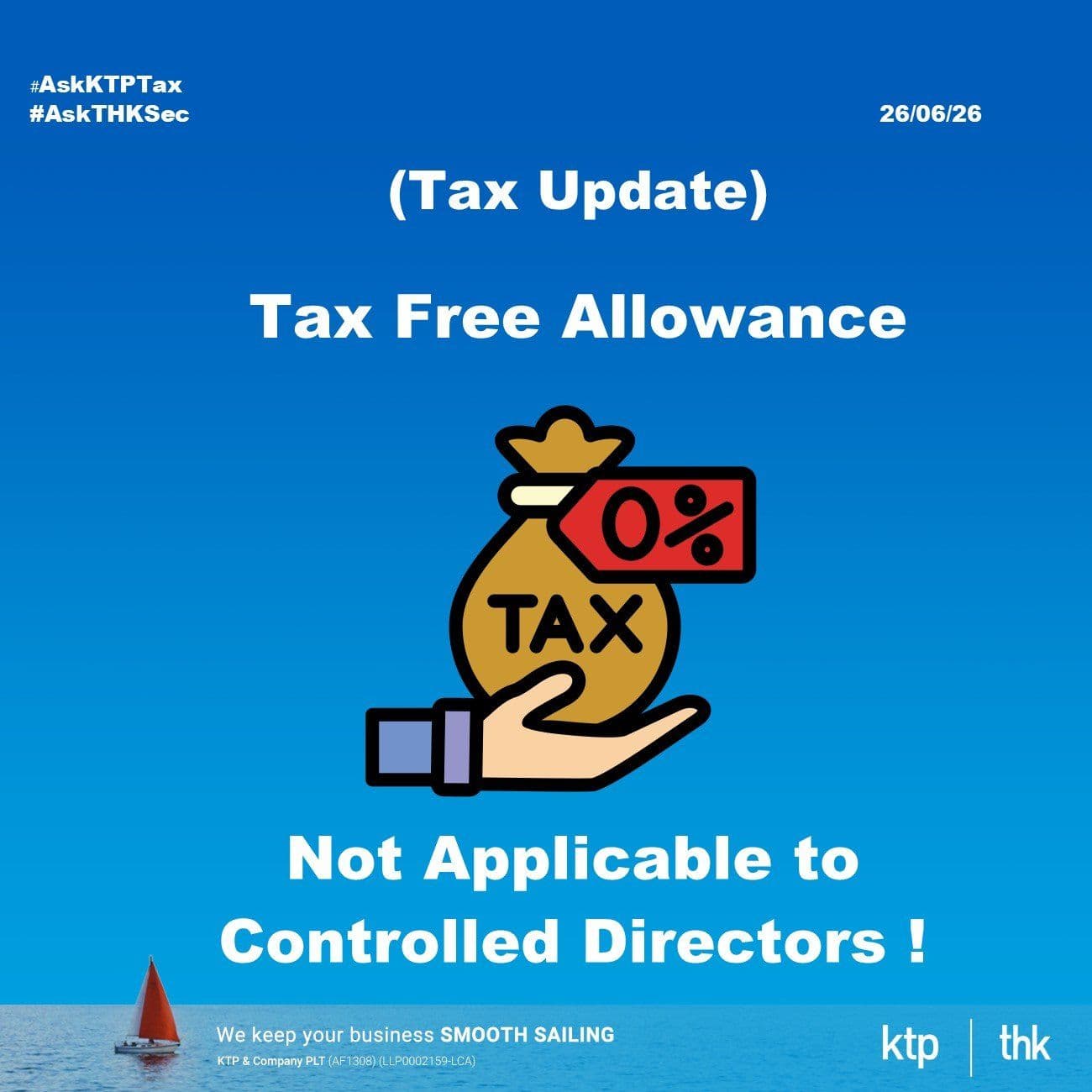
Lessons from Lam Kam Wing v Ketua Pengarah Hasil Dalam Negeri
01Introduction
Employee allowances are common in many Malaysian SMEs.
Meal allowance.
Petrol allowance.
Childcare allowance.
Telephone allowance.
To many business owners, these allowances may look simple and routine. In some cases, they may even be treated as tax exempt employee benefits.
However, the Court of Appeal decision in Lam Kam Wing v Ketua Pengarah Hasil Dalam Negeri is an important reminder that tax exemption is not automatic, especially where the employee is also a director or shareholder of the company.
This case is particularly relevant for SME directors, shareholders, payroll teams and finance managers who provide allowances to directors or key management personnel.
The key issue was simple but important:
Can a managing director who owns shares in the employer company enjoy tax exemption on certain employee allowances?
The Court’s answer was not favourable to the taxpayer on the tax exemption issue.
However, the Court also made an important distinction between an incorrect tax position and intentional tax evasion.
02Background of the Case
The taxpayer, Lam Kam Wing, was the Managing Director of Tasmanco Consultancy Services Sdn Bhd.
He held 30% of the shares in the company.
For the Years of Assessment 2011 and 2012, he received annual allowances of RM14,400, comprising food, petrol, parking and telephone allowances. The company treated these allowances as tax exempt under the Income Tax (Exemption) Order 2009.
Following an LHDN audit on the company’s Scheduled Tax Deduction records for YA 2011 to YA 2013, LHDN found that the allowances had not been included in the company’s STD computation. LHDN took the position that the taxpayer was not entitled to the exemption because the Exemption Order did not apply to him under Paragraph 3.
LHDN then raised Notices of Additional Assessment for YA 2011 and YA 2012. The additional tax payable was RM5,011.20 for each year, including a 45% penalty imposed under Section 113(2) of the Income Tax Act 1967.
03Related Public Ruling
The relevant LHDN guidance is Public Ruling No. 5/2019, Perquisites From Employment, issued on 19 November 2019.
The Public Ruling explains the tax treatment of perquisites received by employees, including allowances and benefits provided by the employer.
For this case, the important point is that certain perquisites or allowances may be exempted, subject to the relevant conditions and limits. These may include items such as parking allowance, meal allowance, petrol allowance, travelling allowance or other employment-related benefits.
However, the exemption must not be read in isolation.
The important restriction is where the employee has control over the employer company.
This was the heart of the dispute in Lam Kam Wing.
The dispute was not whether meal, petrol, parking and telephone allowances can generally be exempt.
The real issue was whether the taxpayer, being the Managing Director and 30% shareholder, had “control” over the company under the Income Tax (Exemption) Order 2009.
The Court of Appeal agreed with LHDN that he had control over the employer company. Therefore, the exemption did not apply to him.
In simple terms:
Normal employee may qualify.
Director-shareholder with control may not qualify.
That is the tax trap.
04Taxpayer’s Position
The taxpayer argued that he did not have “control” over Tasmanco.
Although he was the Managing Director and a shareholder, he maintained that his 30% shareholding did not amount to control over the company.
On this basis, he argued that the allowances received should qualify for tax exemption under the Income Tax (Exemption) Order 2009.
The taxpayer also disputed the penalties imposed by LHDN.
His position was that there was no intention to mislead or deceive LHDN. In other words, even if the tax treatment was incorrect, it should not automatically be treated as a case of intentional tax evasion.
05LHDN’s Position
LHDN argued that the wording of the Exemption Order was clear and unambiguous.
Under Paragraph 3(a)(i), the exemption would not apply where the employee has control over the employer company through the holding of shares in the company.
LHDN took the view that the taxpayer had control over the company because he was both:
- The Managing Director; and
- The largest shareholder at the material time.
Therefore, LHDN argued that the allowances were not exempt from tax.
LHDN also took the position that the taxpayer had under-declared his income, and penalties under Section 113(2) were justified.
06Decision of the Court of Appeal
The Court of Appeal allowed the taxpayer’s appeal in part.
On the tax exemption issue, the Court agreed with LHDN.
The Court held that the taxpayer had “control” over the company as he was the largest shareholder and would be entitled to a greater part of the company’s assets. Accordingly, the allowances claimed by the taxpayer were not exempt under Paragraph 3(a)(i) of the Exemption Order.
As a result, the additional assessments for YA 2011 and YA 2012 were upheld.
However, on the penalty issue, the Court decided in favour of the taxpayer.
The Court set aside the 45% penalty imposed under Section 113(2) of the Income Tax Act 1967. The Court found that the taxpayer did not intend to deceive LHDN. His failure to declare the allowances was based on his interpretation of Paragraph 3(a)(i) of the Exemption Order 2009, although that interpretation was ultimately incorrect.
The Court also noted that the return, although incorrect, was not fraudulent or dishonest. Therefore, the penalty was set aside.
No order as to costs was made.
07Key Tax Takeaways for SMEs
1. Tax exemption on employee allowances is not automatic
Many SME companies provide allowances to directors and employees.
However, whether an allowance is tax exempt depends on the specific exemption provision and whether the employee falls within any exclusion.
A director or shareholder should not assume that the same exemption available to normal employees will automatically apply to him or her.
2. Ownership and management role matter
This case highlights that LHDN and the Court may look at the overall facts.
Being a shareholder alone may not always be conclusive. Being a director alone may also not always be conclusive.
However, where a person is both a director and significant shareholder, the risk becomes higher.
For private companies, especially family-owned SMEs, this is a common situation.
3. Payroll treatment must be reviewed carefully
The issue arose from an LHDN audit on Scheduled Tax Deduction records.
This is a useful reminder that payroll reporting is not merely an administrative matter.
If allowances are wrongly treated as exempt, there may be exposure to:
- Additional tax;
- PCB or MTD issues;
- Penalties; and
- Audit queries from LHDN.
Companies should review the tax treatment of director allowances, benefits-in-kind, reimbursements and fixed monthly allowances.
4. Wrong tax treatment does not always mean tax evasion
This is an important point.
The Court upheld the additional assessments, meaning the tax was still payable.
However, the Court set aside the penalties because there was no evidence of intentional deception.
This distinction is important.
A genuine tax dispute or incorrect interpretation of the law may still result in additional tax. But penalty treatment should depend on the facts, conduct, documents and intention of the taxpayer.
08Practical Action Points for SME Directors
SME directors and finance teams should consider the following:
- Review all allowances paid to directors and shareholders.
- Check whether the employee has “control” over the employer company.
- Do not assume that allowances are exempt simply because they are common in the market.
- Ensure payroll and PCB treatment is properly reviewed.
- Keep proper documentation on the basis of tax treatment.
- Seek clarification where ownership, directorship and employment overlap.
09KTP Comments
This case should be read together with Public Ruling No. 5/2019, Perquisites From Employment.
The Public Ruling provides useful guidance on the tax treatment of employment perquisites, including allowances and employee benefits.
However, SME directors should not read the exemption list alone and stop there.
The more important question is:
Who is receiving the allowance?
If the recipient is an ordinary employee, the exemption may apply, subject to the prescribed conditions.
But if the recipient is also a director, shareholder or person who has control over the employer company, the exemption may be denied.
This is common in SME companies.
The same person is the boss.
The same person is the director.
The same person is the shareholder.
The same person is also receiving “employee allowance”.
From a business angle, this may look normal.
From a tax angle, this may create exposure.
The lesson from this case is clear. Director remuneration planning should not only focus on salary, bonus and dividend.
Getting the tax treatment wrong can result in additional tax.
But, as the Court of Appeal highlighted, an incorrect tax position does not automatically mean there was intentional tax evasion.
That difference is important when penalties are imposed.
Disclaimer: The contents of this article are for general information only and do not constitute professional advice. Legislation, regulatory guidelines, and market practice may change after the date of publication. KTP Group of Companies accepts no liability for reliance placed on this material. Please consult a qualified professional before acting on any matter discussed.
Visit Us
- Wisma KTP, 53 Jalan Molek 1/8, Taman Molek, 81100 Johor Bahru
- Wisma THK, 41, Jalan Molek 1/8, Taman Molek, 81100 Johor Bahru
KTP (Audit, Tax, Advisory)
An approved audit firm and licensed tax firm operating under the KTP group based in Johor Bahru providing audit, tax planning, advisory and compliance services to clients
- Website www.ktp.com.my
- Instagram https://bit.ly/3jZuZuI
- Linkedin https://bit.ly/3sapf4l
- Telegram http://bit.ly/3ptmlpn
THK (Secretarial, Bookkeeping, Payroll, Advisory)
A licensed secretarial firm in Johor Bahru providing fast reliable incorporation, secretarial services, corporate compliance services, outsourcing bookkeeping, and payroll services to clients
- Website www.thks.com.my
- Facebook https://bit.ly/3nQ98rs
KTP Lifestyle
An internal community for our colleagues on work and leisure.
- Tiktok http://bit.ly/3u9LR6Q
- Youtube http://bit.ly/3ppmjyE
- Facebook http://bit.ly/3ateoMz
- Instagram https://bit.ly/3jZpKLo
KTP Career
An external job community on vacancies in Johor Bahru for interns, graduates & experienced candidates.
- Instagram https://bit.ly/3u2PxHg
- Facebook http://bit.ly/3rPxz9o
Come say hello.
Two firms in the heart of Taman Molek, Johor Bahru.
KTP & Company PLT
Wisma KTP, 53, 53-01 & 53-02, Jalan Molek 1/8, Taman Molek, 81100 Johor Bahru, Johor, Malaysia