HASiL Has Started Thinking With AI. Is Your Tax Function Ready?
01Two announcements, one message
On 3 November 2026, HASiL marked its 2026 Innovation and Integrity Day in Cyberjaya. Two things happened on the same stage.
First, the Prime Minister presented Tax Corporate Governance Framework (TCGF) certificates to companies recognised for strong tax governance.
Second, HASiL unveiled the AI tools it now uses to run tax administration. One of them, built on MyInvois e-Invoice data, has already flagged more than 7,700 potential tax risk cases for audit and investigation.
Read those two together and the message is clear. HASiL is sorting taxpayers into two groups. Those who can show their tax house is in order. And those its machines will find first.
The question for you is simple. Which group is your business in?
02What a TCGF certificate actually signals
A TCGF certificate tells HASiL that a company manages its tax risk through a documented, tested system, not through goodwill and a busy finance manager.
HASiL launched the Tax Corporate Governance (TCG) programme on 1 March 2022. The framework follows the OECD's cooperative compliance model and rests on six principles:
- Tax strategy established
- Applied comprehensively
- Responsibility assigned
- Governance documented
- Testing performed
- Assurance provided
The framework covers the taxes HASiL administers, including corporate income tax, RPGT, MTD, withholding tax, stamp duty, transfer pricing and tax incentive conditions.
The programme has not stood still. The TCGF Guidelines were updated to 1 December 2025, replacing the Annual Review with an Annual Risk Assessment. Participants now go through a three year monitoring period. HASiL assesses risk each year, reviews an annual self-declaration letter, and expects material transactions to be disclosed proactively, in real time. Investment holding companies can also now join when they participate together with their subsidiaries or associates.
HASiL describes the programme as a filter. Companies with strong tax governance are identified as low risk. Enforcement effort then goes where it is needed most.
Today, participation is focused on large companies. HASiL's stated direction to 2030 is to widen participation and move toward real time, data based compliance.
03The five AI tools HASiL now works with
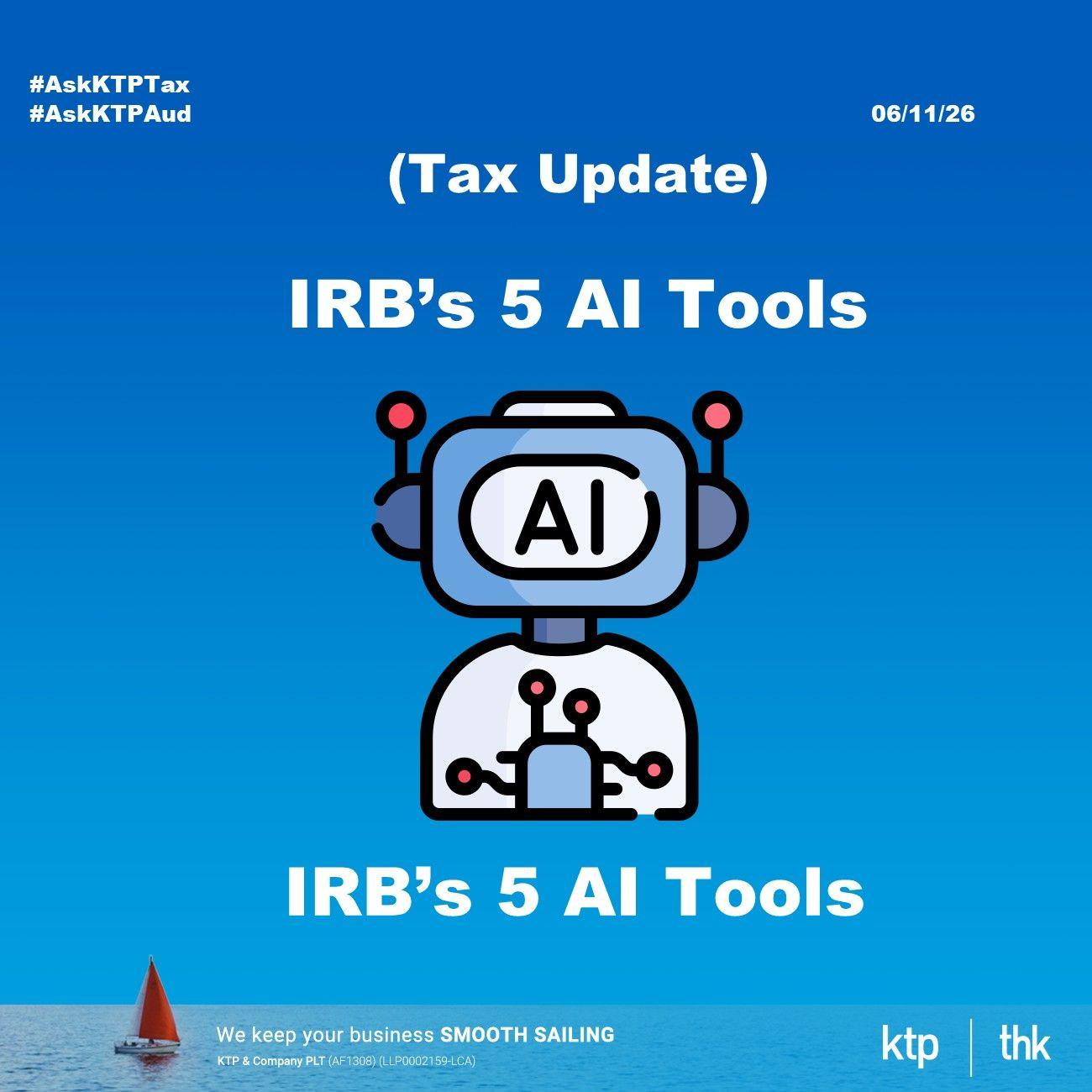
Four of the five tools are about finding risk. Only one is about answering your questions.
1. HAFY TaxAssist: the friendly front door
HAFY TaxAssist is a chatbot powered by conversational AI. It gives taxpayers tax information and guidance around the clock.
Who uses it: the public. HAFY TaxAssist is open to every taxpayer. It sits in the bottom right corner of the HASiL website, where HASiL's Live Chat has now been merged with the chatbot. HAFY answers first. If it cannot resolve your issue, the session is passed to a human consultant, available 9am to 4pm, Monday to Friday, excluding public holidays. It builds on Tanya HAFY, the self-service enquiry platform that replaced Tanya@HKC in January 2026.
This is the one tool built mainly for you, not about you. Questions that used to need a phone call or a branch visit, such as which form to file, when a deadline falls, or how to use MyTax, can now be answered at 11pm on a Sunday.
But be clear about what a chatbot is. It gives general information. It does not know your full facts, and it does not sign off on your tax position.
Treat a HAFY answer as a starting point, not as a position you can defend at audit. If the answer affects how much tax you pay, check it against the Act and the relevant Public Ruling, or ask a licensed tax agent. And keep a screenshot of anything you rely on.
2. IRIM: the document reader
The Instrument Recognition and Intelligence Model (IRIM) identifies the type of document or instrument in front of it, then determines the stamp duty rate based on what the document actually contains.
Who uses it: HASiL. IRIM is described as HASiL's own tool for classifying instruments and setting duty. HASiL has not announced it as a self-service tool for taxpayers. You will feel its effect through the duty assessed on your documents, not by logging in to it.
Stamp duty has always been charged on the instrument, not on what the parties call it. What changes now is scale and consistency. A machine reading every document the same way will not be swayed by a convenient title.
Picture this. Your company signs a "service agreement" with a related party. Buried in clause 9 is a right to occupy premises for three years at a fixed monthly sum. A human officer under time pressure might accept the title. A model trained to read content may classify it as a lease, with a different duty outcome.
The same logic applies to side letters, supplementary agreements, and documents that combine several transactions in one.
What you should do: draft for substance. If a document does two things, know which duty each part attracts. Have tenancy, loan, share transfer and employment documents reviewed before signing, not after HASiL asks.
3. Behavioural Analytics: the peer comparison
Behavioural Analytics analyses the patterns and behaviour of different taxpayer groups. It uses information in HASiL's data warehouse to identify high risk groups, so monitoring and compliance work can be targeted.
Who uses it: HASiL only. This is an internal risk profiling tool running on HASiL's data warehouse. Taxpayers cannot see it, query it, or see their own score.
In plain terms, you are no longer judged alone. You are judged against businesses that look like you.
If most hardware wholesalers in Johor report a gross margin within a certain band and yours sits far below it, that gap becomes a signal. So can a sudden drop in declared profit, a director fee that does not match the size of the business, or a pattern of late filing.
A signal is not an assessment. Many businesses have good reasons to look different: a lost major customer, a one off write down, a deliberate price war to gain market share.
What you should do: know your key ratios and how they compare with your industry. When a year looks unusual, write down why while the facts are fresh, and keep the evidence on file. A clear explanation prepared in March is far more convincing than one reconstructed during an audit two years later.
4. Next Best Action Predictive Model: the collector's playbook
The Next Best Action Predictive Model helps HASiL decide the most appropriate collection action for taxpayers with outstanding tax arrears. It looks at the taxpayer's financial profile, compliance record and behavioural patterns.
Who uses it: HASiL only. This is an internal decision tool for HASiL's collection officers. You will not see the model, only the action it recommends, whether that is a reminder, a WhatsApp notification on arrears, or something firmer.
The model does not create new powers. HASiL's collection tools already sit in Part VII of the Income Tax Act 1967. Two of the firmest are worth knowing.
Under Section 104, the Director General may issue a certificate to the Immigration Department to stop a person from leaving Malaysia until the outstanding tax is paid or security is given. HASiL explains how it applies this in Public Ruling No. 4/2022, Recovery from Persons Leaving Malaysia.
Under Section 106, tax that is due and payable can be recovered by the Government through civil proceedings in court. Section 106(3) limits the defences a taxpayer can raise against the amount claimed in that suit. Disputes over the assessment itself belong in the appeal process, not in the recovery action.
What the model adds is judgement on which step to take, and when.
That means two taxpayers with the same arrears may be treated very differently. One with a long record of paying on time and engaging early may get a gentler path. One with a pattern of silence and missed instalments may move faster toward firmer action.
What you should do: if you cannot pay on time, do not go quiet. Engage HASiL early, propose an instalment arrangement, and keep to it. Your compliance history is now data, and that data shapes what happens next.
5. MyInvois Advanced Analytics and Anomaly Detection: the one already producing cases
This model harnesses e-Invoice data from MyInvois. It has already identified more than 7,700 potential tax risk cases that require audit and investigation intervention.
Who uses it: HASiL only. The analytics layer is internal. What you do see is the MyInvois portal itself, where your e-invoices are submitted and validated. Everything you submit there is the raw material this model works on.
That number tells you this is not a pilot. It is live, and it is feeding real cases to HASiL officers.
The scale of the data explains why. The Prime Minister said 2.14 billion e-invoices had been submitted as of 2 November 2026. Every one of those is a transaction HASiL can see, close to when it happened, without waiting for your annual return.
Now think about what an anomaly looks like. Sales in MyInvois that are higher than revenue in your tax return. A supplier issuing e-invoices to you that you never claimed, or claimed twice. A large cluster of cancelled e-invoices near year end. Consolidated e-invoices that do not line up with your cash takings.
Each of these may have an innocent explanation. Each of them is also exactly the kind of mismatch a model is built to flag.
What you should do: reconcile MyInvois to your general ledger every month, not just at year end. Investigate cancellations and credit notes. And make sure the revenue in your return can be traced back, line by line, to what your e-invoices already told HASiL.
The pattern behind the five
Look at the five tools together. One helps you ask questions. Four help HASiL find risk, read documents, compare peers and choose enforcement steps.
The direction is clear. HASiL is moving from checking a sample of returns after the fact, to watching data continuously and acting on what stands out.
HASiL's CEO, Datuk Dr Abu Tariq Jamaluddin, framed it plainly. AI lets HASiL move away from conventional compliance approaches toward proactive, targeted and data based methods.
The context matters too. HASiL audited and investigated 408,726 cases this year, raising about RM7.7 billion in additional assessments. Focus areas included high net worth individuals, aggressive tax planning, transfer pricing, e-Invoice data and overseas account information.
04What this means for Malaysian SMEs
You may never apply for a TCGF certificate. You will still be read by the same machines.
The TCG programme targets large companies today. The AI tools do not. MyInvois data, peer comparisons and stamp duty reading apply to every taxpayer in the system. So the principles behind TCGF are worth borrowing, even at SME scale.
Five practical steps:
- Reconcile e-Invoice data to your books every month. What you submit to MyInvois and what you report in your return must tell the same story. Gaps are exactly what anomaly detection looks for.
- Write down who owns tax. Name the person responsible for each tax type, from MTD to SST to withholding tax. One page is enough to start.
- Know your numbers against your peers. If your margins sit well outside your industry, keep the commercial explanation on file before anyone asks.
- Draft agreements for substance. With IRIM reading content, stamp duty follows what the document does, not what it is called. Have tenancy, loan and share transfer documents reviewed before signing.
- Test your controls once a year. A short internal review of filings, payments and deadlines is the SME version of Principles 5 and 6.
None of this is new law. It is the same law, now enforced with better eyesight.
Sources
- The Edge via KLSE Screener, 3 November 2026: IRB RM7.7 bil in additional assessments after auditing 408,726 cases
- The Star, 4 November 2026: Over RM7bil in extra taxes from LHDN audits
- HASiL, Hubungi Kami: Live Chat merged with HAFY TaxAssist
- Malay Mail, 15 January 2026: IRB launches WhatsApp service and Tanya HAFY
- Bernama, 5 May 2026: TCG LHDN Diperkasakan, Tambah Baik Kebolehcapaian Dan Perkenal Fasa Pemantauan
- HASiL media statement, 5 March 2024: TCGF Guidelines and FAQ
- Buzzkini, 23 December 2025: TCGF Guidelines updated to 1 December 2025
- HASiL TCGF FAQ: six principles
- Income Tax Act 1967, Part VII: Sections 103 to 107 arrangement
- Public Ruling No. 4/2022: Recovery from Persons Leaving Malaysia
This article is general information for educational purposes and is not tax advice on your specific circumstances. Please speak to a licensed tax agent before acting.
This article was drafted with AI assistance and reviewed by a licensed tax professional at KTP & Company PLT.
Reviewed by: [Koh Teck Peng], Licensed Tax Agent, KTP & Company PLT. Date: 6 Nov 2026
We welcome both announcements. Recognising good tax governance rewards companies that invest in doing things right. Using AI to target risk means compliant businesses should face fewer blunt, broad based audits.
But the burden of proof is shifting. In the past, a business with clean intentions and messy records could often explain itself at audit. In a data driven system, the data speaks first. Your explanation comes later, if at all.
For most SMEs, the gap is not intent. It is documentation. The returns are filed, the tax is paid, but nobody can show how the numbers were checked or who signed off.
Our advice is to start small and start now. Treat MyInvois as a mirror of your books, not a separate system. Put tax ownership in writing. And review your position once a year, before HASiL's models do it for you.
The companies on stage on 3 November did not get there by luck. They built a system. Yours can be smaller. It just needs to exist.
Come say hello.
Two firms in the heart of Taman Molek, Johor Bahru.
KTP & Company PLT
Wisma KTP, 53, 53-01 & 53-02, Jalan Molek 1/8, Taman Molek, 81100 Johor Bahru, Johor, Malaysia