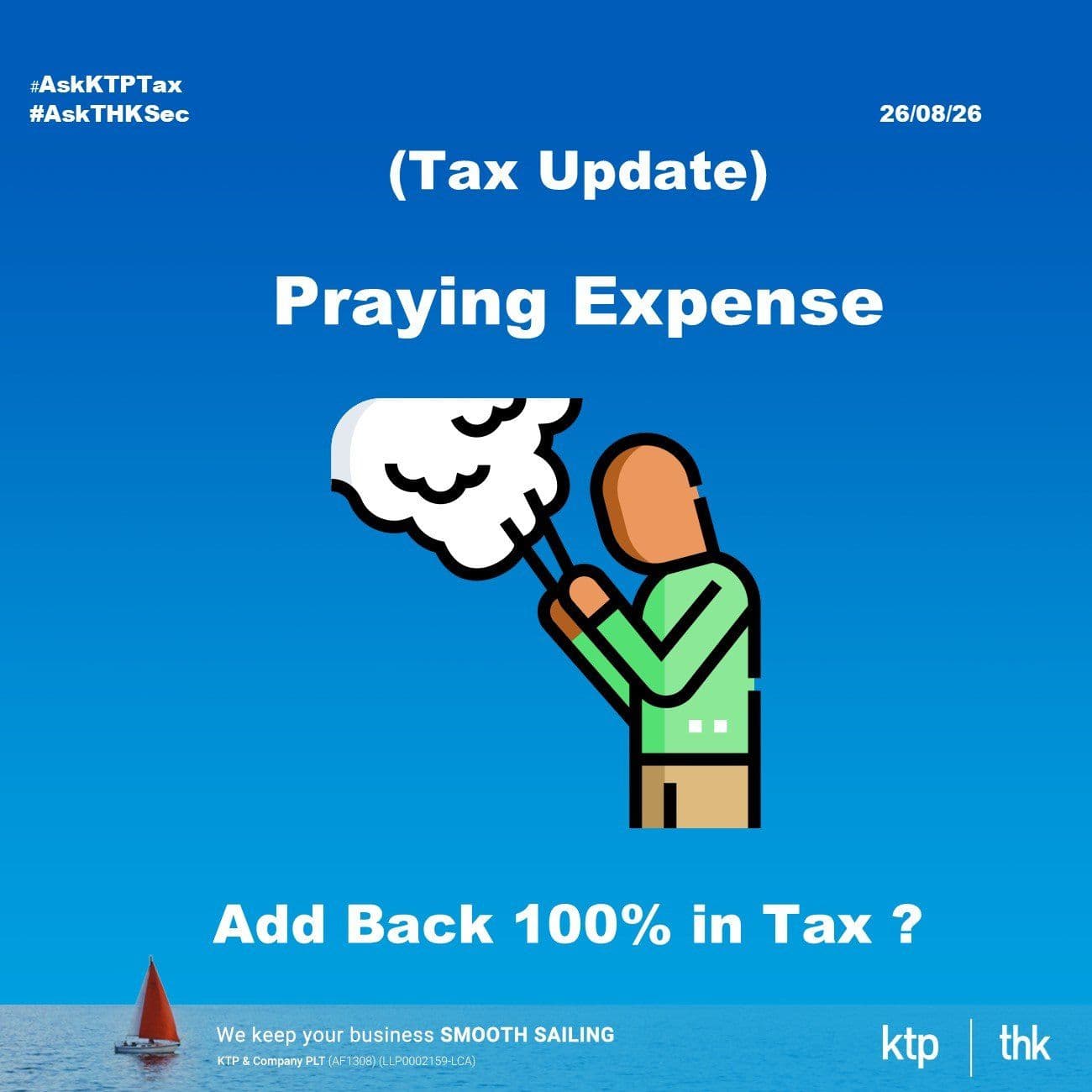
(TAX UPDATE) Hungry Ghost Festival Praying Expenses : What Your Company Can and Cannot Deduct
01Introduction
The seventh lunar month is here.
Walk through any industrial park in Johor Bahru this week and you will see it. A folding table outside the factory gate. Roast pork, oranges, three cups of tea. A metal drum for the joss paper. By evening, forty workers eating from aluminium trays under a canopy.
Two weeks later, the paperwork lands on your bookkeeper's desk. A tentage invoice. A caterer's bill. A handwritten receipt from the joss paper shop for RM3,800. A cash voucher marked "temple contribution".
Your bookkeeper opens one account, calls it Praying Expenses, and posts everything into it.
That single decision is what turns a routine cultural expense into an audit adjustment.
02There is only one test, and it is unforgiving
Section 33(1) of the Income Tax Act 1967 allows a deduction for outgoings and expenses wholly and exclusively incurred in the production of gross income.
Read those two words again. Wholly. Exclusively.
Then read Section 39(1)(a), which denies a deduction for any expenditure not wholly and exclusively laid out or expended for the purpose of producing gross income. Private and domestic expenditure sits squarely inside that prohibition.
Malaysian tax law does not have a line that says "religious observance is deductible" or "religious observance is not deductible". There is no Public Ruling on sembahyang expenses. What you have instead is a general deduction test and a general prohibition, and a Hungry Ghost Festival budget that contains items falling on both sides of it.
So stop asking whether the festival is deductible. Start asking which item, incurred for which purpose, for whose benefit.
03Split the basket into five parts
Food and drink provided to your employees
This falls within the definition of entertainment in Section 18 of the Act, which covers the provision of food, drink, recreation or hospitality.
Once an expense is entertainment, Section 39(1)(l) restricts it to 50 percent, unless it falls within provisos (i) to (viii). Proviso (i) covers the provision of entertainment to employees, and Public Ruling No. 4/2015 confirms that free meals, refreshments, annual dinners, outings and family days for employees qualify for a full 100 percent deduction.
So a prayer session dinner attended only by your staff is 100 percent deductible, provided the underlying Section 33(1) test is met.
The trap is in the same proviso. The 100 percent treatment is lost where the entertainment of employees is incidental to the provision of entertainment for others. Invite your main supplier, your banker, and three customers to the same dinner, and you have a mixed event. LHDN can treat the whole cost as ordinary business entertainment restricted to 50 percent.
If you want the full deduction, keep the guest list to employees and keep the attendance record.
Ceremonial items
Joss paper, incense, papercraft effigies, candles, and the offerings themselves.
This is the exposed part of the claim. These items are not consumed in your trading operations, they generate no identifiable business benefit, and they carry a strong personal and cultural character. In practice this is the category LHDN reaches for first, on the basis that the expenditure is not wholly and exclusively incurred in the production of gross income.
Be honest with yourself about the strength of your position here. There is no public ruling, no LHDN guidance note, and no reported Malaysian decision that puts this beyond argument either way. What that uncertainty means for you is practical: if you claim it, you should expect it to be questioned, and you should be able to state a business purpose that goes beyond "we have always done it".
Our default position is to add these items back in the tax computation. If your facts genuinely support a claim, document the reasoning at the time you incur the cost, not eighteen months later in an audit interview.
Payments to the temple, the medium, or the opera troupe
A cash contribution to your neighbourhood temple committee is not a deductible business expense, and it is not automatically a deductible donation either.
A donation only reaches the tax computation if it is made to an institution or organisation approved under Section 44(6) of the Act, supported by an official receipt from that body, and it is a deduction against aggregate income subject to the statutory cap, not a business expense under Section 33(1).
Check the approval before you write the cheque. LHDN publishes the list of approved bodies. A red packet handed to a temple committee member and recorded on an internal cash voucher will not survive review.
Payment to a getai operator or an opera troupe is a different question again. If the performance is genuinely open to the public and serves a promotional purpose for your business, proviso (v) to Section 39(1)(l) on entertainment for cultural or sporting events open to the public becomes relevant. That is a fact-specific argument, and it needs banners, photographs, and a promotional rationale to stand up.
Ordinary business costs that happen to occur during the festival
Tentage, lighting, chairs, cleaning, waste disposal, extra security, and premises maintenance.
These are not religious expenditure. They are ordinary operating costs, deductible under Section 33(1) on normal principles. Do not let them get swept into a single Prayer Expenses account and disallowed by association.
Cash given to workers
An ang pow or a festival allowance paid to an employee is not entertainment and not a gift in the tax sense. It is remuneration.
The company gets its deduction, but the amount belongs in the employee's Form EA, and Monthly Tax Deduction obligations follow. This is where a well intentioned gesture becomes an employer compliance failure two years later..
04Do this before the offerings are cleared away
Open five accounts, not one.
Staff refreshments and staff entertainment. Ceremonial and offering items. Donations and contributions. Premises and event logistics. Employee allowances.
Keep the attendance list for the dinner. Photograph the tentage. File the temple's Section 44(6) approval reference alongside its receipt, or accept that the payment is not deductible. Note the business purpose of any item you intend to claim, in writing, on the day.
Then have your tax agent decide what gets added back. Not your bookkeeper.
05KTP View
Every year we see the same file. One account, one lump sum, no breakdown, and a client who is surprised when a five figure amount is added back with a penalty on top.
The festival is not the problem. The accounting is.
Cultural expenditure sits at the hardest point in Malaysian deduction law, because the statutory test asks about purpose and the practice asks about evidence, and a folding table outside a factory gate produces very little of either. That is not a reason to stop observing the seventh month. It is a reason to spend fifteen minutes coding the invoices properly before they reach the ledger.
Split the basket. Claim what the law allows. Add back what it does not, before LHDN does it for you.
This article is general educational content on Malaysian tax principles. It is not advice on any specific taxpayer's circumstances and should not be relied on as such. Statutory positions and e-Invoice implementation dates change, so verify against the Income Tax Act 1967, LHDN Public Rulings, and the current LHDN e-Invoice Implementation Timeline before acting.
Visit Us
- Wisma KTP, 53 Jalan Molek 1/8, Taman Molek, 81100 Johor Bahru
- Wisma THK, 41, Jalan Molek 1/8, Taman Molek, 81100 Johor Bahru
KTP (Audit, Tax, Advisory)
KTP & Company PLT (AF1308) (LLP0002159-LCA)
An approved audit firm and licensed tax firm operating under the KTP group based in Johor Bahru providing audit, tax planning, advisory and compliance services to clients
- Website www.ktp.com.my
- Facebook http://facebook.com/www.ktp.com.my
- LinkedIn https://bit.ly/3sapf4l
- Telegram http://bit.ly/3ptmlpn
- Instagram https://bit.ly/3Rko5kN
- XiaoHongShu https://bit.ly/4fqV9Fb
𝐓𝐇𝐊 (𝐒𝐞𝐜𝐫𝐞𝐭𝐚𝐫𝐢𝐚𝐥, 𝐀𝐜𝐜𝐨𝐮𝐧𝐭/𝐏𝐚𝐲𝐫𝐨𝐥𝐥, 𝐀𝐝𝐯𝐢𝐬𝐨𝐫𝐲)
THK Management Advisory Sdn Bhd 200401000220 (638723X)
A licensed secretarial firm in Johor Bahru providing fast reliable incorporation, secretarial services, corporate compliance services, outsource booking, accounting and payroll services to clients
- Website www.thks.com.my
- Facebook https://bit.ly/42XKWsk
- Instagram https://bit.ly/42Uqf0e
- LinkedIn https://bit.ly/3EH885M
𝐊𝐓𝐏 𝐋𝐢𝐟𝐞𝐬𝐭𝐲𝐥𝐞
An internal community for our colleagues on work and leisure.
- Tiktok http://bit.ly/3u9LR6Q
- Youtube http://bit.ly/3ppmjyE
- Facebook http://bit.ly/3ateoMz
- Instagram https://bit.ly/3jZpKLo
- XiaoHongShu https://bit.ly/4fqV9Fb
𝐊𝐓𝐏 𝐂𝐚𝐫𝐞𝐞𝐫
An external job community on vacancy in Johor Bahru for interns, graduates & experienced candidates.
- Facebook http://bit.ly/3rPxz9o
- Instagram https://bit.ly/3u2PxHg
- XiaoHongShu https://bit.ly/4pIq5nL
Come say hello.
Two firms in the heart of Taman Molek, Johor Bahru.
KTP & Company PLT
Wisma KTP, 53, 53-01 & 53-02, Jalan Molek 1/8, Taman Molek, 81100 Johor Bahru, Johor, Malaysia