Budget 2027: Small Value Assets Limit Raised to RM3,000. What It Means for Your Business
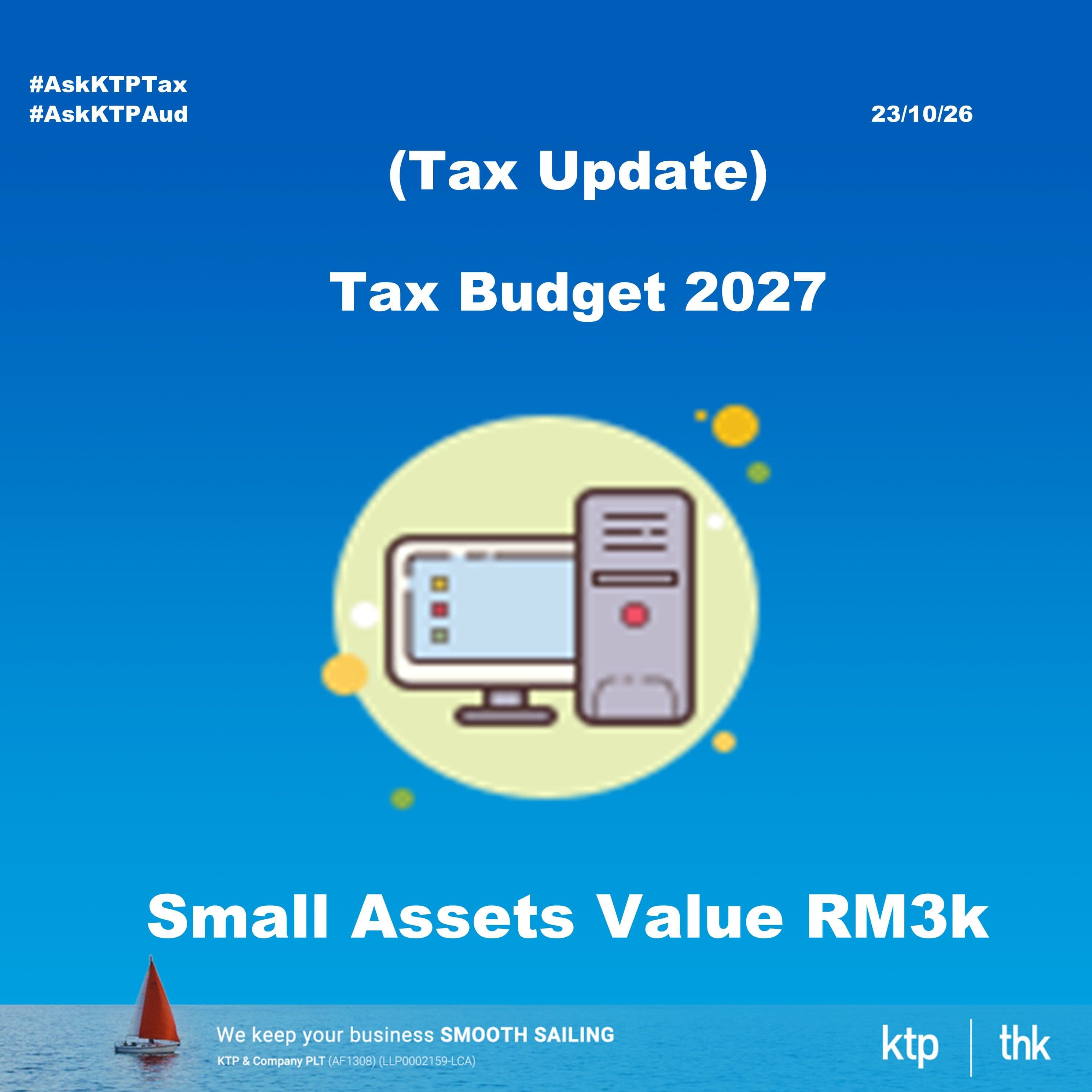
Budget 2027 proposes to raise the threshold for small value assets (SVA) from RM2,000 to RM3,000 per asset. For companies that are not micro, small and medium enterprises (MSMEs), the annual claim cap rises from RM20,000 to RM30,000. MSMEs continue to enjoy no annual cap.
The announcement was made in the Budget 2027 speech tabled on 9 October 2026. On its face, it is a modest change. In practice, it affects how almost every business treats laptops, phones, office furniture, small tools and equipment purchased from 2027.
In this article, we set out the current rules, what Budget 2027 proposes, who benefits, and the practical points you should consider before your next round of purchases.
01The current position
Small value assets are governed by paragraph 19A of Schedule 3 of the Income Tax Act 1967 (ITA). LHDN's latest guidance is Public Ruling No. 4/2026, Special Allowances for Small Value Assets.
Under the current rules:
- An asset costing RM2,000 or less qualifies for a special allowance of 100%. You write off the full qualifying plant expenditure (QPE) in the year of assessment (YA) it is incurred, instead of spreading it over several years.
- An MSME company can claim this special allowance on all qualifying small value assets, with no annual cap.
- A company that is not an MSME is capped at RM20,000 of total SVA claims per YA.
- The special allowance is an option, not an obligation. You may instead claim normal initial and annual allowances on the asset.
The RM2,000 threshold has applied since YA2020. With prices of laptops, phones and basic equipment rising since then, many everyday business assets now sit just above the line.
02What Budget 2027 proposes
Budget 2027 raises both the per-asset threshold and the cap for non-MSMEs, with effect from YA2027.
The maximum cost per asset rises from RM2,000 to RM3,000. The annual cap for non-MSMEs rises from RM20,000 to RM30,000, while MSMEs continue to have no cap. The rate of special allowance remains at 100%.
The measure sits alongside a related proposal. The accelerated capital allowance (ACA) on local plant and machinery, ICT equipment and software, previously due to end on 31 December 2026, is extended to 31 December 2030.
These are Budget proposals. They take effect only when enacted through the Finance Bill, and the final wording, including the effective date, may differ.
03Who qualifies for the unlimited claim
Whether your company enjoys no cap or a RM30,000 cap depends on whether it meets the tax definition of an MSME. This is the same test used for the preferential SME income tax rate. Broadly, the company must meet all of the following:
- paid-up ordinary share capital does not exceed RM2.5 million at the beginning of the basis period;
- gross income from business sources for the basis period does not exceed RM50 million;
- not more than 20% of paid-up ordinary share capital is owned, directly or indirectly, by foreign companies or non-citizen individuals; and
- the company is not related to a company that exceeds the share capital threshold.
Two points often catch businesses out.
First, the tax definition is not the same as the SME Corporation Malaysia definition used for grants and financing. A company can be an SME for a grant application but fail the tax test, and the reverse is also possible.
Second, the test is applied for each YA. A capital injection, a new foreign shareholder or a group restructuring during the year can change your status for the following YA.
04Practical considerations
Check your basis period, not just the calendar. The measure is expressed to apply from YA2027. For a company with a 31 December year end, that means spending in 2027. For a company with, say, a 30 June year end, the basis period for YA2027 may start on 1 July 2026. Whether spending in late 2026 qualifies will depend on how the Finance Bill is drafted. Confirm this before you rely on it.
Do not defer purchases purely for tax. The SVA allowance changes when you claim, not how much you claim in total. An asset costing RM2,500 that misses the SVA rule is still written off through normal or accelerated capital allowances over a few years. If the business needs the asset now, the timing benefit alone rarely justifies waiting.
Itemise on commercial substance. The RM3,000 test applies to each asset. Splitting a single asset across invoices to stay under the threshold, without commercial reason, invites challenge on audit.
Non-MSMEs should plan the cap. With a RM30,000 cap, a larger company should decide which assets go into the SVA claim and which take normal capital allowances. Prioritising assets with the longest normal write-off period gives the greatest timing benefit.
Keep the records. Maintain a separate SVA schedule in your fixed asset register showing cost, date of acquisition and the YA claimed. On disposal, a balancing adjustment may still arise, and Public Ruling No. 4/2026 sets out how disposals and hire purchase assets are treated.
05Illustration
ABC Sdn Bhd is an MSME with a 31 December year end. All purchases below are made in 2027 for business use.
It buys five laptops at RM2,800 each (RM14,000), one office printer at RM2,500 and six office chairs at RM600 each (RM3,600). The total spend is RM20,100.
Under the current rules, only the chairs qualify. The laptops and printer would be written off through normal capital allowances over several years.
Under the Budget 2027 proposal, the full RM20,100 is written off in YA2027. If ABC's chargeable income falls within the first RM150,000 band, taxed at the proposed 14%, the full write-off reduces YA2027 tax by up to RM2,814. Part of that is a timing benefit, as some of the deduction would otherwise have been claimed in later years.
This example is for illustration only and assumes the proposal is enacted as announced.
We welcome the increase. The RM2,000 threshold had fallen behind the cost of the basic tools every business needs, and RM3,000 brings it back in line with what you actually pay for a business laptop or a decent printer.
The value to you, however, is mainly in cash flow and simplicity, not in a permanent tax saving. The bigger risks sit in the details: whether your company truly meets the tax MSME test, how your basis period interacts with the YA2027 start date, and whether your fixed asset register supports the claim if LHDN asks.
Our recommendation is straightforward. Review your MSME status now, confirm your basis period, and set up a clean SVA schedule before your 2027 purchases begin. Once the Finance Bill is published, we will update this article with the enacted position.
Come say hello.
Two firms in the heart of Taman Molek, Johor Bahru.
KTP & Company PLT
Wisma KTP, 53, 53-01 & 53-02, Jalan Molek 1/8, Taman Molek, 81100 Johor Bahru, Johor, Malaysia