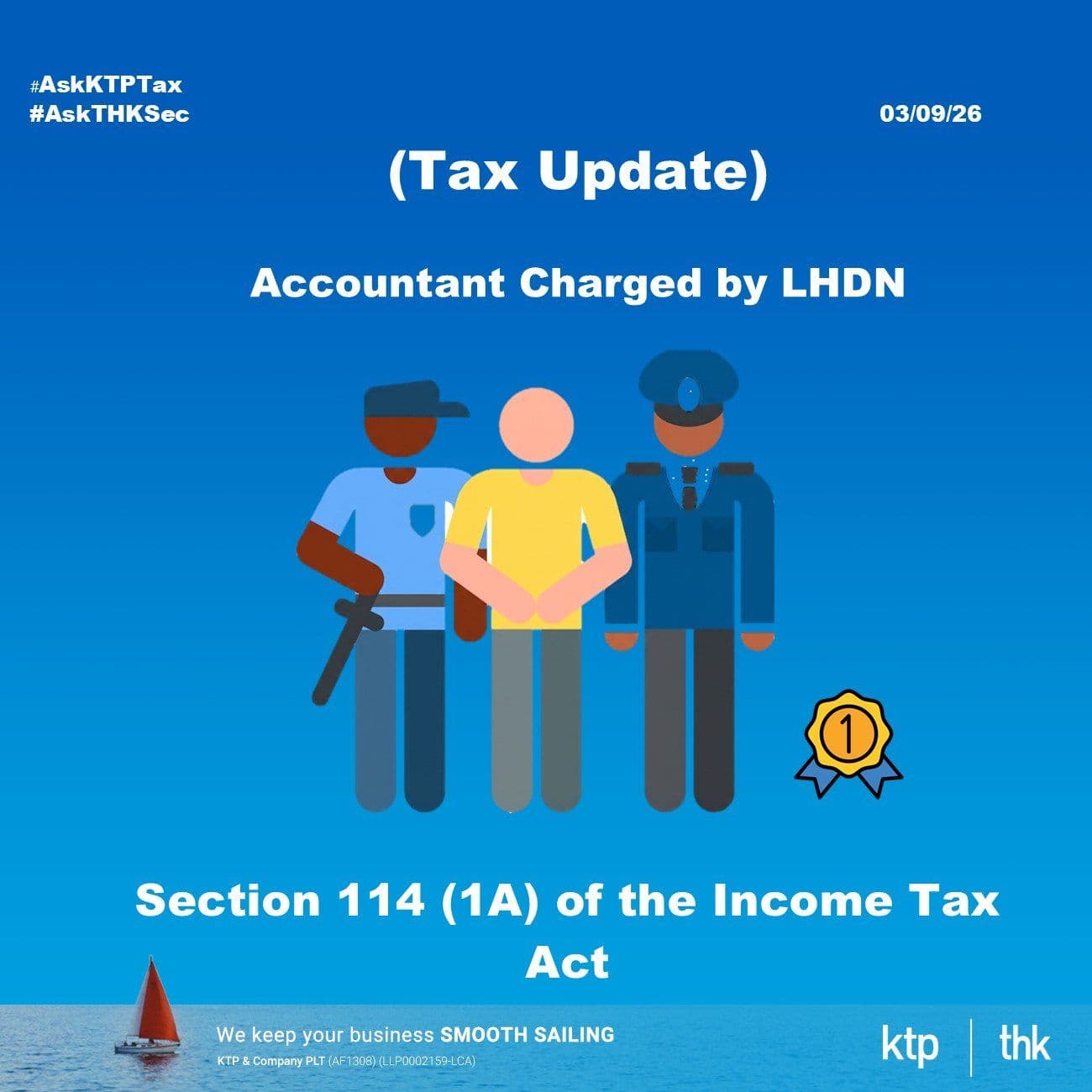
(TAX UPDATE) Accountant charged with helping company under-report RM2.5mil in tax
01Introduction
An accountant was charged in the magistrate's court here today with assisting and advising a company to prepare income returns that resulted in under-reporting tax of RM2,526,144.24 to the Inland Revenue Board (IRB) in 2021.
Chew Ai Keow, 63, a partner at accounting firm Abbacus Cloud Solutions, pleaded not guilty and claimed trial after the charge was read before magistrate Noor Idayu Salim.
According to the charge sheet, Chew allegedly assisted and advised Penshrimp Fishery Sdn Bhd to submit income returns to the IRB director-general by checking and approving sales ledgers that excluded RM10.68 million in sales transactions from the company's bank statements
02What the charge alleges
Chew Ai Keow, 63, a partner at accounting firm Abbacus Cloud Solutions, was charged before magistrate Noor Idayu Salim with assisting and advising Penshrimp Fishery Sdn Bhd in the preparation of income returns furnished to the Director General of Inland Revenue.
The alleged mechanism is uncomfortably simple.
She is said to have checked and approved the preparation of sales ledgers that left out RM10,678,133 of sales transactions which appeared in the company's bank statements and which should have been recorded.
The return was the company's Form C for the 2020 assessment year, furnished under Section 77A(1) and dated 25 March 2021. The alleged shortfall is RM2,526,144.24. The offence is said to have been committed while she served as the company's accounting provider, between January and March 2021.
She pleaded not guilty and claimed trial. Bail was granted at RM4,000 with one surety, and 28 October fixed for mention.
Nothing has been proven. The charge is a charge, she is entitled to the presumption of innocence, and the matter is before the court.
The provision matters more than the outcome, because most people who prepare accounts for other people have never read it.
03Section 114 Power
Section 114 is the criminal evasion section. It is not one offence. It is two, and they are aimed at different people.
Section 114(1) is for the taxpayer and anyone who helps them evade. Deliberate omission of income. False statements or entries. False books of account. Fraud, art or contrivance.
On conviction, a fine of not less than RM1,000 and not more than RM20,000, or imprisonment up to three years, or both, plus a special penalty of three times the tax undercharged. That treble penalty is where the real money sits. On these reported figures, three times RM2.5 million is RM7.5 million.
Section 114(1A) is for you if you prepare, review or advise on someone else's return. It is the quieter subsection sitting directly underneath, and it is the one Chew was charged under.
To bring a Section 114(1A) charge, the prosecution needs two things :
- that you assisted in, or advised with respect to, the preparation of a return, and
- that the return resulted in an understatement of another person's liability for tax.
Now read what is missing from that list.
No requirement to prove you gained anything.
No requirement to prove you signed the Form C.
No requirement to prove a scheme, a kickback or an inflated fee.
The taxpayer was the company. The declaration was the company's declaration under Section 77A(1).
Checking and approving the ledger that fed that return was, on the prosecution's case, enough to put a name on a charge sheet.
Section 114(1A) carries a fine of not less than RM2,000 and not more than RM20,000, or imprisonment up to three years, or both. No treble penalty, because you were not the taxpayer.
Look at that RM20,000 ceiling and be careful about the conclusion you draw. The fine is not the exposure. The custodial term is real, and so is everything that follows a conviction: your MIA standing, your position as a partner, the renewal of your approval as a tax agent under Section 153(3), your professional indemnity position, and the twenty year client relationship that ends with one phone call.
04The whole case turns on two words
Section 114(1A) comes with a statutory defence. You are liable unless you satisfy the court that the assistance or advice was given with reasonable care.
Read the direction of that sentence again.
The burden is on you. Not on the prosecution. Once assistance and understatement are established, you are the one standing up to explain what you did and why it was enough.
LHDN's Public Ruling No. 8/2000 sets the standard. Reasonable care is the degree of care and conscientiousness in paying proper attention to a task that would be expected, in a similar situation, of an ordinary person who, considering the circumstances and the foreseeable consequences, acts with reason, sound judgment and responsibility.
The Ruling also gives you the shape of a good defence. No inference of dishonest intention should be drawn where you acted in good faith, on an interpretation any reasonable person with your knowledge and experience would have reached, in the light of all information available after making the inquiries that a reasonable person would have made.
That last clause is the one that decides cases. The defence is not "the client lied to me". The defence is "I asked, I asked in writing, and here is the file".
05Where LHDN itself says the line falls
The worked examples in Public Ruling No. 8/2000 are worth more than any commentary, because they are the regulator describing its own enforcement posture.
The bookkeeper who was exposed. A sole proprietor kept no proper records. The bookkeeper prepared accounts and the return using figures that were partly estimated and partly fictitious, and disclosed none of it. The Ruling puts him squarely inside Section 114(1A). What would have saved him was a disclosure on the face of the accounts stating they were prepared from incomplete records, identifying the unsupported figures, and showing the basis for the estimates.
The tax agent who walked away clean. Sundry expenses included a RM10,000 donation. The agent wrote in immediately asking for the receipt and advised that only donations to bodies approved under Section 44(6) are deductible. The company confirmed in writing that it qualified. The deadline was close, so the agent relied on that confirmation. The donation turned out to be to a non-approved body. The Ruling states that no action should be taken against the agent.
The agent told to claim a double deduction. A director provided a confirmed statement of R&D expenses and instructed a claim under Section 34A. The agent explained the conditions, obtained the director's written confirmation, and filed. The documentation later proved insufficient. No action against the agent. The Ruling puts the director inside Section 114(1A) instead.
The isolated error against the pattern. Where a wrong figure went into a return but the correct tax was paid anyway, the Ruling finds no dishonest intention and takes no action. Then it adds the sting: where a pattern of similar occurrences appears across a number of other cases, action under Section 114(1A) may be considered against the firm.
Three habits run through every example on the safe side of that line. A written inquiry. A written client response. A written disclosure where something is unsupported.
06If you are the director
A Section 114(1A) charge against your accounting provider does not move your own exposure anywhere.
The return was your company's return. The company and the director remain exposed under Section 114(1) for wilful evasion, with its treble special penalty, and under Section 113 for an incorrect return. Outsourcing the bookkeeping does not outsource the liability. It adds one more person who can be charged, standing next to you rather than in front of you.
07Visit Us
- Wisma KTP, 53 Jalan Molek 1/8, Taman Molek, 81100 Johor Bahru
- Wisma THK, 41, Jalan Molek 1/8, Taman Molek, 81100 Johor Bahru
KTP (Audit, Tax, Advisory)
KTP & Company PLT (AF1308) (LLP0002159-LCA)
An approved audit firm and licensed tax firm operating under the KTP group based in Johor Bahru providing audit, tax planning, advisory and compliance services to clients
- Website www.ktp.com.my
- Facebook http://facebook.com/www.ktp.com.my
- LinkedIn https://bit.ly/3sapf4l
- Telegram http://bit.ly/3ptmlpn
- Instagram https://bit.ly/3Rko5kN
- XiaoHongShu https://bit.ly/4fqV9Fb
𝐓𝐇𝐊 (𝐒𝐞𝐜𝐫𝐞𝐭𝐚𝐫𝐢𝐚𝐥, 𝐀𝐜𝐜𝐨𝐮𝐧𝐭/𝐏𝐚𝐲𝐫𝐨𝐥𝐥, 𝐀𝐝𝐯𝐢𝐬𝐨𝐫𝐲)
THK Management Advisory Sdn Bhd 200401000220 (638723X)
A licensed secretarial firm in Johor Bahru providing fast reliable incorporation, secretarial services, corporate compliance services, outsource booking, accounting and payroll services to clients
- Website www.thks.com.my
- Facebook https://bit.ly/42XKWsk
- Instagram https://bit.ly/42Uqf0e
- LinkedIn https://bit.ly/3EH885M
𝐊𝐓𝐏 𝐋𝐢𝐟𝐞𝐬𝐭𝐲𝐥𝐞
An internal community for our colleagues on work and leisure.
- Tiktok http://bit.ly/3u9LR6Q
- Youtube http://bit.ly/3ppmjyE
- Facebook http://bit.ly/3ateoMz
- Instagram https://bit.ly/3jZpKLo
- XiaoHongShu https://bit.ly/4fqV9Fb
𝐊𝐓𝐏 𝐂𝐚𝐫𝐞𝐞𝐫
An external job community on vacancy in Johor Bahru for interns, graduates & experienced candidates.
- Facebook http://bit.ly/3rPxz9o
- Instagram https://bit.ly/3u2PxHg
- XiaoHongShu https://bit.ly/4pIq5nL
Section 114(1A) is not the evasion section, and that is exactly why it is dangerous. The prosecution does not have to show you gained a sen. It only has to show you assisted, and that the return came out short. From there the burden flips, and you either produce a file demonstrating reasonable care or you do not.
The RM20,000 ceiling is the least of it. What ends a career is the conviction, not the quantum.
So here is our position, and it has not changed since long before this case. We put our queries in writing. We keep your written answers. We disclose what we could not verify. We do not sign off on numbers we have not tested. Some clients find that tedious, and a small number leave for a provider who asks less.
That is a trade we will keep making. The file we build today is the only thing either of us can hand to a magistrate five years from now.
And on that note: 2020 assessment year, filed 25 March 2021, charged 2 September 2026. Five and a half years. LHDN's memory is longer than yours.
Come say hello.
Two firms in the heart of Taman Molek, Johor Bahru.
KTP & Company PLT
Wisma KTP, 53, 53-01 & 53-02, Jalan Molek 1/8, Taman Molek, 81100 Johor Bahru, Johor, Malaysia