(TAX UPDATE) RM150,000. Then RM500,000. Then RM1 million. Now RM3 million. In Two Years.
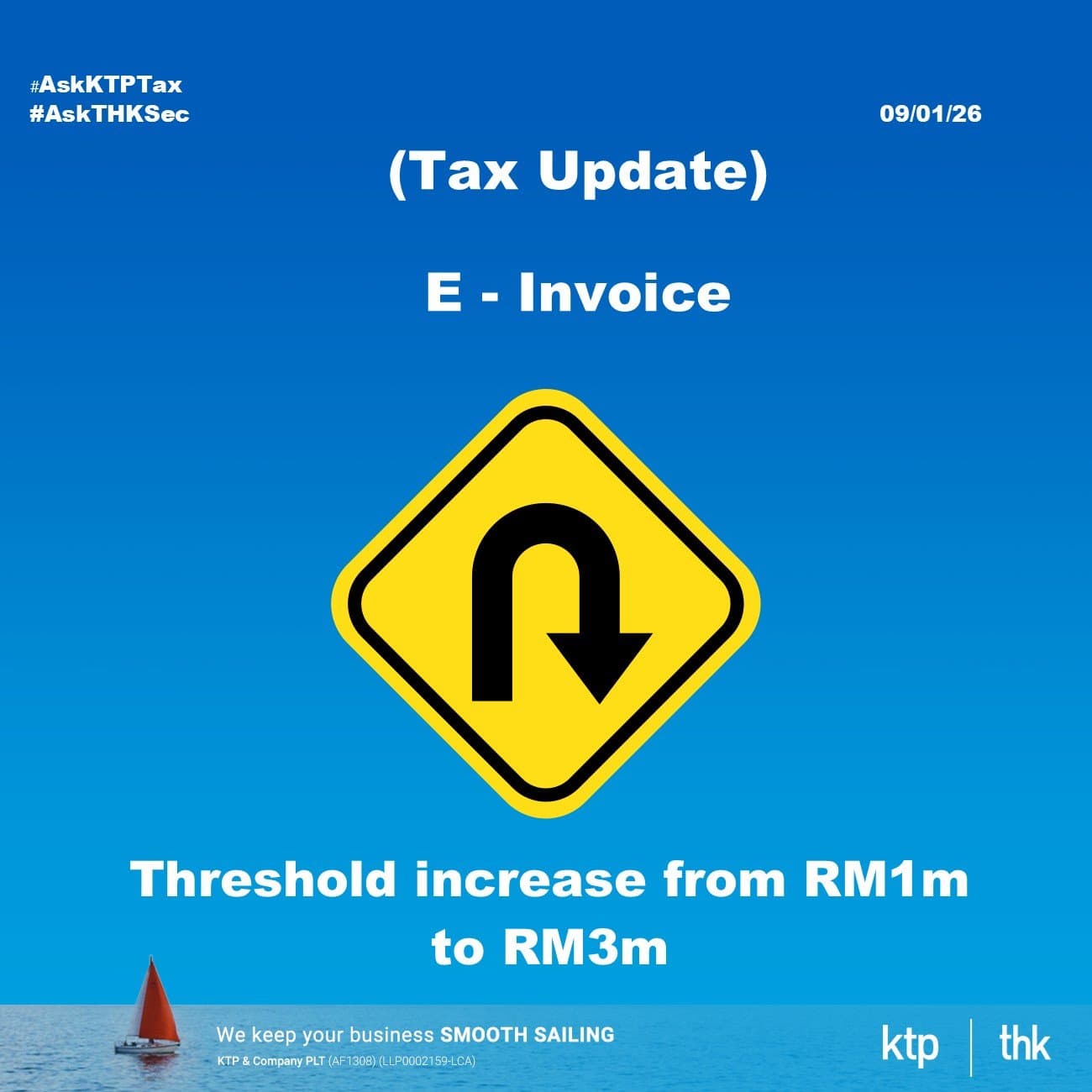
SMEs with annual revenue below RM3 mil exempt from e-invoicing
01Introduction
Somewhere in Johor Bahru there is a business owner who spent RM18,000 on an e-Invoice middleware licence in November 2025.
He did the right thing. His FY2022 turnover was RM2.1 million, so he sat squarely in Phase 4. He signed up, integrated his accounting system with MyInvois, trained two account clerks, went live on 1 January 2026, and has been validating invoices for eight months.
On 30 August 2026 the Prime Minister stood up for the National Day address and raised the e-Invoice exemption threshold to RM3 million.
That owner is now, on paper, below the line.
His first question to us was not a technical one. It was, "So can I stop?"
That is the question this article is about. And the honest answer today is: not yet, and possibly not at all.
02The history of threshold exemption
Before anything else, count how many times the goalpost has moved.
e-Invoice went live on 1 August 2024. Anyone below RM150,000 was exempt.
On 5 June 2025, Guideline v4.4 lifted that line to RM500,000.
On 6 and 7 December 2025, Cabinet and the Prime Minister lifted it again to RM1,000,000 with effect from 1 January 2026, and cancelled the old Phase 5 for the smallest taxpayers entirely.
On 30 August 2026, Guideline v4.8 lifted it to RM3,000,000 with effect from 1 September 2026.
Three revisions in fifteen months. A twentyfold increase from where it started.
We are not making a political point. We are making a planning point. If you build compliance decisions around a threshold in this environment, build them so they survive the threshold moving again.
03What actually changed on 30 August 2026
HASiL published e-Invoice Guideline Version 4.8, dated 30 August 2026.
The headline: taxpayers with annual turnover or revenue below RM3 million may now qualify for exemption from issuing e-Invoices, including self-billed e-Invoices. The previous threshold under Version 4.7 was RM1 million.
HASiL's own statement put numbers on it. The higher threshold benefits more than 1.1 million businesses that qualify for the exemption. And since e-Invoicing started on 1 August 2024, 265,379 taxpayers have submitted more than 1.84 billion e-Invoices.
Read those two numbers side by side. 1.1 million businesses out. 265,379 businesses in, holding 1.84 billion validated documents. This is a policy that has just been narrowed to roughly a fifth of the taxpayer base while the data pipeline it feeds stays fully intact.
Version 4.8 also carries three quieter changes.
New businesses. A business that commenced operations between 2023 and 2025 must implement e-Invoice from 1 July 2026 only where its annual turnover or revenue reaches at least RM3 million. The old test used RM1 million. For businesses commencing in 2026 or later, the date is generally 1 July 2026 or the commencement date. But where first-year turnover is expected to stay below RM3 million, implementation is deferred to 1 January of the second year following the year in which turnover first reaches RM3 million.
Public bodies. Version 4.8 clarifies that statutory bodies, statutory authorities, local authorities and international organisations must issue e-Invoices for goods sold or services performed from 1 July 2025, separating commercial supplies from other receipts.
Once mandated, still mandated. The guideline keeps the general principle that once a mandatory implementation date has been determined, subsequent changes in turnover or revenue do not normally remove the obligation. Hold that thought. We come back to it.
04The RM3 million line is not a line you read off your revenue in P&L
This is the part that will catch Johor SME groups, and it is the reason we are writing at length instead of posting a one-line congratulations.
The exemption is not a standalone entity test. New paragraph 1.6.10 provides that the exemption does not apply where the taxpayer has a non-individual shareholder with annual turnover or revenue of at least RM3 million, where it is a subsidiary of a holding company reaching that threshold, or where it has a related company or joint venture with turnover or revenue of at least RM3 million.
"Related company" is interpreted by reference to Section 2 of the Promotion of Investments Act 1986.
Translate that into how a typical Malaysian SME group is actually built.
You have a trading Sdn Bhd doing RM2.4 million. You have a property holding Sdn Bhd with almost no revenue. You have a joint venture with your brother-in-law for a Kulai project that turned over RM4 million last year. Your late father's investment holding company still holds 60 percent of the trading company.
Every one of those four facts is a potential disqualifier. The RM2.4 million on your own income statement tells you almost nothing.
05And if you trade as an enterprise or a partnership, the test changes shape again
Everything above assumes a Sdn Bhd. Most of our JB client base is not only Sdn Bhd. There is an enterprise in the wife's name, a second enterprise for the online business, and a partnership with two cousins.
The measurement rule is different for each, and this is where the RM3 million headline quietly stops applying.
Sdn Bhd. Each company is tested on its own annual turnover or revenue. Then paragraph 1.6.10 layers the shareholder, holding company, related company and joint venture tests on top.
Sole proprietorship, meaning an enterprise. Revenue from all enterprises carried on by the same individual is aggregated. One person, one Tax Identification Number, one combined figure. You do not get one RM3 million allowance per business registration.
Partnership. The test runs on the partnership's total annual revenue, the figure that goes into Form P. Not your profit share. A 25 percent partner in a partnership turning over RM8 million cannot argue his slice is RM2 million.
06If you already started, do not switch it off yet
Back to our RM2.1 million owner with the RM18,000 licence.
Version 4.8 raised the threshold. It did not say whether a taxpayer whose mandatory implementation date has already passed may now stop.
The guideline's general principle is that once an implementation date is determined, later changes in turnover or revenue do not alter the obligation. But that wording appears aimed at changes in the taxpayer's own turnover, not at a policy decision to raise the exemption threshold for everybody.
So there are two readings, and they lead to opposite operational decisions.
Reading A. The exemption is a status test applied on current facts. Your turnover is below RM3 million from 1 September 2026, so you are exempt from that date. Switch off, save the subscription.
Reading B. Your implementation date was 1 January 2026. It has passed. It was validly determined. Paragraph on determined dates means it stays determined. Keep issuing.
We are not going to pretend we know which reading HASiL will adopt. Nobody outside HASiL does. What we will say is that the asymmetry of being wrong is brutally lopsided.
If you follow Reading B and HASiL later confirms Reading A, you have overpaid for a software licence and issued invoices you did not strictly have to. Annoying. Recoverable.
If you follow Reading A and HASiL confirms Reading B, you have a gap in validated documents starting September 2026, an obligation under Section 82C of the Income Tax Act 1967 that you failed to meet, and exposure to penalty under Section 120(1)(d), which runs from RM200 to RM20,000 per offence, with imprisonment of up to six months. Per invoice. Not per month.
You do not need a decision tree for that. You need patience.
Our position: keep issuing until HASiL publishes a dedicated announcement, FAQ or transitional paragraph on this exact question. The e-Invoice General FAQs and the Guideline have been revised repeatedly through this rollout, and a transition ruling is the obvious next document. Wait for it. Do not rip out your MyInvois integration on the strength of a National Day speech and a version number.
07What to do next
Seven things, in order.
- Do not cancel anything. No middleware terminations, no API decommissioning, no letters to customers announcing you have stopped. Freeze the estate as it is.
- Map your group. Every shareholder that is not a natural person. Every holding company. Every related company under Section 2 of the Promotion of Investments Act 1986. Every joint venture. With turnover figures against each one.
- Add up every enterprise in the same name. All sole proprietorships under one individual go into one figure. Include the dormant one and the side business nobody thinks of as a business. For partnerships, take the Form P revenue, not your profit share.
- Document the turnover basis you used. Which financial year, which set of accounts, which line of the statement of comprehensive income. If HASiL asks in 2028 why you claimed exemption, the answer must already be on file.
- Check the one-way door. If any entity in the group has ever crossed a mandatory implementation date, note it. That entity is probably in for good.
- Ask your customers. Large buyers already on MyInvois may contractually require a validated e-Invoice from you regardless of what HASiL requires. Your exemption is not their procurement policy.
- Watch the RM3 million line if you are close. At RM2.7 million and growing, you are preparing for implementation anyway. Nothing about 30 August changes that.
08The strategic read
Do not mistake a raised threshold for a reversal of direction.
The government's own language is that MSMEs are strongly encouraged to participate voluntarily in e-Invoice implementation, in line with the country's aspiration to digitalise businesses. 1.84 billion documents have already been captured. The Peppol and MyInvois infrastructure is built and paid for. Malaysia is separately in active public debate about reintroducing GST.
An economy that reintroduces a broad consumption tax needs transaction-level invoice data. Guess where that comes from.
Our read is that RM3 million is breathing room, not amnesty. The businesses that treat the next eighteen months as a chance to get their master data, TIN records, customer records and item codes clean will find their eventual go-live boring. The businesses that treat it as a reprieve will do the same panic in 2028 that Phase 4 did in December 2025, with less notice.
09KTP View
The threshold moved four times in two years. That is the actual story here, and it is not a story about RM3 million.
It is a story about what you can safely build a compliance decision on. Our view is that you build on structure, not on thresholds. Clean master data, a mapped group chart, documented turnover workings, and an invoicing process that can be validated whether or not the law currently requires it. Those assets survive the next revision. A cancelled software subscription does not.
For our clients between RM1 million and RM3 million who are already live: hold. Keep issuing. We are watching for the HASiL transition FAQ and we will write to you the day it lands.
For our clients under RM3 million who never started: check your structure before you celebrate. Paragraph 1.6.10 does not care what your own income statement says. If there is a corporate shareholder, a holding company, a related company or a joint venture at RM3 million or more anywhere in the chart, you were never exempt and you are still not.
And if you trade through enterprises rather than a Sdn Bhd, add them all up first. One person, one aggregated figure. Three businesses at RM1.1 million each is not three exemptions. It is RM3.3 million and a mandate.
And for everyone: the exemption door swings one way. Once you are in, you are in. Plan as though that is permanent, because for you it is.
General educational content only. Not advice on any specific taxpayer's facts. Statutory references, thresholds and dates are stated as at 1 September 2026 and should be verified against the Income Tax Act 1967, the current HASiL e-Invoice Guideline and e-Invoice General FAQs before you act.
Visit Us
- Wisma KTP, 53 Jalan Molek 1/8, Taman Molek, 81100 Johor Bahru
- Wisma THK, 41, Jalan Molek 1/8, Taman Molek, 81100 Johor Bahru
KTP (Audit, Tax, Advisory)
KTP & Company PLT (AF1308) (LLP0002159-LCA)
An approved audit firm and licensed tax firm operating under the KTP group based in Johor Bahru providing audit, tax planning, advisory and compliance services to clients
- Website www.ktp.com.my
- Facebook http://facebook.com/www.ktp.com.my
- LinkedIn https://bit.ly/3sapf4l
- Telegram http://bit.ly/3ptmlpn
- Instagram https://bit.ly/3Rko5kN
- XiaoHongShu https://bit.ly/4fqV9Fb
𝐓𝐇𝐊 (𝐒𝐞𝐜𝐫𝐞𝐭𝐚𝐫𝐢𝐚𝐥, 𝐀𝐜𝐜𝐨𝐮𝐧𝐭/𝐏𝐚𝐲𝐫𝐨𝐥𝐥, 𝐀𝐝𝐯𝐢𝐬𝐨𝐫𝐲)
THK Management Advisory Sdn Bhd 200401000220 (638723X)
A licensed secretarial firm in Johor Bahru providing fast reliable incorporation, secretarial services, corporate compliance services, outsource booking, accounting and payroll services to clients
- Website www.thks.com.my
- Facebook https://bit.ly/42XKWsk
- Instagram https://bit.ly/42Uqf0e
- LinkedIn https://bit.ly/3EH885M
𝐊𝐓𝐏 𝐋𝐢𝐟𝐞𝐬𝐭𝐲𝐥𝐞
An internal community for our colleagues on work and leisure.
- Tiktok http://bit.ly/3u9LR6Q
- Youtube http://bit.ly/3ppmjyE
- Facebook http://bit.ly/3ateoMz
- Instagram https://bit.ly/3jZpKLo
- XiaoHongShu https://bit.ly/4fqV9Fb
𝐊𝐓𝐏 𝐂𝐚𝐫𝐞𝐞𝐫
An external job community on vacancy in Johor Bahru for interns, graduates & experienced candidates.
- Facebook http://bit.ly/3rPxz9o
- Instagram https://bit.ly/3u2PxHg
- XiaoHongShu https://bit.ly/4pIq5nL
Come say hello.
Two firms in the heart of Taman Molek, Johor Bahru.
KTP & Company PLT
Wisma KTP, 53, 53-01 & 53-02, Jalan Molek 1/8, Taman Molek, 81100 Johor Bahru, Johor, Malaysia