(TAX UPDATE) The 60 Day Rule. Accounting Entry Within The Date of Transaction
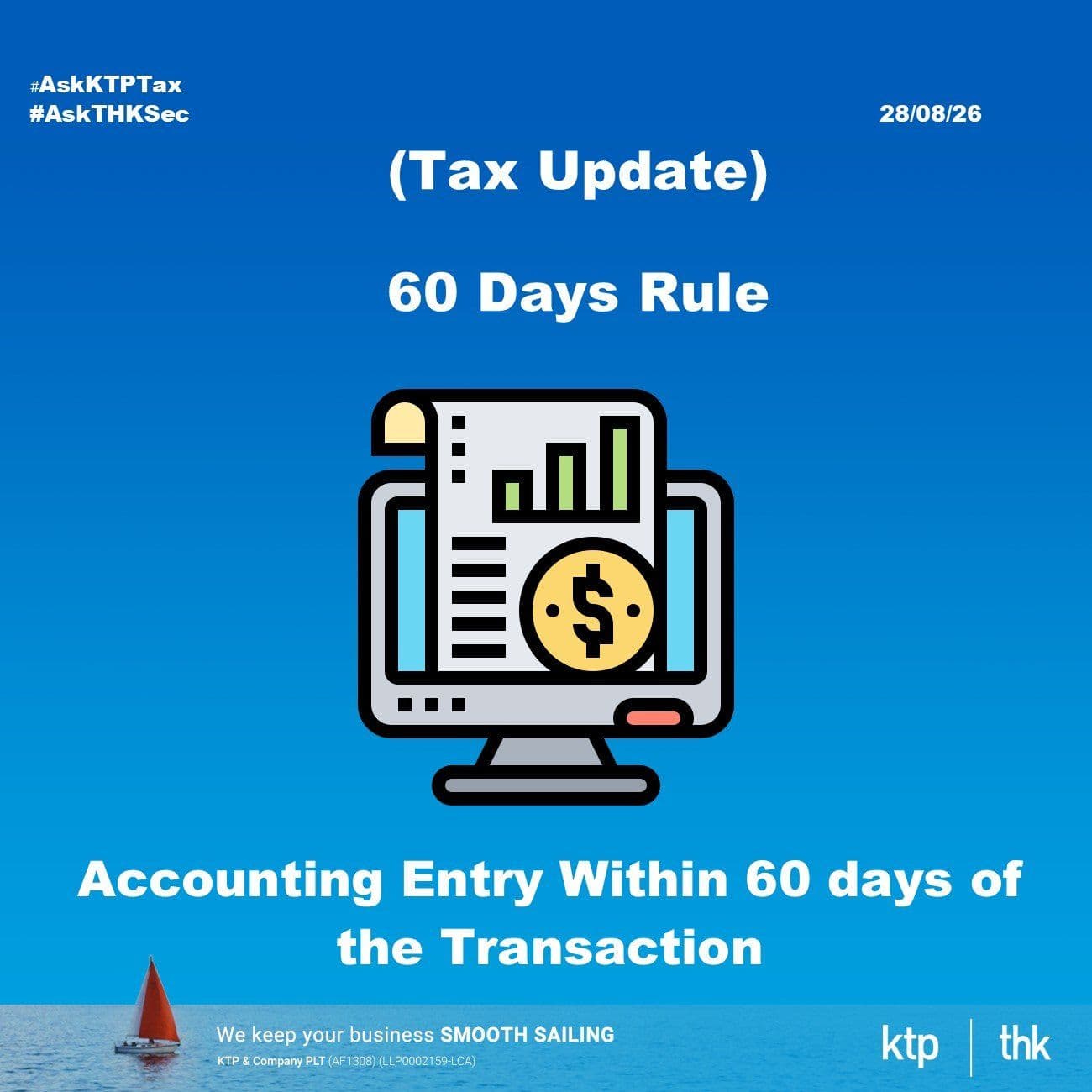
Statutory record keeping obligations under the Companies Act 2016 and the Income Tax Act 1967.
01Introduction
At a glance
- Section 245(2) of the Companies Act 2016 requires entries to be made in a company's accounting records within 60 days of completion of the transaction to which they relate. The obligation is imposed on the company, its directors and its managers.
- Public Ruling No. 4/2000 (Revised), issued under Section 82 of the Income Tax Act 1967, applies the same 60 day standard for tax purposes.
- e-Invoice has introduced materially shorter timeframes, including a seven day window after month end for consolidated e-Invoices and a 72 hour window to reject or cancel a validated e-Invoice.
- Consequences of failure range from a fine of up to RM500,000 and imprisonment of up to three years under Section 245(9) of the Companies Act 2016, to a best judgement assessment under the Income Tax Act 1967.
02Yearly accounting service
Advertisements for a "yearly account service" continue to appear regularly on social media. The proposition is straightforward. A single fee, paid once, for a full year of accounts prepared after the financial year has closed.
The commercial appeal is obvious, particularly to a small company with limited administrative capacity. The compliance position is less so.
Where a company with a 31 December year end delivers its records in the following June, the entries for the earlier part of the year are being made some five to six months after the underlying transactions were completed. That is not a matter of best practice. It is a departure from an express statutory requirement, and it has been one for six decades.
The purpose of this article is to set out where the 60 day requirement comes from, how it interacts with the reporting deadlines that directors are more familiar with, what an inspecting officer looks for in practice, and what the exposure is when the requirement is not met.
03The statutory position
Companies Act 2016: entries within 60 days of the transaction
Section 245(2) provides that a company, and the directors and managers of a company, shall cause appropriate entries to be made in the accounting and other records within sixty days of the completion of the transactions to which the entries relate.
Two features of the drafting merit attention.
First, the obligation is not expressed as an obligation of the accounting function. It is imposed on the company, on the directors and on the managers. Delegation of the work to an external service provider does not transfer the duty.
Second, the clock runs from completion of the transaction, not from the financial year end. Each transaction carries its own deadline.
Section 245(3) requires the records to be retained for seven years after completion of the transactions or operations to which the entries relate.
Income Tax Act 1967: the same 60 day standard for tax
Section 82 imposes a duty to keep sufficient records. The 60 day standard is set out in the administrative guidance issued under it.
Public Ruling No. 4/2000 (Revised), Keeping Sufficient Records (Companies and Co-operatives), issued 30 June 2001, states that the books of account should be written up at regular intervals, and that appropriate entries for each transaction should be recorded as soon as possible, in any case not later than 60 days after the transaction.
The alignment between the two regimes is deliberate rather than coincidental. A comparable 60 day requirement existed under the Companies Act 1965, and the Public Ruling was framed to be consistent with it.
e-Invoice: a materially shorter clock
The introduction of e-Invoice has changed the practical significance of the 60 day rule, and directors should understand why.
Section 82C of the Income Tax Act 1967 provides the legal basis for e-Invoice. Taxpayers within scope are required to have transactions validated by LHDN through the MyInvois platform, and validation occurs in near real time.
The relevant timeframes are as follows.
- Consolidated e-Invoice. Where consolidation is permitted, the consolidated e-Invoice must be submitted for validation within seven calendar days after the end of the month.
- Correction window. Following validation, the buyer has 72 hours to request rejection and the supplier has 72 hours to cancel. Once that window has closed, adjustments must be effected through credit notes or debit notes, supported by appropriate documentation.
- System unavailability. Where MyInvois is unavailable, the supplier may issue the document and submit it for validation within 72 hours of the system being restored.
- Individual transactions of RM10,000 or more. With effect from 1 January 2026, a single transaction of RM10,000 or more requires its own individual e-Invoice and may not be included in a monthly consolidation.
- Scope. The mandate is phased by reference to FY2022 annual turnover. The exemption threshold was raised to RM1 million turnover in December 2025, which cancelled the final phase as originally scheduled. Taxpayers in the RM1 million to RM5 million band came within scope on 1 January 2026, subject to a relaxation period.
04Recording obligations are not reporting obligations
A recurring source of confusion, and of inaccurate commentary, is the60 day recording requirement with the reporting deadlines that follow the financial year end.
The 60 day requirement concerns the entry of transactions into the accounting records. It is a bookkeeping obligation. It does not govern the approval of financial statements, their lodgement with SSM, or the filing of the income tax return. Those obligations run on separate and longer timelines.
05Observations from a recent SSM inspection
In July, officers from SSM attended our company for a compliance inspection. The visit was routine in nature, and did not arise from a complaint or an investigation.
Having conducted audit fieldwork for many years, we are familiar with the mechanics of a records inspection from the auditor's side of the table. There is value in observing how a regulator approaches the same exercise.
The inspection did not begin with the financial statements or the audit report. The officer requested the accounting records.
A small number of transactions were then selected, comprising, and a single test was applied to each. The date of the transaction was compared with the date on which the corresponding entry was posted.
That comparison is the substance of the Section 245(2) test. It is not concerned with the presentation of the financial statements or with the adequacy of disclosure. It is concerned with the interval between occurrence and recording.
06What the SSM inspecting officer is testing
The following areas derive directly from Section 245 and from Public Ruling No. 4/2000 (Revised). Directors may find it useful to apply them to their own company.
1. Posting interval. Select a transaction from six months ago and identify when the entry was made. Where entries are made only when accounts are prepared, the position under Section 245(2) is unlikely to be defensible.
2. Adequacy of the books themselves. The Public Ruling contemplates a cash book, a sales ledger, a purchases ledger and a general ledger, scaled to the nature and size of the business. A file of bank statements does not constitute a set of books.
3. Serial numbering of receipts. Where gross takings for a year exceed RM150,000 from the sale of goods, or RM100,000 from the performance of services, receipts issued must be serially numbered.
4. Location of records. Records and books of accounts should be kept at the registered office or the business premises in Malaysia. Where accounting data resides exclusively on servers outside Malaysia, the company should consider how it would respond to a request for production locally.
5. Source documents. Where accounting software is used, original invoices and receipts must still be retained, together with system documentation including the accounting manual and the chart of accounts. A system entry evidences the record, not the underlying transaction.
6. Language. Records should be maintained in Bahasa Malaysia or English. Where another language is used, the cost of translation falls on the company when the Director General requests it.
7. Stock valuation. A valuation of stock in trade should be performed at the end of each accounting period and the supporting records retained. A year end figure without a supporting valuation invites enquiry.
07Consequences of non-compliance
Companies Act 2016, Section 245(9). A person who contravenes Section 245 commits an offence and, on conviction, is liable to a fine not exceeding RM500,000 or imprisonment for a term not exceeding three years, or both. Exposure extends to the company and to the officers in default, including directors.
Income Tax Act 1967, Section 119A. Failure to keep sufficient records may attract a fine of not less than RM300 and not more than RM10,000, or imprisonment for a term not exceeding 12 months, or both.
Best judgement assessment. Public Ruling No. 4/2000 (Revised) provides that where sufficient records are not kept, the chargeable income of the company may be determined according to the best judgement of the Director General and an assessment raised accordingly.
08Why annual bookkeeping is becoming unsustainable
Independently of Section 245, the compliance environment is narrowing the gap.
e-Invoice. A seven day consolidation window and a 72 hour correction window cannot realistically be serviced by a bookkeeping function that operates once a year.
SST. A registered person filing on a bimonthly basis cannot prepare a reliable return from records written up annually. The return is a periodic form supported by a continuous process.
Directors' duties. Section 213 of the Companies Act 2016 requires a director to exercise reasonable care, skill and diligence. It is difficult to demonstrate compliance with that standard in respect of a period during which the director had no visibility of the company's financial position.
The direction of travel is consistent. Monthly recording is becoming the baseline expectation rather than a premium service level.
09Actions for directors to consider
1. Establish your current position. Identify the most recent entry in the accounting system and compare its posting date with the transaction date. Where the interval exceeds 60 days, the position under Section 245(2) is known and can be addressed.
2. Distinguish the deliverable from the process. Financial statements are an output. Bookkeeping is a process that produces the output. An engagement that provides only the former does not discharge the recording obligation.
3. Allocate the obligation expressly. Determine who within the organisation is accountable for the 60 day requirement, and record that allocation. Under the Act, responsibility rests with the company, its directors and its managers. In the absence of an internal allocation, it rests with the board.
4. Align the bookkeeping cycle with the shortest applicable deadline. For a company within scope of e-Invoice, that is now measured in days rather than months.
10KTP View
The annual accounting service is not inexpensive. The cost is deferred rather than avoided.
What is deferred is a bookkeeping fee. What is incurred in its place is a Section 245 exposure, the risk of a best judgement assessment, an audit that takes materially longer because the auditor is reconstructing rather than testing, and a financial year in which management decisions are taken without current information.
We are not aware of a client that has been disadvantaged by maintaining current records. We are aware of a number that have been disadvantaged by not doing so.
Sixty days is not a target or a matter of professional preference. It is an express requirement in two Acts, and for companies within scope of e-Invoice it is now the most generous of the three timeframes that apply.
This article is general educational content on statutory record keeping requirements in Malaysia. It does not constitute advice in relation to any particular set of facts. Statutory references are to the Companies Act 2016, the Income Tax Act 1967 and Public Ruling No. 4/2000 (Revised). Provisions, thresholds and administrative guidance should be verified against current primary sources before being relied upon. Companies requiring advice on their own position should consult their licensed tax agent or approved auditor.
Visit Us
- Wisma KTP, 53 Jalan Molek 1/8, Taman Molek, 81100 Johor Bahru
- Wisma THK, 41, Jalan Molek 1/8, Taman Molek, 81100 Johor Bahru
KTP (Audit, Tax, Advisory)
KTP & Company PLT (AF1308) (LLP0002159-LCA)
An approved audit firm and licensed tax firm operating under the KTP group based in Johor Bahru providing audit, tax planning, advisory and compliance services to clients
- Website www.ktp.com.my
- Facebook http://facebook.com/www.ktp.com.my
- LinkedIn https://bit.ly/3sapf4l
- Telegram http://bit.ly/3ptmlpn
- Instagram https://bit.ly/3Rko5kN
- XiaoHongShu https://bit.ly/4fqV9Fb
𝐓𝐇𝐊 (𝐒𝐞𝐜𝐫𝐞𝐭𝐚𝐫𝐢𝐚𝐥, 𝐀𝐜𝐜𝐨𝐮𝐧𝐭/𝐏𝐚𝐲𝐫𝐨𝐥𝐥, 𝐀𝐝𝐯𝐢𝐬𝐨𝐫𝐲)
THK Management Advisory Sdn Bhd 200401000220 (638723X)
A licensed secretarial firm in Johor Bahru providing fast reliable incorporation, secretarial services, corporate compliance services, outsource booking, accounting and payroll services to clients
- Website www.thks.com.my
- Facebook https://bit.ly/42XKWsk
- Instagram https://bit.ly/42Uqf0e
- LinkedIn https://bit.ly/3EH885M
𝐊𝐓𝐏 𝐋𝐢𝐟𝐞𝐬𝐭𝐲𝐥𝐞
An internal community for our colleagues on work and leisure.
- Tiktok http://bit.ly/3u9LR6Q
- Youtube http://bit.ly/3ppmjyE
- Facebook http://bit.ly/3ateoMz
- Instagram https://bit.ly/3jZpKLo
- XiaoHongShu https://bit.ly/4fqV9Fb
𝐊𝐓𝐏 𝐂𝐚𝐫𝐞𝐞𝐫
An external job community on vacancy in Johor Bahru for interns, graduates & experienced candidates.
- Facebook http://bit.ly/3rPxz9o
- Instagram https://bit.ly/3u2PxHg
- XiaoHongShu https://bit.ly/4pIq5nL
Come say hello.
Two firms in the heart of Taman Molek, Johor Bahru.
KTP & Company PLT
Wisma KTP, 53, 53-01 & 53-02, Jalan Molek 1/8, Taman Molek, 81100 Johor Bahru, Johor, Malaysia